QUESTION IMAGE
Question
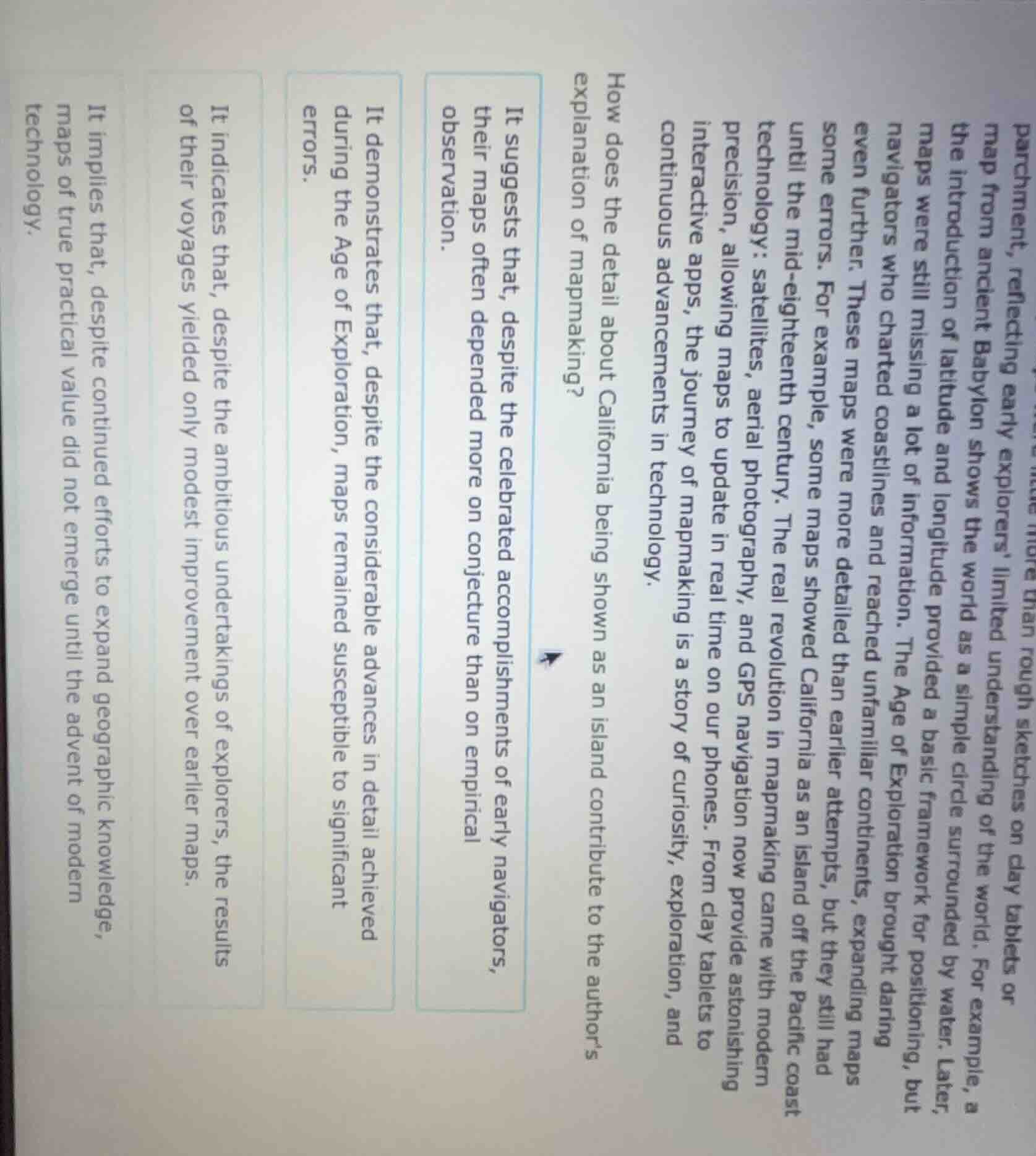
parchment, reflecting early explorers limited understanding of the world. for example, a map from ancient babylon shows the world as a simple circle surrounded by water. later, the introduction of latitude and longitude provided a basic framework for positioning, but maps were still missing a lot of information. the age of exploration brought daring navigators who charted coastlines and reached unfamiliar continents, expanding maps even further. these maps were more detailed than earlier attempts, but they still had some errors. for example, some maps showed california as an island off the pacific coast until the mid - eighteenth century. the real revolution in mapmaking came with modern technology: satellites, aerial photography, and gps navigation now provide astonishing precision, allowing maps to update in real time on our phones. from clay tablets to interactive apps, the journey of mapmaking is a story of curiosity, exploration, and continuous advancements in technology. how does the detail about california being shown as an island contribute to the authors explanation of mapmaking? it suggests that, despite the celebrated accomplishments of early navigators, their maps often depended more on conjecture than on empirical observation. it demonstrates that, despite the considerable advances in detail achieved during the age of exploration, maps remained susceptible to significant errors. it indicates that, despite the ambitious undertakings of explorers, the results of their voyages yielded only modest improvement over earlier maps. it implies that, despite continued efforts to expand geographic knowledge, maps of true practical value did not emerge until the advent of modern technology.
The text frames mapmaking as a journey of gradual improvement with persistent errors before modern tech. The example of California shown as an island illustrates that even as maps became more detailed in the Age of Exploration, they still had major inaccuracies, meaning they relied more on guesswork than direct, evidence-based observation.

Snap & solve any problem in the app
Get step-by-step solutions on Sovi AI
Photo-based solutions with guided steps
Explore more problems and detailed explanations
It suggests that, despite the celebrated accomplishments of early navigators, their maps often depended more on conjecture than on empirical observation.