QUESTION IMAGE
Question
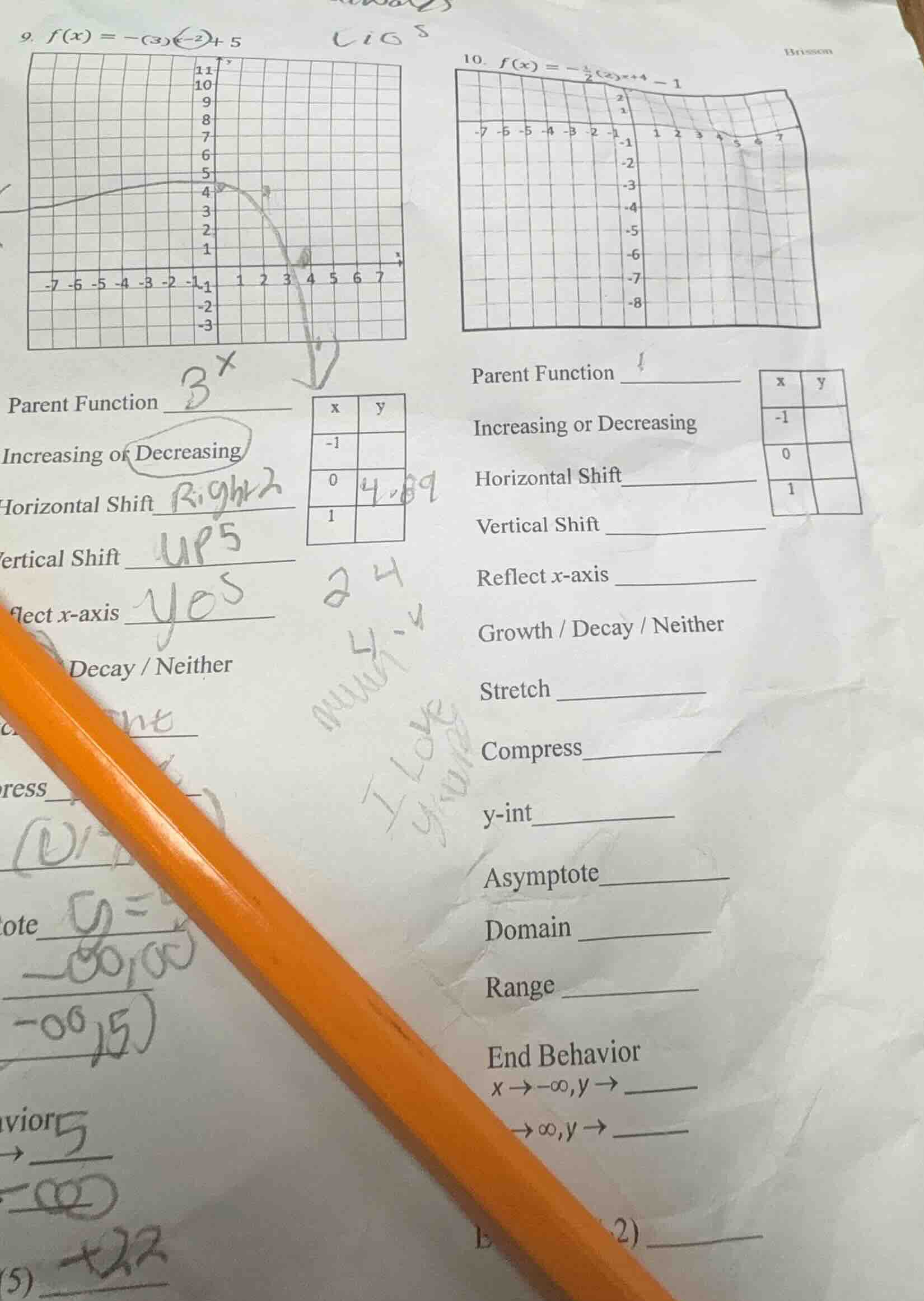
- $f(x) = -(3)^{x - 2} + 5$
parent function
increasing or decreasing
horizontal shift
vertical shift
reflect $x$-axis
growth / decay / neither
stretch
compress
y-int
asymptote
domain
range
end behavior
$x \to -\infty, y \to $
$x \to \infty, y \to $
- $f(x) = -\frac{1}{2}(2)^{x + 4} - 1$
parent function
increasing or decreasing
horizontal shift
vertical shift
reflect $x$-axis
growth / decay / neither
stretch
compress
y-int
asymptote
domain
range
end behavior
$x \to -\infty, y \to $
$x \to \infty, y \to $
We analyze the function \(f(x) = -\frac{1}{2}(2)^{x+4} - 1\) using the standard form of transformed exponential functions \(f(x) = a(b)^{x-h} + k\), where \(b^x\) is the parent function.
Step1: Identify parent function
The core exponential form is \(2^x\).
Step2: Determine increasing/decreasing
Since base \(b=2>1\), but \(a=-\frac{1}{2}<0\), the function reflects over x-axis and decreases.
Conclusion: Decreasing
Step3: Find horizontal shift
Rewrite function: \(f(x) = -\frac{1}{2}(2)^{x-(-4)} - 1\). Here \(h=-4\), so shift left 4 units.
Step4: Find vertical shift
From \(k=-1\), shift down 1 unit.
Step5: Check x-axis reflection
Since \(a=-\frac{1}{2}<0\), reflection over x-axis is Yes.
Step6: Classify growth/decay
Base \(b=2>1\), but reflection makes it decay.
Conclusion: Decay
Step7: Identify stretch/compress
\(|a|=\frac{1}{2}<1\), so vertical compression by factor \(\frac{1}{2}\).
Stretch: None; Compress: Vertical by \(\frac{1}{2}\)
Step8: Calculate y-intercept
Set \(x=0\):
\(f(0) = -\frac{1}{2}(2)^{0+4} - 1 = -\frac{1}{2}(16) - 1 = -8 - 1 = -9\)
y-int: \((0, -9)\)
Step9: Find horizontal asymptote
For \(f(x)=a(b)^{x-h}+k\), asymptote is \(y=k\).
Asymptote: \(y=-1\)
Step10: Determine domain
Exponential functions have all real x-values.
Domain: \((-\infty, \infty)\)
Step11: Determine range
Since \(a<0\), the function approaches \(y=-1\) from below, so \(y < -1\).
Range: \((-\infty, -1)\)
Step12: Find end behavior
- As \(x \to -\infty\): \(2^{x+4} \to 0\), so \(f(x) \to -\frac{1}{2}(0) -1 = -1\)
- As \(x \to \infty\): \(2^{x+4} \to \infty\), so \(f(x) \to -\infty\)
Step13: Complete x-y table
- \(x=-1\): \(f(-1)=-\frac{1}{2}(2)^{-1+4}-1=-\frac{1}{2}(8)-1=-4-1=-5\)
- \(x=0\): \(f(0)=-9\) (from Step8)
- \(x=1\): \(f(1)=-\frac{1}{2}(2)^{1+4}-1=-\frac{1}{2}(32)-1=-16-1=-17\)

Snap & solve any problem in the app
Get step-by-step solutions on Sovi AI
Photo-based solutions with guided steps
Explore more problems and detailed explanations
Parent Function: \(2^x\)
Increasing or Decreasing: Decreasing
Horizontal Shift: Left 4 units
Vertical Shift: Down 1 unit
Reflect x-axis: Yes
Growth / Decay / Neither: Decay
Stretch: None
Compress: Vertical by a factor of \(\frac{1}{2}\)
y-int: \((0, -9)\)
Asymptote: \(y=-1\)
Domain: \((-\infty, \infty)\)
Range: \((-\infty, -1)\)
End Behavior:
\(x \to -\infty, y \to -1\)
\(x \to \infty, y \to -\infty\)
x-y table:
| x | y |
|---|---|
| 0 | -9 |
| 1 | -17 |