QUESTION IMAGE
Question
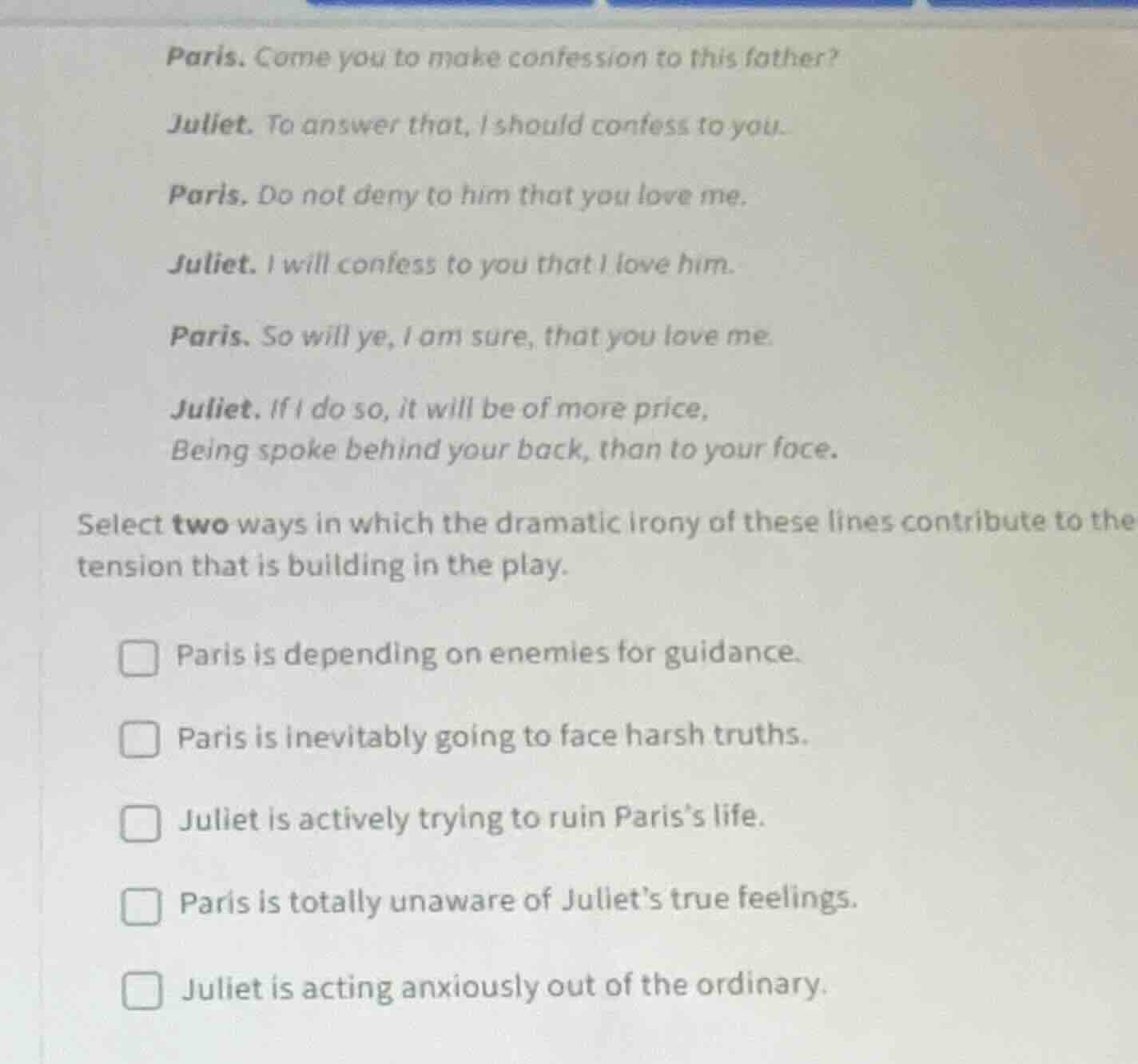
paris. come you to make confession to this father?
juliet. to answer that, i should confess to you.
paris. do not deny to him that you love me.
juliet. i will confess to you that i love him.
paris. so will ye, i am sure, that you love me.
juliet. if i do so, it will be of more price,
being spoke behind your back, than to your face.
select two ways in which the dramatic irony of these lines contribute to the tension that is building in the play.
□ paris is depending on enemies for guidance.
□ paris is inevitably going to face harsh truths.
□ juliet is actively trying to ruin paris’s life.
□ paris is totally unaware of juliet’s true feelings.
□ juliet is acting anxiously out of the ordinary.
- Dramatic irony here means the audience knows Juliet loves Romeo, not Paris, while Paris does not. This creates tension because we know Paris is in for hurtful, harsh truths about Juliet's actual feelings that he is completely unaware of.
- "Paris is inevitably going to face harsh truths" is correct because the audience knows Juliet does not love him, so his confidence in her affection will be shattered, creating tense anticipation of that confrontation.
- "Paris is totally unaware of Juliet's true feelings" is correct because his ignorance of her love for Romeo, paired with the audience's knowledge, builds tension as we wait for this gap in understanding to come to a head.
- The other options are incorrect: Paris is not relying on enemies, Juliet is not trying to ruin Paris's life, and her behavior is not unusually anxious here—she is speaking in deliberate, double-edged terms.

Snap & solve any problem in the app
Get step-by-step solutions on Sovi AI
Photo-based solutions with guided steps
Explore more problems and detailed explanations
- Paris is inevitably going to face harsh truths.
- Paris is totally unaware of Juliet's true feelings.