QUESTION IMAGE
Question
part a
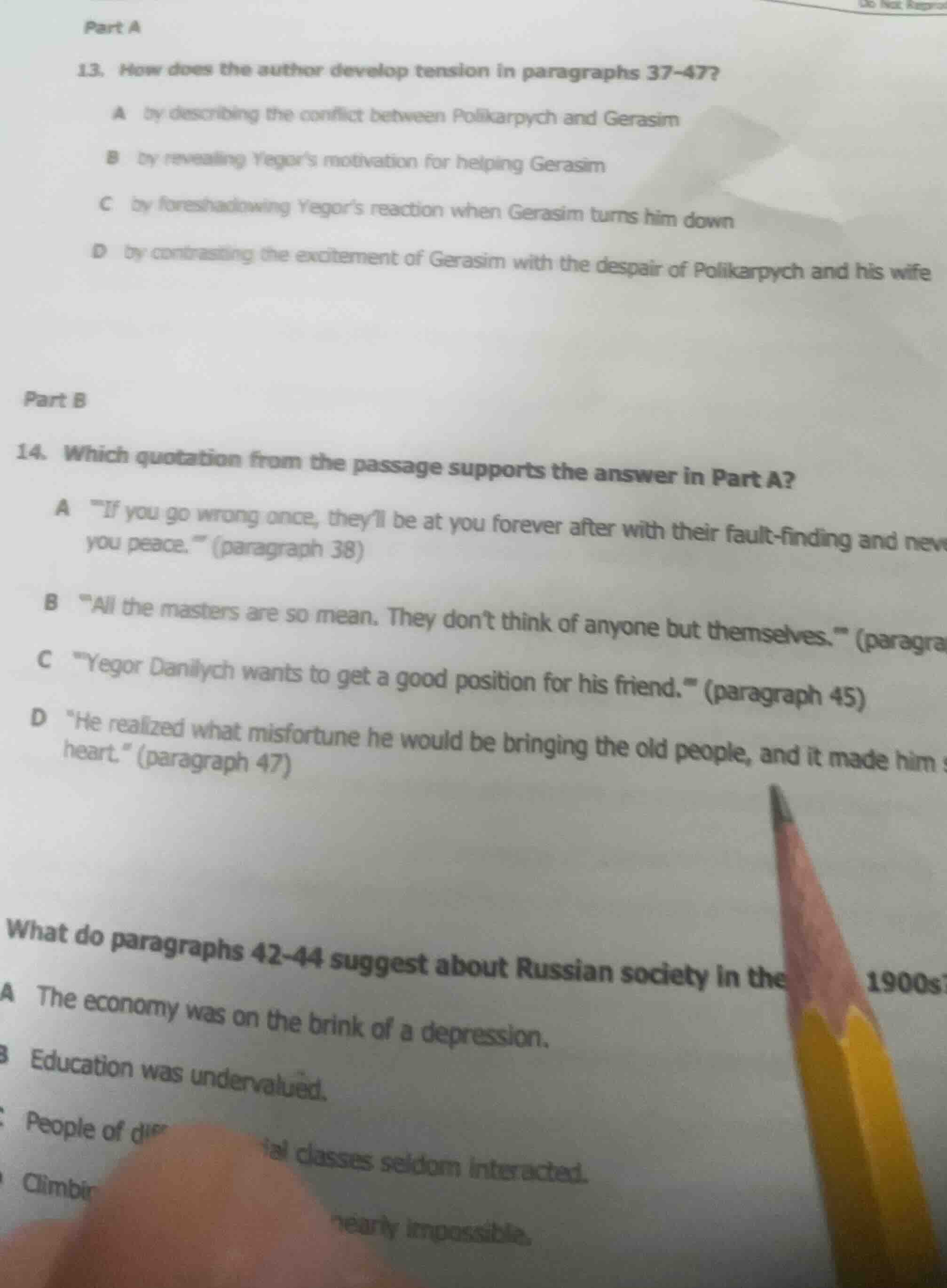
- how does the author develop tension in paragraphs 37-47?
a by describing the conflict between polikarpych and gerasim
b by revealing yegor’s motivation for helping gerasim
c by foreshadowing yegor’s reaction when gerasim turns him down
d by contrasting the excitement of gerasim with the despair of polikarpych and his wife
part b
- which quotation from the passage supports the answer in part a?
a “if you go wrong once, they’ll be at you forever after with their fault - finding and never you peace.” (paragraph 38)
b “all the masters are so mean. they don’t think of anyone but themselves.” (paragra
c “yegor danilych wants to get a good position for his friend.” (paragraph 45)
d “he realized what misfortune he would be bringing the old people, and it made him heart.” (paragraph 47)
what do paragraphs 42 - 44 suggest about russian society in the 1900s?
a the economy was on the brink of a depression.
b education was undervalued.
c people of dif al classes seldom interacted.
d climbir nearly impossible.
Part A
To determine how the author develops tension, we analyze each option:
- Option A: Describing conflict between Polikarpych and Gerasim could create tension as conflict is a common source of narrative tension.
- Option B: Revealing Yegor’s motivation for helping doesn’t inherently create tension; it explains a character’s action.
- Option C: Foreshadowing Yegor’s reaction when turned down is more about future events, not tension in the given paragraphs.
- Option D: Contrasting excitement and despair can create tension, but we need to check the text context. However, the most direct way to create tension in these paragraphs is likely the conflict between Polikarpych and Gerasim (Option A), as interpersonal conflict is a key tension - building device.
We need a quotation that supports the answer in Part A (conflict between Polikarpych and Gerasim or related tension).
- Option A: Talks about fault - finding, which could be part of a conflict - ridden relationship, supporting the idea of tension from conflict.
- Option B: Is a general complaint about masters, not related to the specific conflict in Part A.
- Option C: Is about Yegor’s motivation, not the conflict.
- Option D: Is about Gerasim’s realization, not the conflict. So Option A supports the answer in Part A.
In Russian society in the 1900s, there were strict class hierarchies (nobility, peasants, etc.). Paragraphs 42 - 44 likely show limited interaction between different classes. The option about different classes seldom interacting aligns with this historical and social context.

Snap & solve any problem in the app
Get step-by-step solutions on Sovi AI
Photo-based solutions with guided steps
Explore more problems and detailed explanations
A. by describing the conflict between Polikarpych and Gerasim