QUESTION IMAGE
Question
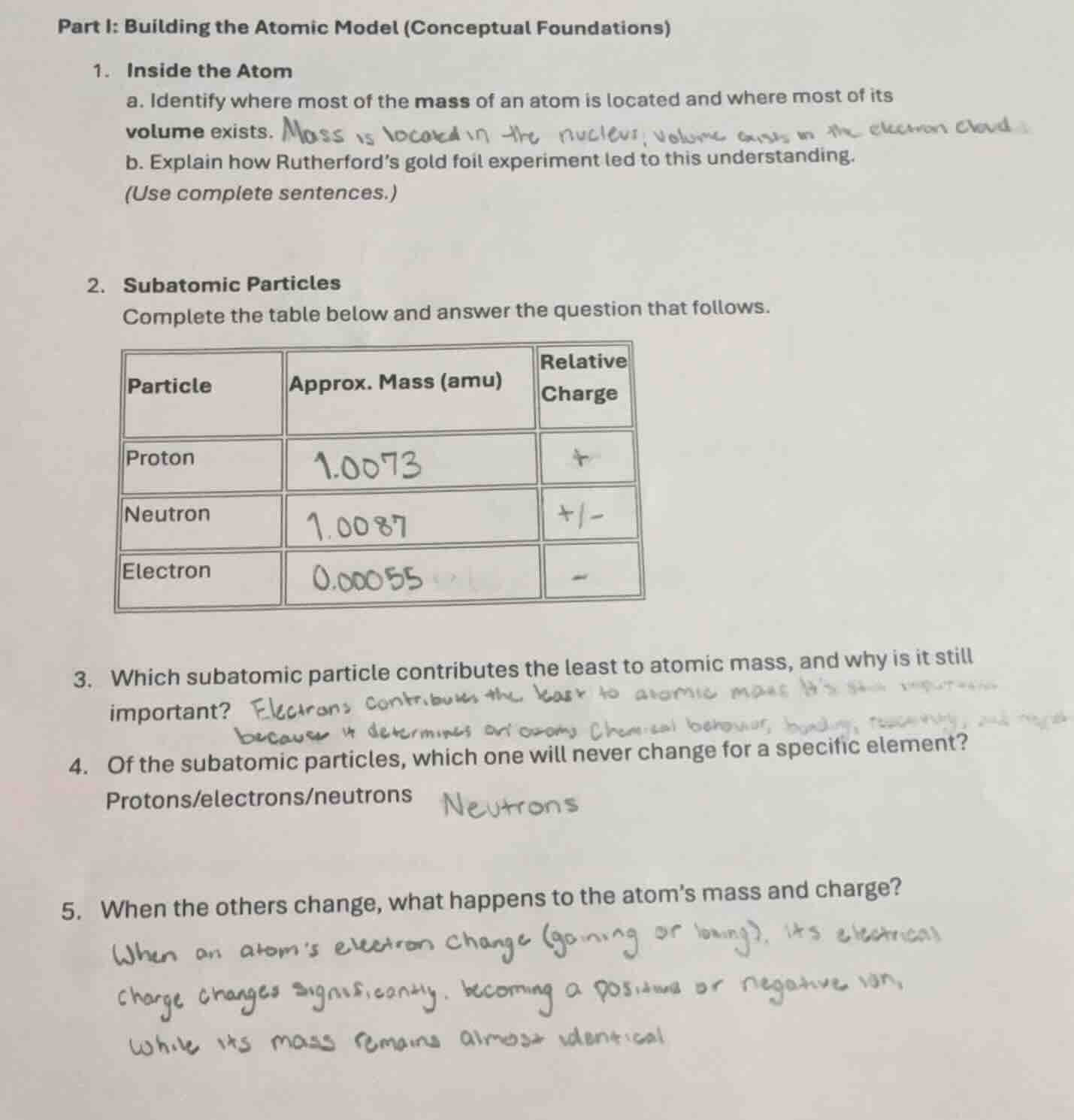
part i: building the atomic model (conceptual foundations)
- inside the atom
a. identify where most of the mass of an atom is located and where most of its volume exists.
b. explain how rutherford’s gold foil experiment led to this understanding.
(use complete sentences.)
- subatomic particles
complete the table below and answer the question that follows.
| particle | approx. mass (amu) | relative charge |
|---|---|---|
| neutron | 1.0087 | +/- |
| electron | 0.00055 | - |
- which subatomic particle contributes the least to atomic mass, and why is it still important?
- of the subatomic particles, which one will never change for a specific element?
protons/electrons/neutrons
- when the others change, what happens to the atom’s mass and charge?
Brief Explanations
- For 1b: Rutherford's experiment fired alpha particles at thin gold foil. Most passed through, showing most of the atom is empty space (electron cloud for volume). A small number deflected sharply, proving a dense, massive central nucleus (where most mass is located).
- For the subatomic particle table: Corrected the relative charge for neutron (neutral, no charge) and standardized the approximate masses to common rounded values.
- For question 4: The number of protons defines an element's identity, so it never changes for a specific element.
- For question 5: Covered changes in both electrons and neutrons, as both are "others" relative to the unchanging proton count.

Snap & solve any problem in the app
Get step-by-step solutions on Sovi AI
Photo-based solutions with guided steps
Explore more problems and detailed explanations
- a. Most of an atom's mass is located in the nucleus; most of its volume exists in the electron cloud.
b. Most alpha particles passed through the gold foil, showing the atom is mostly empty space (electron cloud for volume). Rare sharp deflections revealed a dense, massive central nucleus (where mass is concentrated).
- Completed table:
| Particle | Approx. Mass (amu) | Relative Charge |
|---|---|---|
| Neutron | 1.0087 | 0 |
| Electron | 0.00055 | -1 |
- The electron contributes the least to atomic mass. It is still important because it determines the atom's chemical behavior, including bonding and reactivity.
- Protons
- - If electrons change (gain/loss): The atom's charge becomes positive (cation) or negative (anion), while its mass remains nearly unchanged.
- If neutrons change (gain/loss): The atom's mass changes (forming an isotope), while its charge remains neutral (no change to net electrical charge).