QUESTION IMAGE
Question
part b
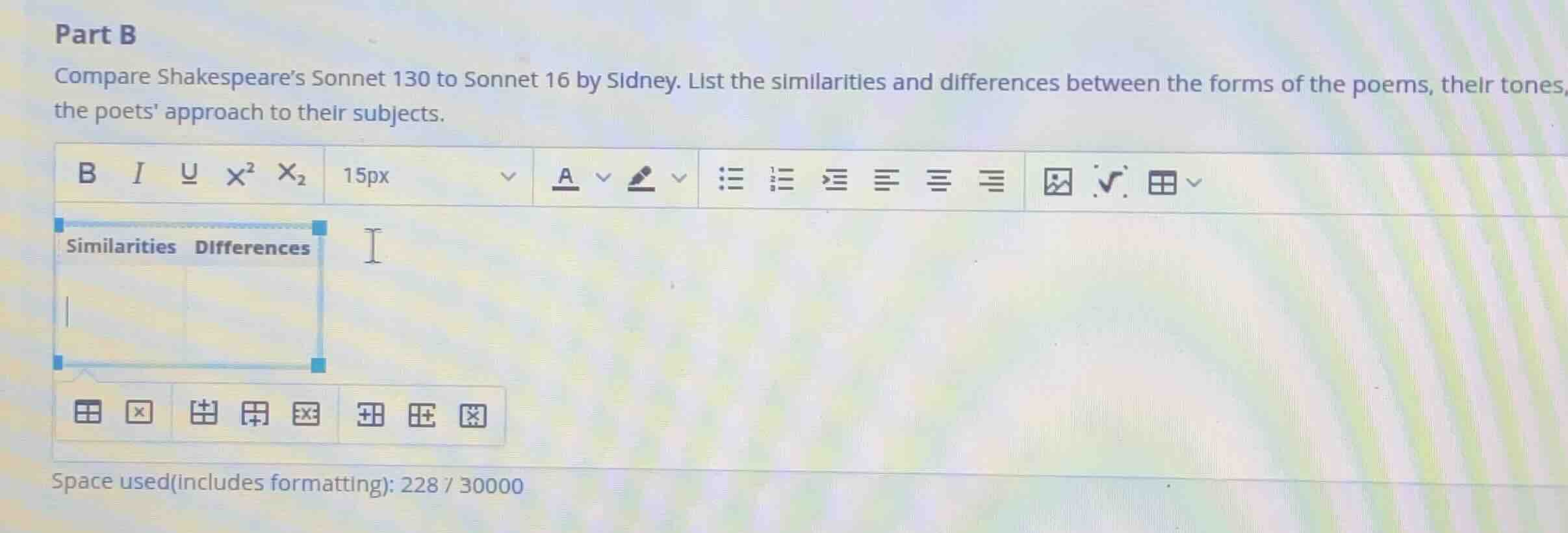
compare shakespeare’s sonnet 130 to sonnet 16 by sidney. list the similarities and differences between the forms of the poems, their tones, the poets’ approach to their subjects.
similarities differences
Brief Explanations
Similarities:
- Form: Both are sonnets, following strict rhyme and meter (Shakespearean/English sonnet for 130, Petrarchan for Sidney’s 16, but both have 14 - line structures).
- Subject: Both explore love and the poet’s feelings toward a beloved, using poetic conventions of the time.
- Tone: Both have a personal, introspective tone as they reflect on their love and the beloved’s qualities.
Differences:
- Form: Shakespeare’s Sonnet 130 has a rhyme scheme of $abab\ cdcd\ efef\ gg$ (English sonnet, 3 quatrains + couplet), while Sidney’s Sonnet 16 (Petrarchan) has $abba\ abba\ cdc\ dcd$ (octave + sestet).
- Tone: Shakespeare’s tone is more playful and satirical (mocking traditional love poetry’s exaggerations, e.g., “My mistress’ eyes are nothing like the sun”), while Sidney’s is more earnest and idealized (elevating the beloved, e.g., using celestial imagery to praise her).
- Approach to Subject: Shakespeare subverts clichés (compares mistress to real, unromanticized traits), while Sidney uses conventional, elevated imagery (e.g., linking the beloved to the heavens, time’s power) to glorify her.

Snap & solve any problem in the app
Get step-by-step solutions on Sovi AI
Photo-based solutions with guided steps
Explore more problems and detailed explanations
Similarities:
- Form: Both are 14 - line sonnets with structured rhyme/meter.
- Subject: Both focus on love and the beloved’s qualities.
- Tone: Personal, introspective reflection on love.
Differences:
- Form: Shakespeare: $abab\ cdcd\ efef\ gg$ (English, 3 quatrains + couplet); Sidney: $abba\ abba\ cdc\ dcd$ (Petrarchan, octave + sestet).
- Tone: Shakespeare: Playful/satirical (mocks love - poem clichés); Sidney: Earnest/idealized (elevates the beloved).
- Approach: Shakespeare subverts clichés (real - life comparisons); Sidney uses elevated, traditional imagery (celestial, time - related) to glorify the beloved.