QUESTION IMAGE
Question
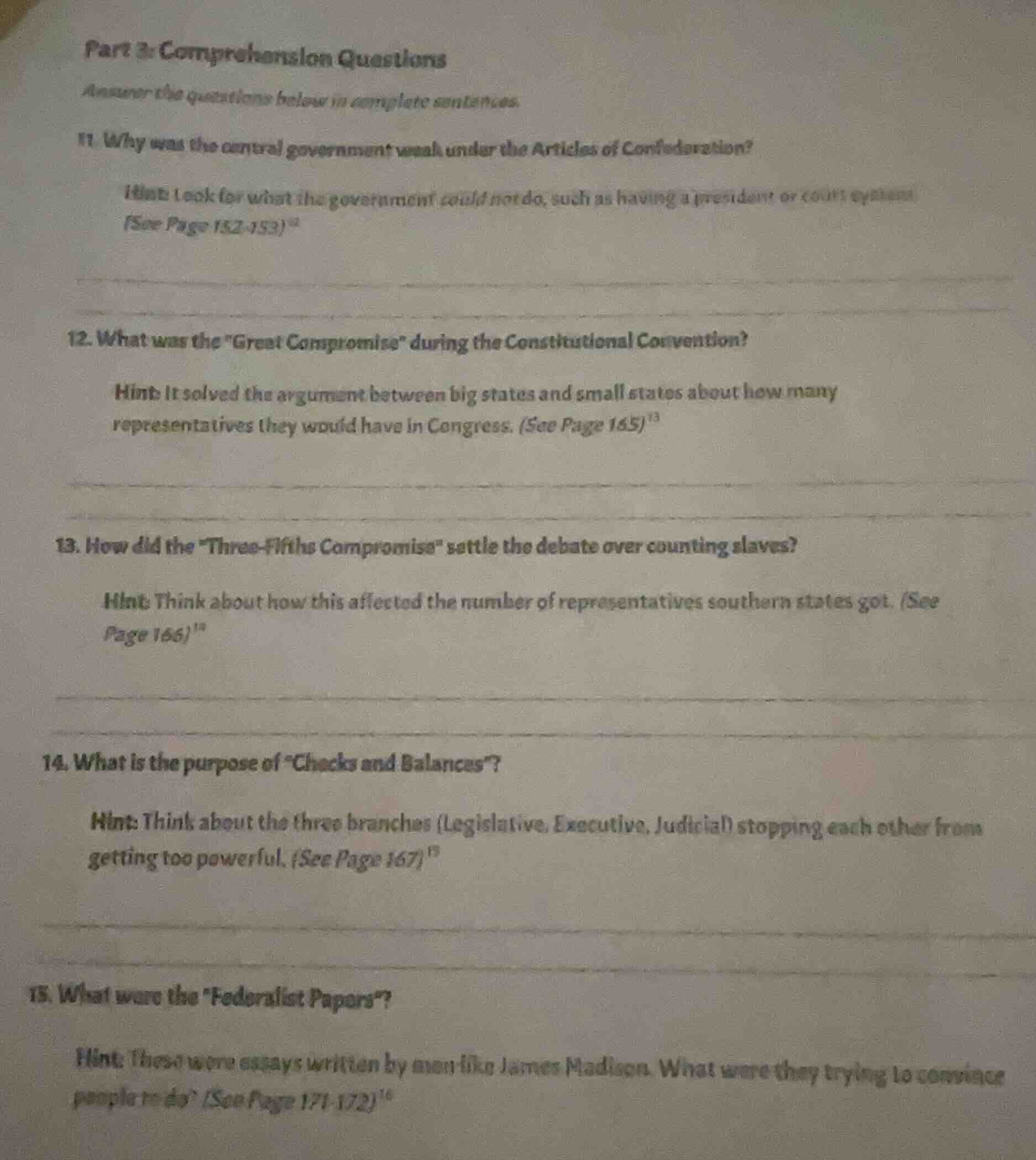
part 3: comprehension questions
answer the questions below in complete sentences.
- why was the central government weak under the articles of confederation?
hint: look for what the government could not do, such as having a president or court system. (see page 152 - 153)
- what was the \great compromise\ during the constitutional convention?
hint: it solved the argument between big states and small states about how many representatives they would have in congress. (see page 165)
- how did the \three - fifths compromise\ settle the debate over counting slaves?
hint: think about how this affected the number of representatives southern states got. (see page 166)
- what is the purpose of \checks and balances\?
hint: think about the three branches (legislative, executive, judicial) stopping each other from getting too powerful. (see page 167)
- what were the \federalist papers\?
hint: these were essays written by men like james madison. what were they trying to convince people to do? (see page 171 - 172)
Question 11
Under the Articles of Confederation, the central government was weak because it lacked key powers. It had no president (executive branch) or national court system (judicial branch). It couldn’t tax, regulate interstate commerce, or enforce laws effectively. States held most power, and the central government relied on states for funding and compliance, leading to inefficiency and disunity.
The “Great Compromise” (or Connecticut Compromise) during the Constitutional Convention resolved the dispute between large and small states over congressional representation. It established a bicameral legislature: the Senate, with equal representation (2 senators per state, favoring small states), and the House of Representatives, with representation based on state population (favoring large states). This balanced the interests of both large and small states.
The “Three - Fifths Compromise” settled the debate over counting slaves for representation and taxation by agreeing that three - fifths of a state’s slave population would be counted. Southern states (with many slaves) wanted slaves fully counted for more representatives, while Northern states opposed this. The compromise allowed Southern states to increase their representation in the House (and related taxation) by counting a portion of their slave population, while Northern states accepted a partial count to resolve the dispute.

Snap & solve any problem in the app
Get step-by-step solutions on Sovi AI
Photo-based solutions with guided steps
Explore more problems and detailed explanations
The central government was weak under the Articles of Confederation because it lacked a president (executive authority), a national court system (judicial authority), the power to tax, the ability to regulate interstate commerce, and the means to enforce laws. States retained most governing power, and the central government depended on states for resources and compliance, resulting in limited authority and inefficiency.