QUESTION IMAGE
Question
part c - connect and reflect
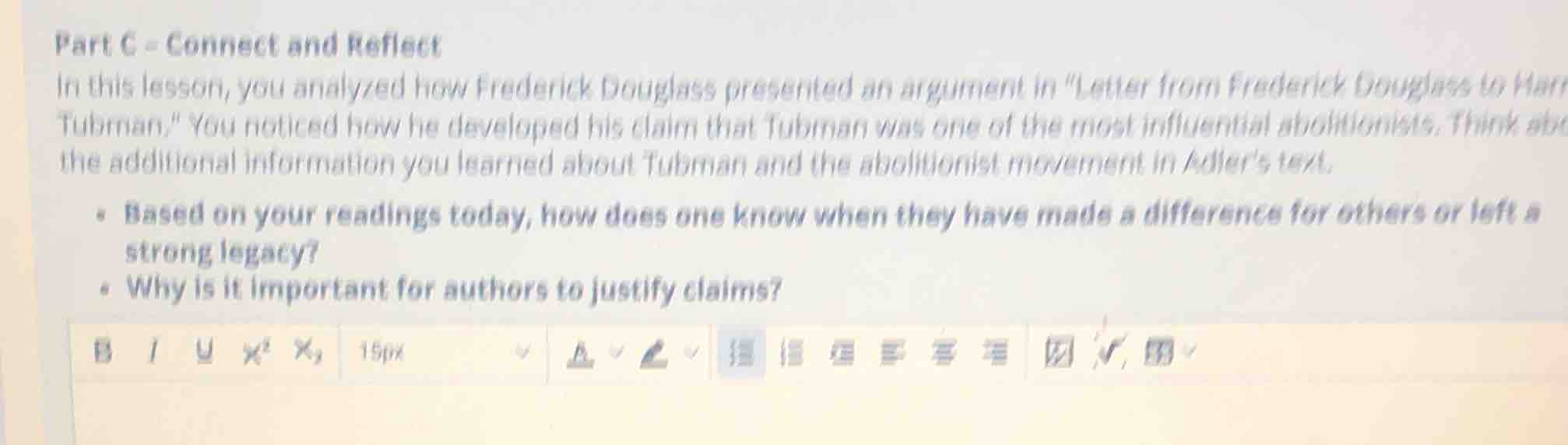
in this lesson, you analyzed how frederick douglass presented an argument in \letter from frederick douglass to harr tubman.\ you noticed how he developed his claim that tubman was one of the most influential abolitionists. think abo the additional information you learned about tubman and the abolitionist movement in adlers text.
- based on your readings today, how does one know when they have made a difference for others or left a strong legacy?
- why is it important for authors to justify claims?
Brief Explanations
- For the first question: A legacy or impact on others is evident when others adopt, build on, or honor one's work, as seen in how Tubman's abolitionist actions were celebrated and amplified by Douglass, and how her work continued to advance the abolitionist cause. Positive, lasting changes in the lives of marginalized groups or shifts in societal attitudes also signal a meaningful difference.
- For the second question: Justifying claims ensures an argument is credible, persuasive, and rooted in evidence. In Douglass's letter, his claim about Tubman's influence gains weight from context about her actions, which helps readers accept and understand the validity of the statement, fostering trust and clarity in communication.

Snap & solve any problem in the app
Get step-by-step solutions on Sovi AI
Photo-based solutions with guided steps
Explore more problems and detailed explanations
- One knows they have made a difference or left a strong legacy when their actions create lasting positive change for others, their work is recognized, celebrated, or built upon by subsequent individuals or movements, and they shift societal perspectives or systems (as seen in Tubman's lasting impact on abolition and the fight for freedom).
- It is important for authors to justify claims to establish the credibility of their argument, persuade readers of the validity of their statements, and provide clear, evidence-based reasoning that helps audiences understand and accept the claim (exemplified by how Douglass's framing of Tubman's work relies on context about her actions to support his assertion of her influence).