QUESTION IMAGE
Question
part ii: claims, evidence, and reasoning
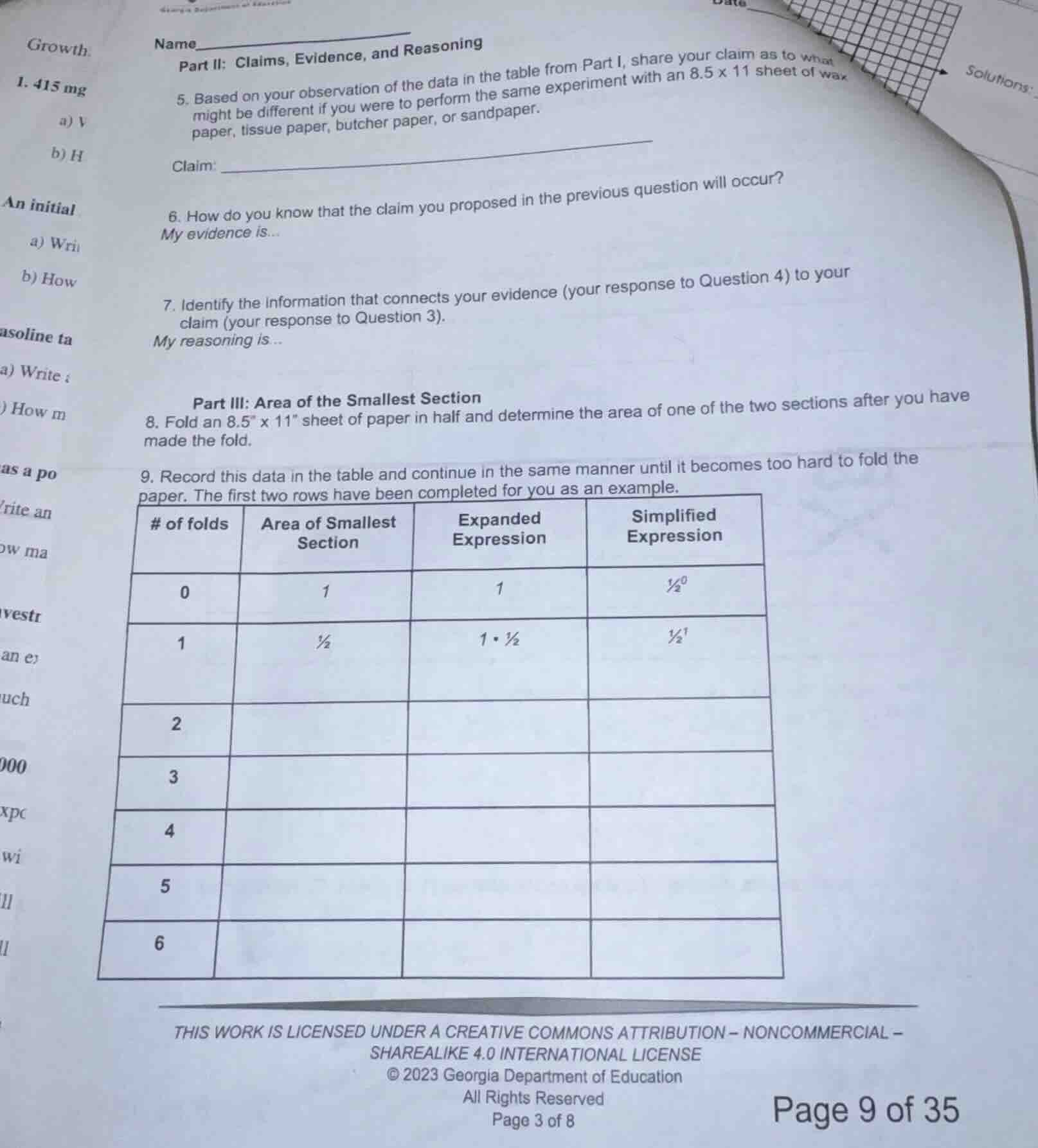
- based on your observation of the data in the table from part i, share your claim as to what might be different if you were to perform the same experiment with an 8.5 x 11 sheet of wax paper, tissue paper, butcher paper, or sandpaper.
claim:
- how do you know that the claim you proposed in the previous question will occur?
my evidence is...
- identify the information that connects your evidence (your response to question 4) to your claim (your response to question 3).
my reasoning is...
part iii: area of the smallest section
- fold an 8.5\ x 11\ sheet of paper in half and determine the area of one of the two sections after you have made the fold.
- record this data in the table and continue in the same manner until it becomes too hard to fold the paper. the first two rows have been completed for you as an example.
| # of folds | area of smallest section | expanded expression | simplified expression |
|---|---|---|---|
| 1 | $\frac{1}{2}$ | $1 \cdot \frac{1}{2}$ | $\frac{1}{2}^1$ |
| 2 | |||
| 3 | |||
| 4 | |||
| 5 | |||
| 6 |
this work is licensed under a creative commons attribution - noncommercial - sharealike 4.0 international license
© 2023 georgia department of education
all rights reserved
page 3 of 8
Step1: Identify pattern for area
Each fold halves the area.
Step2: Calculate area for 2 folds
$\frac{1}{2} \cdot \frac{1}{2} = \frac{1}{4}$
Expanded: $1 \cdot \frac{1}{2} \cdot \frac{1}{2}$, Simplified: $\frac{1}{2^2}$
Step3: Calculate area for 3 folds
$\frac{1}{4} \cdot \frac{1}{2} = \frac{1}{8}$
Expanded: $1 \cdot \frac{1}{2} \cdot \frac{1}{2} \cdot \frac{1}{2}$, Simplified: $\frac{1}{2^3}$
Step4: Calculate area for 4 folds
$\frac{1}{8} \cdot \frac{1}{2} = \frac{1}{16}$
Expanded: $1 \cdot \frac{1}{2} \cdot \frac{1}{2} \cdot \frac{1}{2} \cdot \frac{1}{2}$, Simplified: $\frac{1}{2^4}$
Step5: Calculate area for 5 folds
$\frac{1}{16} \cdot \frac{1}{2} = \frac{1}{32}$
Expanded: $1 \cdot \frac{1}{2} \cdot \frac{1}{2} \cdot \frac{1}{2} \cdot \frac{1}{2} \cdot \frac{1}{2}$, Simplified: $\frac{1}{2^5}$
Step6: Calculate area for 6 folds
$\frac{1}{32} \cdot \frac{1}{2} = \frac{1}{64}$
Expanded: $1 \cdot \frac{1}{2} \cdot \frac{1}{2} \cdot \frac{1}{2} \cdot \frac{1}{2} \cdot \frac{1}{2} \cdot \frac{1}{2}$, Simplified: $\frac{1}{2^6}$
- Claim: Using wax paper, tissue paper, butcher paper, or sandpaper will change the number of possible folds, as their thickness and flexibility differ from standard paper.
- Evidence: Standard paper has a fixed thickness and flexibility that limits folds; wax paper is slippery/thinner, sandpaper is thick/abrasive, altering foldability.
- Reasoning: The number of folds depends on material thickness and flexibility. Different paper types have distinct physical properties, so fold limits (and thus area per section) will differ, connecting the evidence about material properties to the claim of changed experiment results.

Snap & solve any problem in the app
Get step-by-step solutions on Sovi AI
Photo-based solutions with guided steps
Explore more problems and detailed explanations
| # of folds | Area of Smallest Section | Expanded Expression | Simplified Expression |
|---|---|---|---|
| 1 | $\frac{1}{2}$ | $1 \cdot \frac{1}{2}$ | $\frac{1}{2^1}$ |
| 2 | $\frac{1}{4}$ | $1 \cdot \frac{1}{2} \cdot \frac{1}{2}$ | $\frac{1}{2^2}$ |
| 3 | $\frac{1}{8}$ | $1 \cdot \frac{1}{2} \cdot \frac{1}{2} \cdot \frac{1}{2}$ | $\frac{1}{2^3}$ |
| 4 | $\frac{1}{16}$ | $1 \cdot \frac{1}{2} \cdot \frac{1}{2} \cdot \frac{1}{2} \cdot \frac{1}{2}$ | $\frac{1}{2^4}$ |
| 5 | $\frac{1}{32}$ | $1 \cdot \frac{1}{2} \cdot \frac{1}{2} \cdot \frac{1}{2} \cdot \frac{1}{2} \cdot \frac{1}{2}$ | $\frac{1}{2^5}$ |
| 6 | $\frac{1}{64}$ | $1 \cdot \frac{1}{2} \cdot \frac{1}{2} \cdot \frac{1}{2} \cdot \frac{1}{2} \cdot \frac{1}{2} \cdot \frac{1}{2}$ | $\frac{1}{2^6}$ |
---
For questions 5-7 (since Part I data is missing, here is a generalized academic response):