QUESTION IMAGE
Question
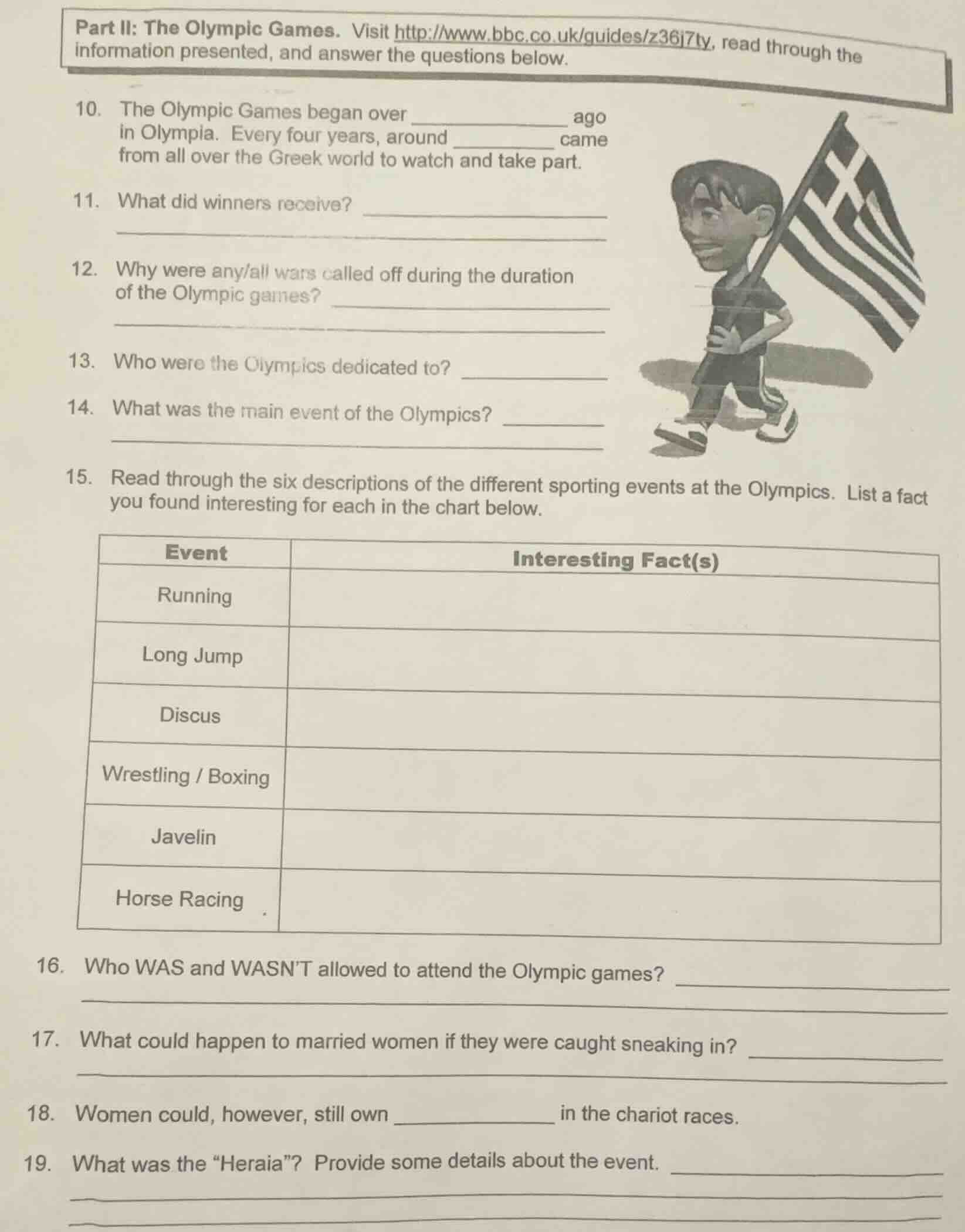
part ii: the olympic games. visit http://www.bbc.co.uk/guides/z36j7ty, read through the information presented, and answer the questions below.10. the olympic games began over _____________ agoin olympia. every four years, around ______ camefrom all over the greek world to watch and take part.11. what did winners receive?12. why were any/all wars called off during the durationof the olympic games?13. who were the olympics dedicated to?14. what was the main event of the olympics?15. read through the six descriptions of the different sporting events at the olympics. list a fact you found interesting for each in the chart below.| event | interesting fact(s) || ---- | ---- || running | || long jump | || discus | || wrestling / boxing | || javelin | || horse racing | |16. who was and wasnt allowed to attend the olympic games?17. what could happen to married women if they were caught sneaking in?18. women could, however, still own _____________ in the chariot races.19. what was the \heraia\? provide some details about the event.
All answers are sourced from the specified BBC guide to ancient Olympic Games facts.

Snap & solve any problem in the app
Get step-by-step solutions on Sovi AI
Photo-based solutions with guided steps
Explore more problems and detailed explanations
- 2700 years; 40,000 people
- An olive wreath (kotinos)
- To uphold the Olympic Truce, ensuring safe travel for participants and spectators.
- Zeus, the king of the Greek gods
- The stade (a 192-metre foot race)
15.
| Event | Interesting Fact(s) |
|---|---|
| Long Jump | Athletes used weights (halteres) to boost their jump distance. |
| Discus | Discuses were made of stone, bronze, or lead, not modern metal. |
| Wrestling / Boxing | Boxing matches had no rounds, no weight classes, and ended when one athlete conceded. |
| Javelin | The javelin had a leather thong attached to help with throwing accuracy. |
| Horse Racing | Owners (not riders) received the olive wreath prize if their horse won. |
- Allowed: Free Greek men, boys, and male athletes from Greek city-states. <br> Not Allowed: Married women, non-Greeks, slaves, and convicted criminals.
- They could be thrown off a cliff as punishment.
- Chariots (and horses)
- The Heraia was an ancient Greek women's athletic festival dedicated to the goddess Hera. It was held every four years at Olympia, only unmarried Greek women could participate, and events included foot races over shorter distances than the men's Olympic races. Winners received olive wreaths and could dedicate statues to Hera.