QUESTION IMAGE
Question
part iii: reflection
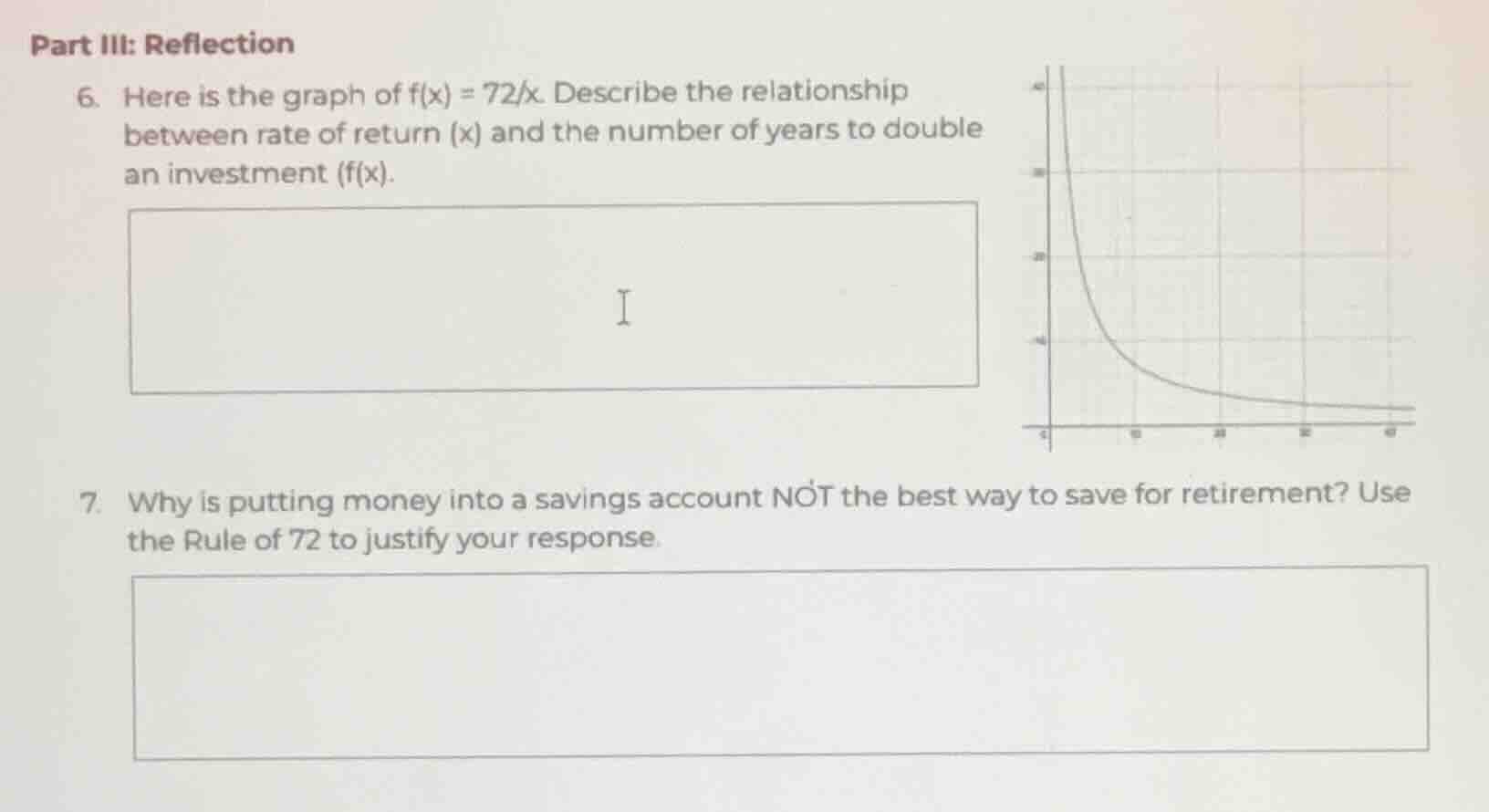
- here is the graph of $f(x)=\frac{72}{x}$. describe the relationship between rate of return (x) and the number of years to double an investment (f(x)).
- why is putting money into a savings account not the best way to save for retirement? use the rule of 72 to justify your response.
For question 6:
The function $f(x)=\frac{72}{x}$ is an inverse variation (hyperbolic) function. As the rate of return $x$ increases, the value of $\frac{72}{x}$ decreases, which matches the downward-sloping, decreasing curve shown. This means the two variables move in opposite directions.
For question 7:
Savings accounts have very low annual interest rates (typically well below 2%). Using the Rule of 72 ($f(x)=\frac{72}{x}$), a low rate leads to an extremely long time to double the investment. For example, with a 1% rate, it takes $\frac{72}{1}=72$ years to double, which is too slow to build sufficient retirement savings within a typical working lifetime.

Snap & solve any problem in the app
Get step-by-step solutions on Sovi AI
Photo-based solutions with guided steps
Explore more problems and detailed explanations
- The rate of return ($x$) and the number of years to double an investment ($f(x)$) have an inverse relationship: as the rate of return increases, the number of years needed to double the investment decreases, and vice versa.
- Savings accounts have very low annual interest rates. Using the Rule of 72, a low rate (e.g., 1%) results in a very long time to double savings ($\frac{72}{1}=72$ years), which is too slow to grow enough money for retirement in a reasonable timeframe, so it is not the best option.