QUESTION IMAGE
Question
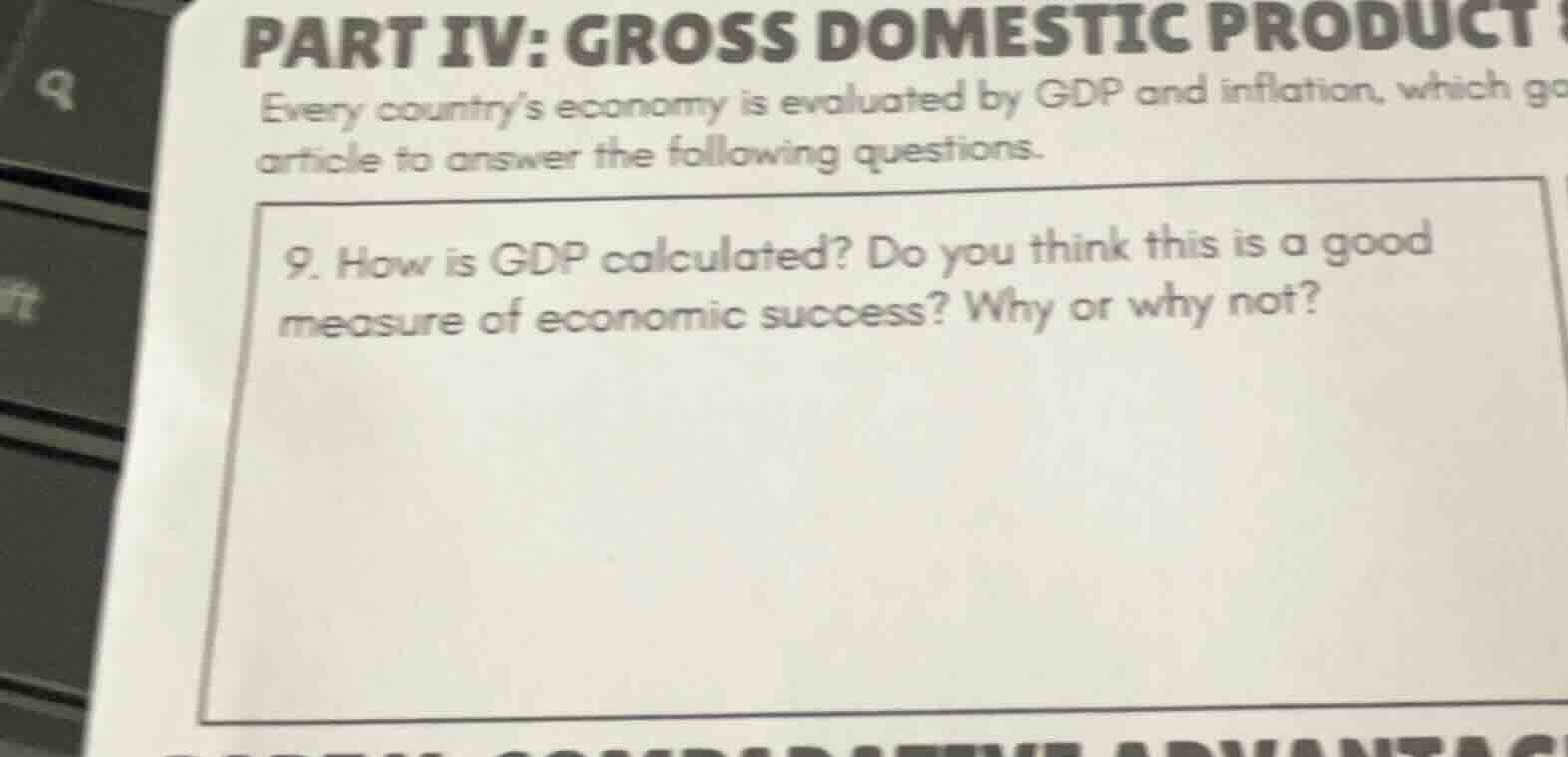
part iv: gross domestic product every countrys economy is evaluated by gdp and inflation, which go article to answer the following questions. 9. how is gdp calculated? do you think this is a good measure of economic success? why or why not?
Brief Explanations
GDP is calculated via three main methods:
- Expenditure Approach: Sums total spending on final goods/services in an economy, using the formula $GDP = C + I + G + (X-M)$, where $C$ = consumer spending, $I$ = business investment, $G$ = government spending, $X$ = exports, $M$ = imports.
- Income Approach: Adds up all incomes earned in production (wages, profits, rent, interest) plus indirect taxes minus subsidies and depreciation.
- Production (Value-Added) Approach: Sums the value added at each stage of production across all industries to avoid double-counting.
GDP is a useful but imperfect measure of economic success:
- Strengths: It provides a standardized, quantifiable snapshot of an economy's size, growth, and productivity over time, enabling cross-country comparisons and guiding policy.
- Limitations: It excludes non-market activities (e.g., unpaid household work), ignores income inequality, does not account for environmental harm or resource depletion, and does not measure quality of life factors like health, education, or happiness.

Snap & solve any problem in the app
Get step-by-step solutions on Sovi AI
Photo-based solutions with guided steps
Explore more problems and detailed explanations
GDP is calculated through three primary methods:
- Expenditure Approach: $GDP = C + I + G + (X-M)$, where $C$ = consumer spending, $I$ = business investment, $G$ = government spending, $X$ = exports, $M$ = imports.
- Income Approach: Sum of all factor incomes (wages, profits, rent, interest) plus indirect taxes minus subsidies and depreciation.
- Production Approach: Sum of value added at each production stage across all industries.
GDP is a partially good but incomplete measure of economic success:
- It is useful for tracking overall economic size, growth, and productivity, and allows for cross-country and time-series comparisons to inform policy.
- However, it fails to account for non-market work, income inequality, environmental costs, and quality-of-life metrics (health, well-being, education), so it cannot fully capture holistic economic success.