QUESTION IMAGE
Question
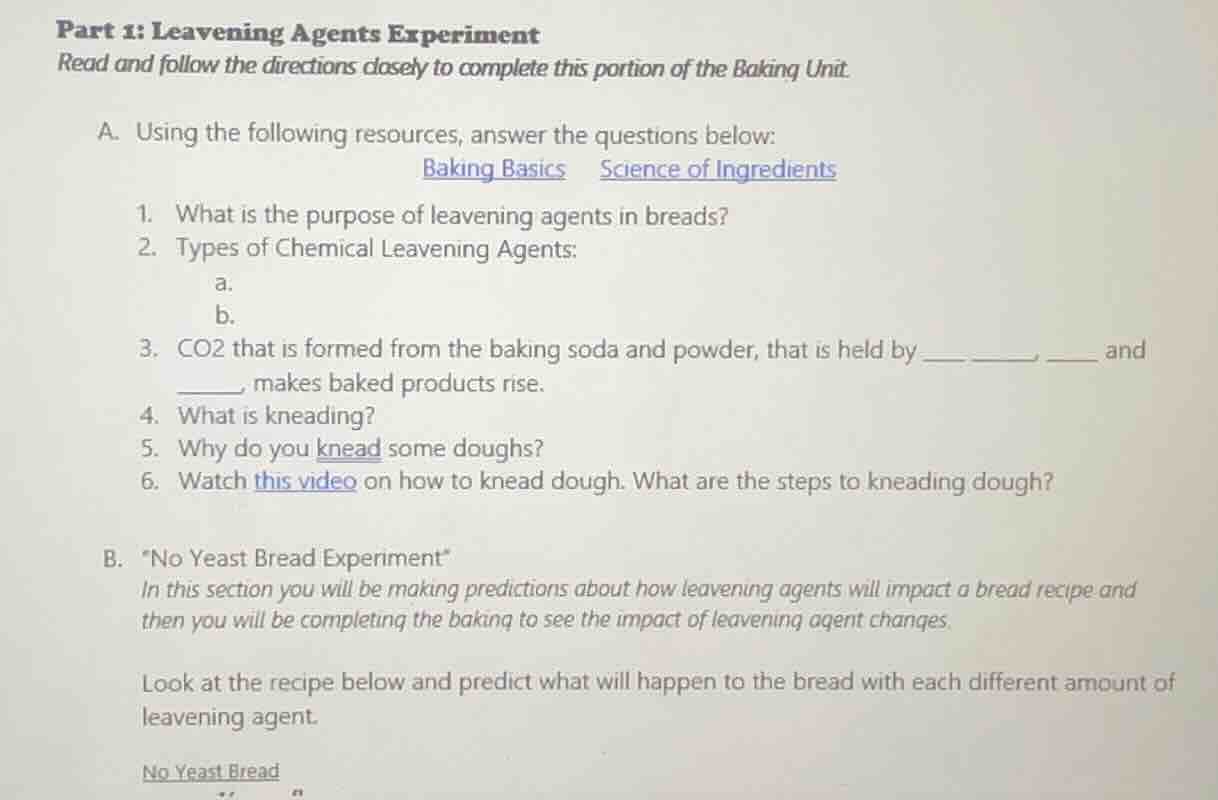
part 1: leavening agents experiment
read and follow the directions closely to complete this portion of the baking unit.
a. using the following resources, answer the questions below:
\t\t\t\t\t\tbaking basics science of ingredients
\t1. what is the purpose of leavening agents in breads?
\t2. types of chemical leavening agents:
\t\t\ta.
\t\t\tb.
\t3. co2 that is formed from the baking soda and powder, that is held by _ , _ and
\t___, makes baked products rise.
\t4. what is kneading?
\t5. why do you knead some doughs?
\t6. watch this video on how to knead dough. what are the steps to kneading dough?
b.
o yeast bread experiment\
in this section you will be making predictions about how leavening agents will impact a bread recipe and
then you will be completing the baking to see the impact of leavening agent changes.
look at the recipe below and predict what will happen to the bread with each different amount of
leavening agent.
no yeast bread
- Leavening agents create air pockets in bread dough, which expand during baking to make the bread light, fluffy, and rise instead of remaining dense.
- Common chemical leavening agents include baking soda (sodium bicarbonate) and baking powder (a mix of baking soda, acid, and cornstarch).
- The CO₂ produced by baking soda/powder is trapped by the gluten structure, starch, and air bubbles in the dough, which allows the baked good to rise.
- Kneading is the process of repeatedly pressing, folding, and stretching bread dough with hands or tools.
- Kneading develops the gluten network in dough, which gives bread structure, helps it hold leavening gases, and creates a chewy texture.
- Standard kneading steps: (1) Flatten the dough on a floured surface; (2) Fold the top third of the dough down to the center; (3) Fold the bottom third up over the top; (4) Rotate the dough 90 degrees; (5) Repeat the fold-and-rotate motion for 8-10 minutes until the dough is smooth, elastic, and springs back when pressed.
For the "No Yeast Bread Experiment" predictions (since the full recipe amounts are not shown, general predictions are provided):
- No leavening agent: The bread will remain very dense, flat, and compact with no rise, as there is no source of gas to expand the dough.
- Too little leavening agent: The bread will rise slightly but stay denser than intended, with a tight, crumbly texture.
- Correct amount of leavening agent: The bread will rise evenly, have a light, airy crumb, and a soft, fluffy texture.
- Too much leavening agent: The bread will rise quickly and may collapse during baking, have a bitter, soapy taste (from excess baking soda), and a coarse, irregular crumb.

Snap & solve any problem in the app
Get step-by-step solutions on Sovi AI
Photo-based solutions with guided steps
Explore more problems and detailed explanations
- To make bread light, fluffy, and rise by creating/holding air pockets.
- a. Baking Soda (Sodium Bicarbonate)
b. Baking Powder
- gluten, starch, air bubbles
- Working dough by pressing, folding, stretching it.
- To develop gluten for structure and texture.
- 1. Flatten dough on floured surface
- Fold top third to center
- Fold bottom third over top
- Rotate dough 90 degrees
- Repeat 8-10 mins until smooth/elastic
No Yeast Bread Predictions (general):
- No leavening: Dense, flat, no rise
- Too little leavening: Slight rise, dense crumb
- Correct amount: Even rise, light/airy crumb
- Too much leavening: Over-rises then collapses, bitter taste, coarse crumb