QUESTION IMAGE
Question
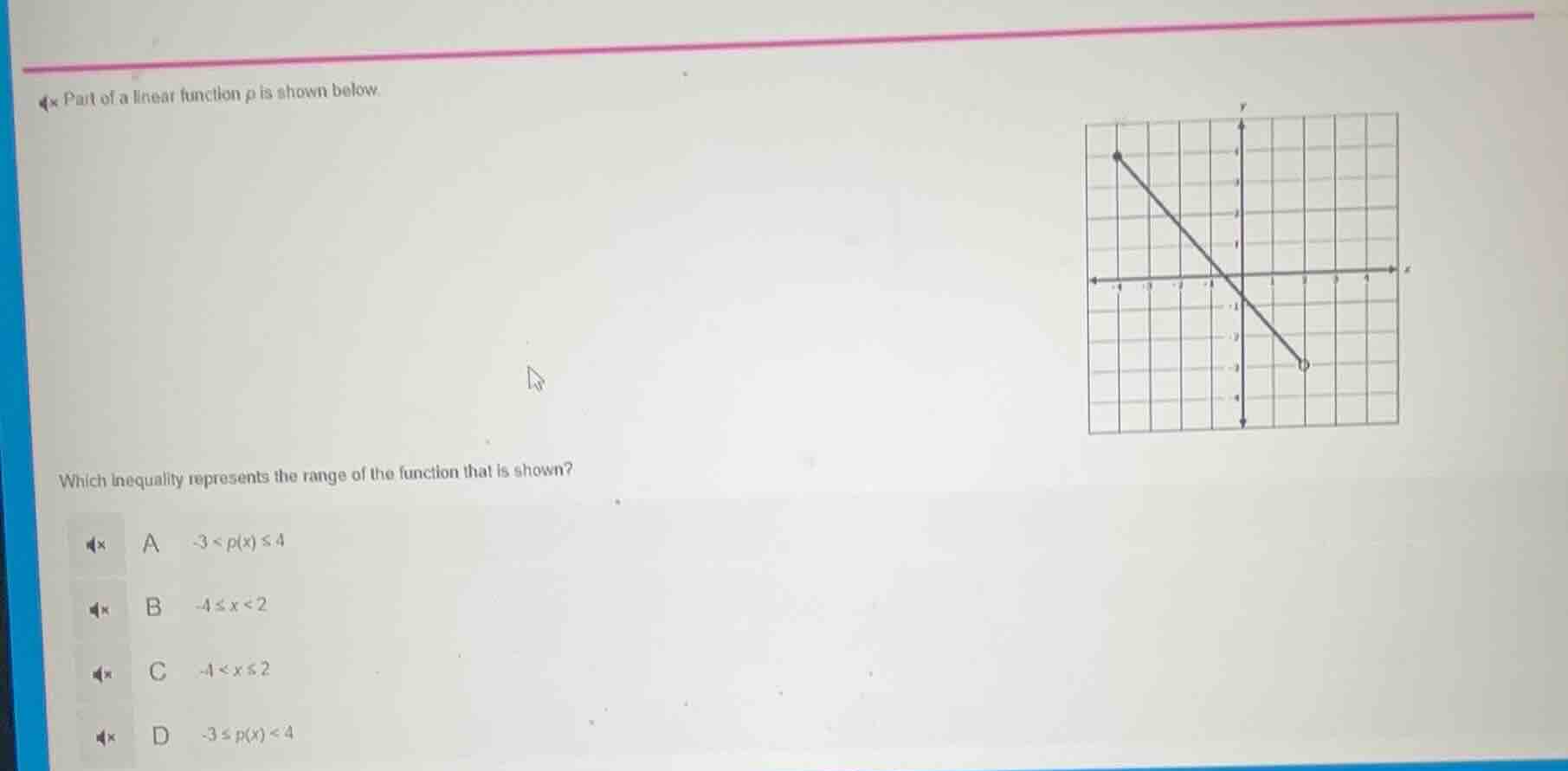
part of a linear function p is shown below. which inequality represents the range of the function that is shown? a -3 < p(x) ≤ 4 b -4 ≤ x < 2 c -4 < x ≤ 2 d -3 ≤ p(x) < 4
Step1: Understand Range Definition
Range of a function is the set of all possible output values (\(y\)-values) of the function. So we need to find the minimum and maximum \(y\)-values from the graph.
Step2: Analyze the Graph's \(y\)-values
- The closed dot (filled circle) is at \(y = 4\) (so \(p(x)\) can take the value 4, hence \(\leq 4\)).
- The open dot (hollow circle) is at \(y=-3\) (so \(p(x)\) cannot take the value -3, hence \(> - 3\)).
- The line is decreasing, so the \(y\)-values range from just above -3 (since open dot at -3) up to and including 4 (closed dot at 4).
Step3: Match with Options
- Option A: \(-3 < p(x) \leq 4\) matches our analysis (open dot at -3: \(p(x) > - 3\); closed dot at 4: \(p(x) \leq 4\)).
- Option B: \(-4 \leq x < 2\) is about domain (\(x\)-values), not range. Eliminate.
- Option C: \(-4 < x \leq 2\) is about domain. Eliminate.
- Option D: \(-3 \leq p(x) < 4\) is incorrect because the closed dot is at 4 (so \(p(x)\) can be 4) and open dot at -3 (so \(p(x)\) can't be -3). Eliminate.

Snap & solve any problem in the app
Get step-by-step solutions on Sovi AI
Photo-based solutions with guided steps
Explore more problems and detailed explanations
A. \(-3 < p(x) \leq 4\)