QUESTION IMAGE
Question
part c
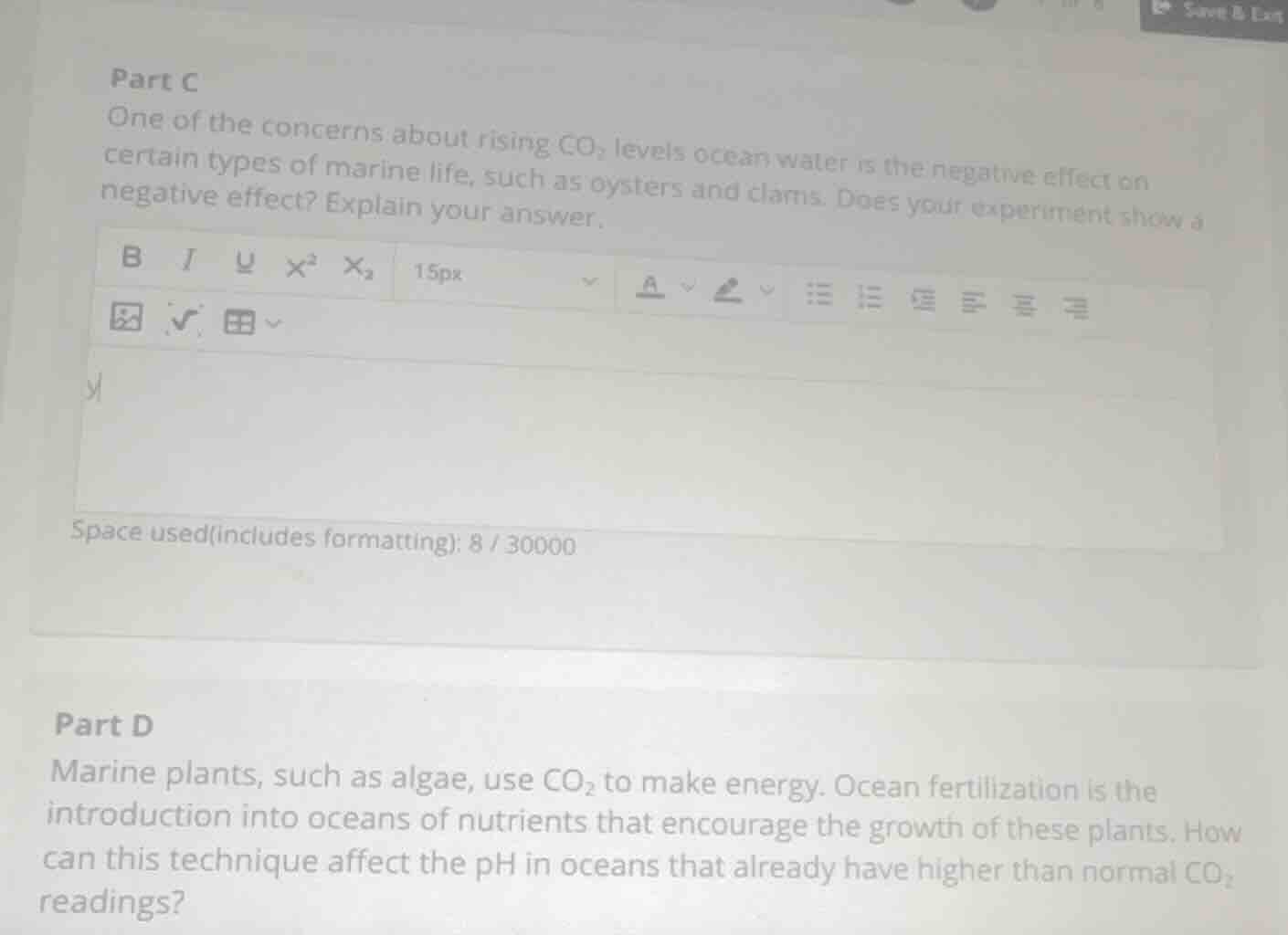
one of the concerns about rising co₂ levels ocean water is the negative effect on certain types of marine life, such as oysters and clams. does your experiment show a negative effect? explain your answer.
part d
marine plants, such as algae, use co₂ to make energy. ocean fertilization is the introduction into oceans of nutrients that encourage the growth of these plants. how can this technique affect the ph in oceans that already have higher than normal co₂ readings?
Part C:
Rising ocean CO₂ drives the reaction $\text{CO}_2 + \text{H}_2\text{O}
ightleftharpoons \text{H}_2\text{CO}_3
ightleftharpoons \text{H}^+ + \text{HCO}_3^-$, lowering pH (ocean acidification). Oysters and clams build calcium carbonate shells via $\text{Ca}^{2+} + 2\text{HCO}_3^-
ightleftharpoons \text{CaCO}_3 + \text{CO}_2 + \text{H}_2\text{O}$. More $\text{H}^+$ reacts with $\text{HCO}_3^-$ and dissolves existing $\text{CaCO}_3$, impeding shell formation and survival, which an experiment measuring shell growth/survival under high CO₂ would confirm.
Part D:
Increased algae growth from fertilization accelerates photosynthesis: $6\text{CO}_2 + 6\text{H}_2\text{O}
ightarrow \text{C}_6\text{H}_{12}\text{O}_6 + 6\text{O}_2$. This removes excess dissolved CO₂ from the water, shifting the carbonic acid equilibrium left, reducing $\text{H}^+$ concentration and raising the ocean's pH, mitigating acidification from elevated CO₂.

Snap & solve any problem in the app
Get step-by-step solutions on Sovi AI
Photo-based solutions with guided steps
Explore more problems and detailed explanations
Part C:
Yes, the experiment would show a negative effect.
Part D:
Ocean fertilization would increase ocean pH (reduce acidity) in waters with elevated CO₂.