QUESTION IMAGE
Question
part b
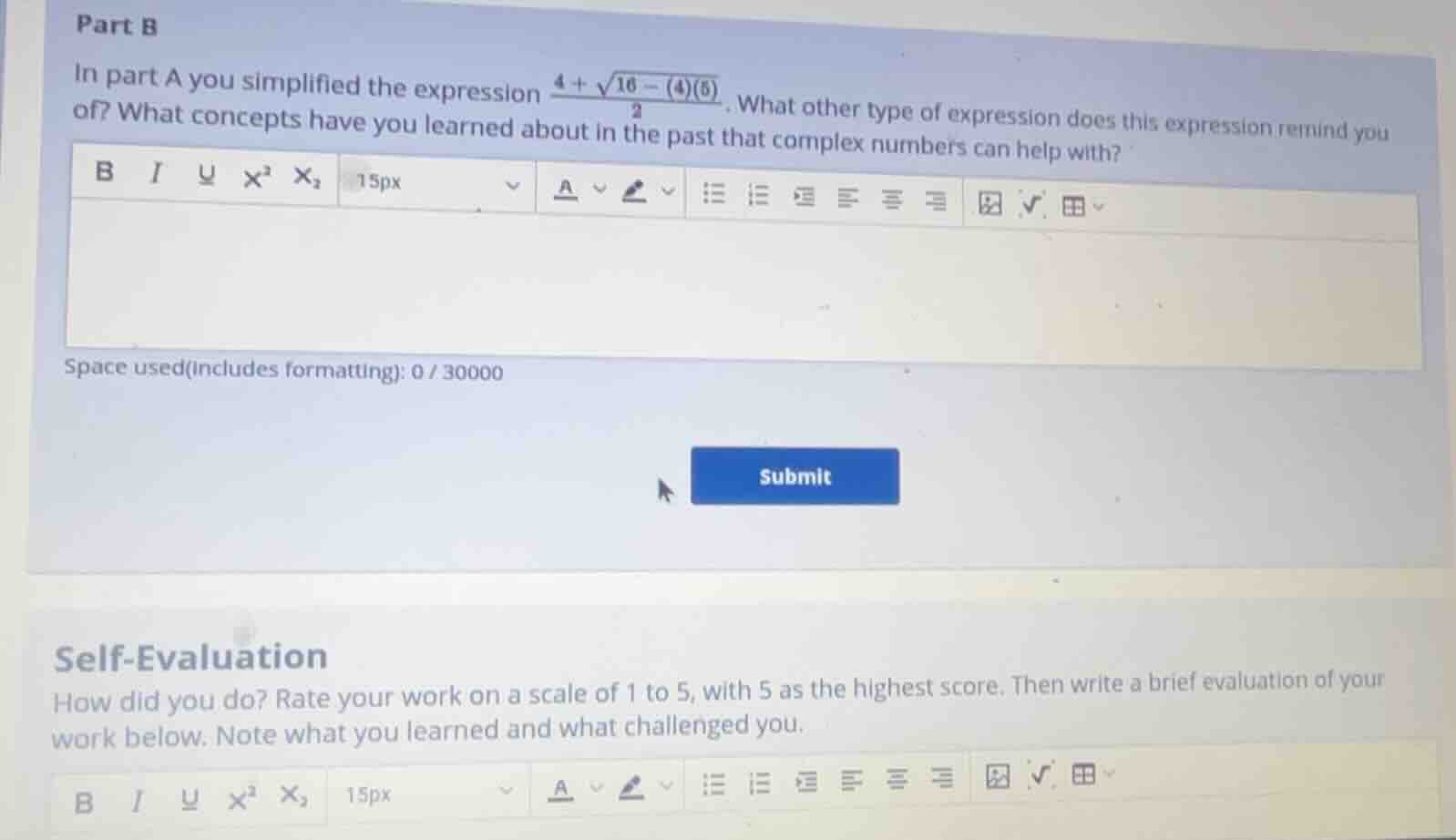
in part a you simplified the expression \\(\frac{4 + \sqrt{16 - (4)(6)}}{2}\\). what other type of expression does this expression remind you of? what concepts have you learned about in the past that complex numbers can help with?
space used(includes formatting): 0 / 30000
self - evaluation
how did you do? rate your work on a scale of 1 to 5, with 5 as the highest score. then write a brief evaluation of your work below. note what you learned and what challenged you.
The given expression $\frac{4+\sqrt{16-(4)(6)}}{2}$ matches the structure of the quadratic formula, used to solve quadratic equations of the form $ax^2+bx+c=0$. The term under the square root, $16-(4)(6)=16-24=-8$, is negative, which would result in no real solutions—this is where complex numbers are used to find non-real (complex) roots of quadratic equations.

Snap & solve any problem in the app
Get step-by-step solutions on Sovi AI
Photo-based solutions with guided steps
Explore more problems and detailed explanations
- This expression is identical in form to the quadratic formula $\frac{-b+\sqrt{b^2-4ac}}{2a}$ (here, $a=1$, $b=-4$, $c=6$ corresponds to the quadratic $x^2-4x+6=0$).
- Complex numbers help with solving quadratic (and higher-degree) polynomial equations where the discriminant ($b^2-4ac$) is negative, a case where no real number solutions exist, but complex solutions (involving $i=\sqrt{-1}$) do.