QUESTION IMAGE
Question
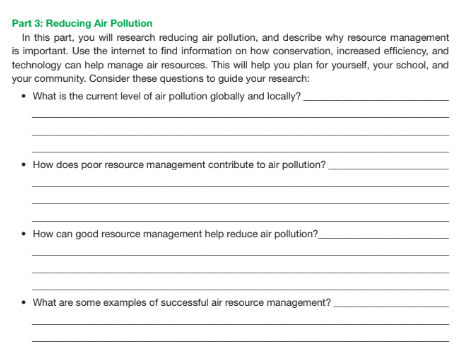
part 3: reducing air pollution
in this part, you will research reducing air pollution, and describe why resource management
is important. use the internet to find information on how conservation, increased efficiency, and
technology can help manage air resources. this will help you plan for yourself, your school, and
your community. consider these questions to guide your research:
- what is the current level of air pollution globally and locally?
- how does poor resource management contribute to air pollution?
- how can good resource management help reduce air pollution?
- what are some examples of successful air resource management?
Since this is a research - guiding question set related to air pollution and resource management, and the subfield of Natural Science that is most relevant here is Environmental Sciences. Here is the way to answer these sub - questions:
1. What is the current level of air pollution globally and locally?
To answer this, we can refer to global air quality reports from organizations like the World Health Organization (WHO) and local environmental protection agency reports. Globally, many regions still have high levels of pollutants such as PM2.5, PM10, and nitrogen oxides. For example, in some developing countries, the annual average PM2.5 concentration may exceed the WHO guideline of 10 μg/m³. Locally, in urban areas with heavy industry or traffic, air pollution levels are often higher than in rural areas.
Poor resource management can lead to air pollution in several ways. For example, inefficient use of fossil fuels in energy production (e.g., old - fashioned power plants with low - efficiency combustion) releases more pollutants. Also, improper waste management, such as open burning of waste, releases harmful gases and particulate matter into the air. In the case of natural resources, deforestation (a form of poor forest resource management) reduces the number of trees that can absorb pollutants, leading to higher air pollution levels.
Good resource management can reduce air pollution in multiple aspects. Efficient use of energy resources (e.g., using energy - efficient technologies in power generation and transportation) can reduce the amount of fossil fuels burned, thus reducing pollutant emissions. Sustainable forest management, which includes reforestation and proper forest protection, can increase the number of trees that act as carbon sinks and filter pollutants from the air. Also, proper waste management, such as recycling and using waste - to - energy technologies in an environmentally friendly way, can reduce the amount of waste that is burned or landfilled, thereby reducing air pollution.

Snap & solve any problem in the app
Get step-by-step solutions on Sovi AI
Photo-based solutions with guided steps
Explore more problems and detailed explanations
- Global: Many areas have elevated levels of pollutants (e.g., PM2.5, NOₓ) with some regions exceeding WHO air quality guidelines.
- Local: Varies by location; urban/industrial areas often have higher pollution than rural areas.