QUESTION IMAGE
Question
part 1 — setting up the problem
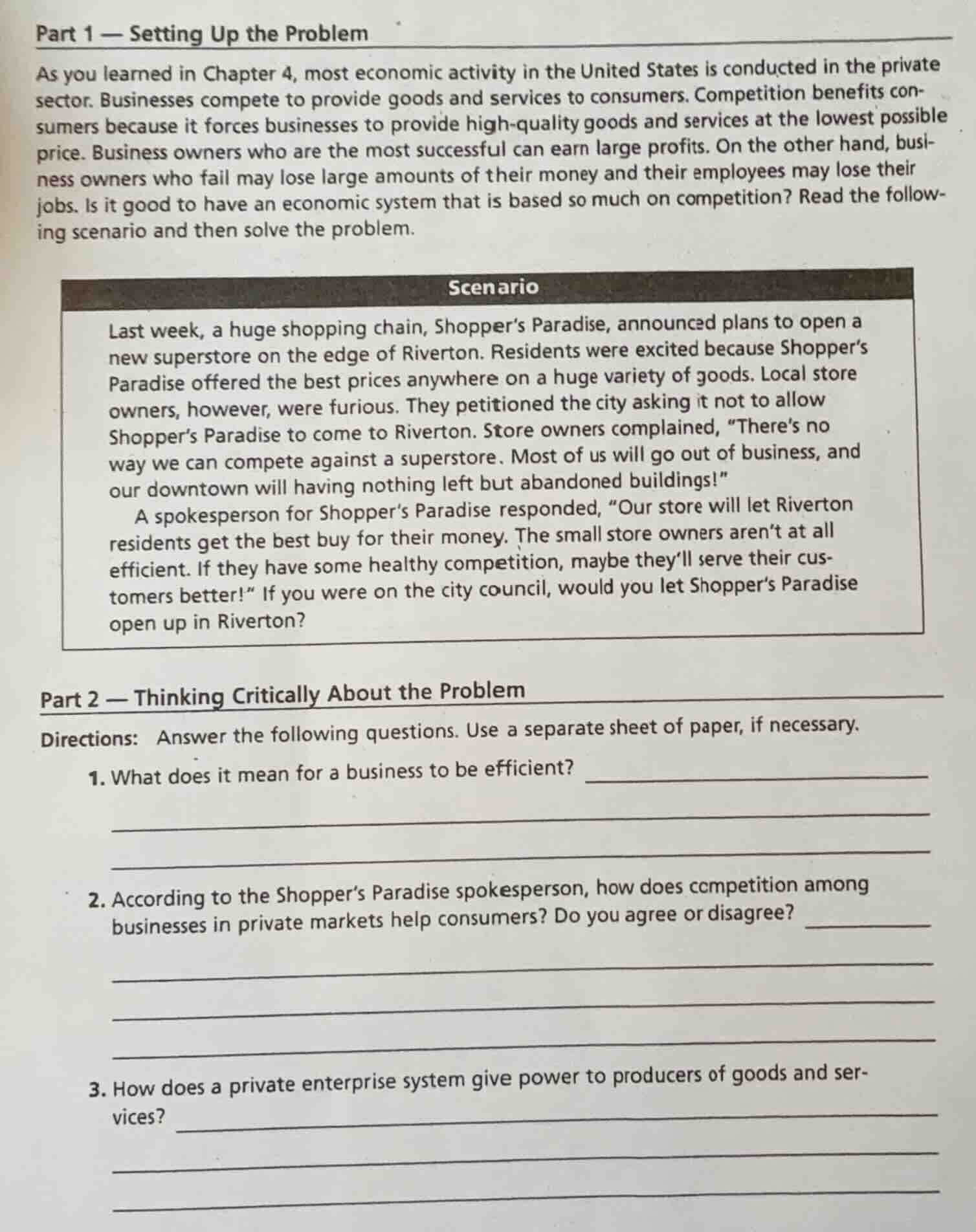
as you learned in chapter 4, most economic activity in the united states is conducted in the private sector. businesses compete to provide goods and services to consumers. competition benefits consumers because it forces businesses to provide high-quality goods and services at the lowest possible price. business owners who are the most successful can earn large profits. on the other hand, business owners who fail may lose large amounts of their money and their employees may lose their jobs. is it good to have an economic system that is based so much on competition? read the following scenario and then solve the problem.
scenario
last week, a huge shopping chain, shoppers paradise, announced plans to open a new superstore on the edge of riverton. residents were excited because shoppers paradise offered the best prices anywhere on a huge variety of goods. local store owners, however, were furious. they petitioned the city asking it not to allow shoppers paradise to come to riverton. store owners complained, \theres no way we can compete against a superstore. most of us will go out of business, and our downtown will having nothing left but abandoned buildings!\
a spokesperson for shoppers paradise responded, \our store will let riverton residents get the best buy for their money. the small store owners arent at all efficient. if they have some healthy competition, maybe theyll serve their customers better!\ if you were on the city council, would you let shoppers paradise open up in riverton?
part 2 — thinking critically about the problem
directions: answer the following questions. use a separate sheet of paper, if necessary.
- what does it mean for a business to be efficient?
- according to the shoppers paradise spokesperson, how does competition among businesses in private markets help consumers? do you agree or disagree?
- how does a private enterprise system give power to producers of goods and services?
- For a business, efficiency means using the least amount of resources (like time, labor, materials) to produce or provide goods and services, while keeping costs low and output high to maximize value.
- The spokesperson states competition lets consumers get the best value for their money and pushes smaller stores to serve customers better. Agreement can vary: agreeing aligns with the idea that competition drives lower prices and better service; disagreeing may stem from concerns about small business closures harming the local community and economy.
- In a private enterprise system, producers have the freedom to choose what goods/services to offer, set their own prices (within market limits), compete for customers, and keep profits from successful operations, which gives them control over their business decisions and the ability to respond to consumer demand.

Snap & solve any problem in the app
Get step-by-step solutions on Sovi AI
Photo-based solutions with guided steps
Explore more problems and detailed explanations
- A business is efficient when it uses minimal resources (labor, materials, time) to produce goods or services at low cost while maximizing output and value.
- The spokesperson says competition helps consumers get the best value for their money and pushes smaller stores to improve customer service. (Agreement example: I agree, as competition typically drives lower prices and better quality. Disagreement example: I disagree, because the loss of small businesses could harm the local community's unique character and employment.)
- A private enterprise system gives producers power by letting them choose what to sell, set prices, compete freely, and retain profits from successful operations, allowing them to make independent business decisions based on market demand.