QUESTION IMAGE
Question
part 2: the test results
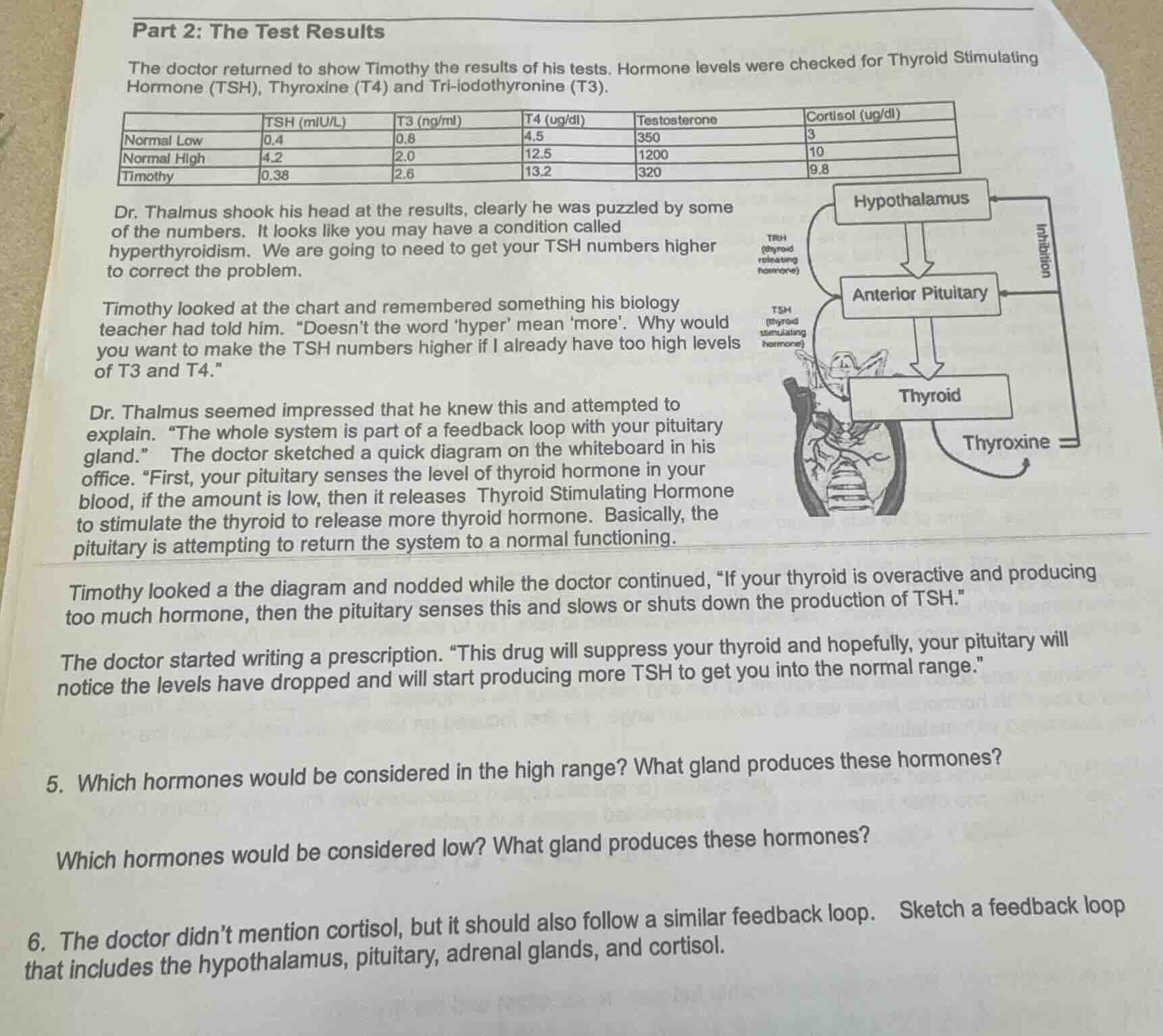
the doctor returned to show timothy the results of his tests. hormone levels were checked for thyroid stimulating
hormone (tsh), thyroxine (t4) and tri - iodothyronine (t3).
| tsh (miu/l) | t3 (ng/ml) | t4 (ug/dl) | testosterone | cortisol (ug/dl) | |
| normal low | 0.4 | 0.8 | 4.5 | 350 | 3 |
| normal high | 4.2 | 2.0 | 12.5 | 1200 | 10 |
| timothy | 0.38 | 2.6 | 13.2 | 320 | 9.8 |
dr. thalmus shook his head at the results, clearly he was puzzled by some
of the numbers. it looks like you may have a condition called
hyperthyroidism. we are going to need to get your tsh numbers higher
to correct the problem.
timothy looked at the chart and remembered something his biology
teacher had told him. “doesnt the word hyper meanmore. why would
you want to make the tsh numbers higher if i already have too high levels
of t3 and t4.”
dr. thalmus seemed impressed that he knew this and attempted to
explain. “the whole system is part of a feedback loop with your pituitary
gland.” the doctor sketched a quick diagram on the whiteboard in his
office. “first, your pituitary senses the level of thyroid hormone in your
blood, if the amount is low, then it releases thyroid stimulating hormone
to stimulate the thyroid to release more thyroid hormone. basically, the
pituitary is attempting to return the system to a normal functioning.
timothy looked a the diagram and nodded while the doctor continued, “if your thyroid is overactive and producing
too much hormone, then the pituitary senses this and slows or shuts down the production of tsh.”
the doctor started writing a prescription. “this drug will suppress your thyroid and hopefully, your pituitary will
notice the levels have dropped and will start producing more tsh to get you into the normal range.”
- which hormones would be considered in the high range? what gland produces these hormones?
which hormones would be considered low? what gland produces these hormones?
- the doctor didnt mention cortisol, but it should also follow a similar feedback loop. sketch a feedback loop
that includes the hypothalamus, pituitary, adrenal glands, and cortisol.
Question 5
- High Hormones: Compare Timothy's results to the normal high range. T3 (2.6 ng/mL > 2.0 ng/mL) and T4 (13.2 ug/dl > 12.5 ug/dl) are elevated. These are produced by the thyroid gland.
- Low Hormones: Compare Timothy's results to the normal low range. TSH (0.38 mIU/L < 0.4 mIU/L) is below normal. TSH is produced by the anterior pituitary gland.
The cortisol feedback loop follows the same negative feedback structure as the thyroid loop. The hypothalamus initiates the cascade, the pituitary signals the target gland, and high cortisol levels inhibit the upstream glands.

Snap & solve any problem in the app
Get step-by-step solutions on Sovi AI
Photo-based solutions with guided steps
Explore more problems and detailed explanations
- High range hormones: Tri-iodothyronine (T3) and Thyroxine (T4). These are produced by the thyroid gland.
- Low range hormone: Thyroid Stimulating Hormone (TSH). This is produced by the anterior pituitary gland.
---