QUESTION IMAGE
Question
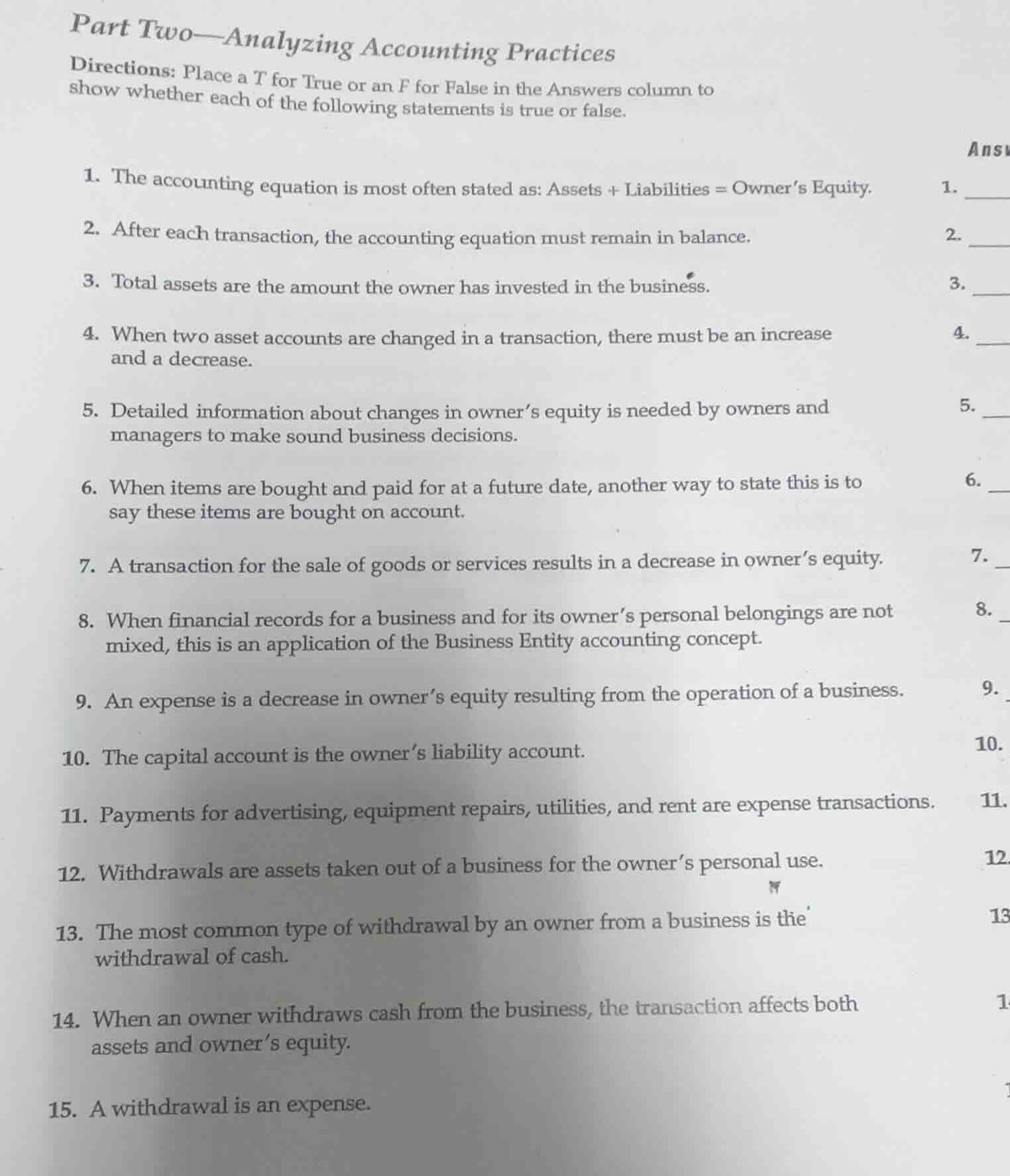
part two—analyzing accounting practices
directions: place a t for true or an f for false in the answers column to show whether each of the following statements is true or false.
- the accounting equation is most often stated as: assets + liabilities = owners equity.
- after each transaction, the accounting equation must remain in balance.
- total assets are the amount the owner has invested in the business.
- when two asset accounts are changed in a transaction, there must be an increase and a decrease.
- detailed information about changes in owners equity is needed by owners and managers to make sound business decisions.
- when items are bought and paid for at a future date, another way to state this is to say these items are bought on account.
- a transaction for the sale of goods or services results in a decrease in owners equity.
- when financial records for a business and for its owners personal belongings are not mixed, this is an application of the business entity accounting concept.
- an expense is a decrease in owners equity resulting from the operation of a business.
- the capital account is the owners liability account.
- payments for advertising, equipment repairs, utilities, and rent are expense transactions.
- withdrawals are assets taken out of a business for the owners personal use.
- the most common type of withdrawal by an owner from a business is the withdrawal of cash.
- when an owner withdraws cash from the business, the transaction affects both assets and owners equity.
- a withdrawal is an expense.
Brief Explanations
- The correct accounting equation is $\text{Assets} = \text{Liabilities} + \text{Owner's Equity}$.
- A core rule of double-entry accounting is that the equation stays balanced after every transaction.
- Owner's equity, not total assets, is the owner's invested amount.
- Two asset accounts can both increase (e.g., taking a loan to buy equipment: cash and equipment both rise) or both decrease.
- Owner's equity changes reflect business performance, critical for decision-making.
- Buying on account means purchasing goods/services to be paid for later.
- Sales of goods/services increase revenue, which increases owner's equity.
- The Business Entity Concept requires separating business and personal finances.
- Expenses are costs of operations that reduce owner's equity.
- The capital account is an owner's equity account, not a liability.
- These payments are all operational costs classified as expenses.
- Withdrawals are assets removed from the business for personal owner use.
- Cash is the most frequently withdrawn asset due to its liquidity.
- Cash (asset) decreases, and owner's equity decreases when cash is withdrawn.
- Withdrawals are personal distributions, not operational expenses.

Snap & solve any problem in the app
Get step-by-step solutions on Sovi AI
Photo-based solutions with guided steps
Explore more problems and detailed explanations
- F
- T
- F
- F
- T
- T
- F
- T
- T
- F
- T
- T
- T
- T
- F