QUESTION IMAGE
Question
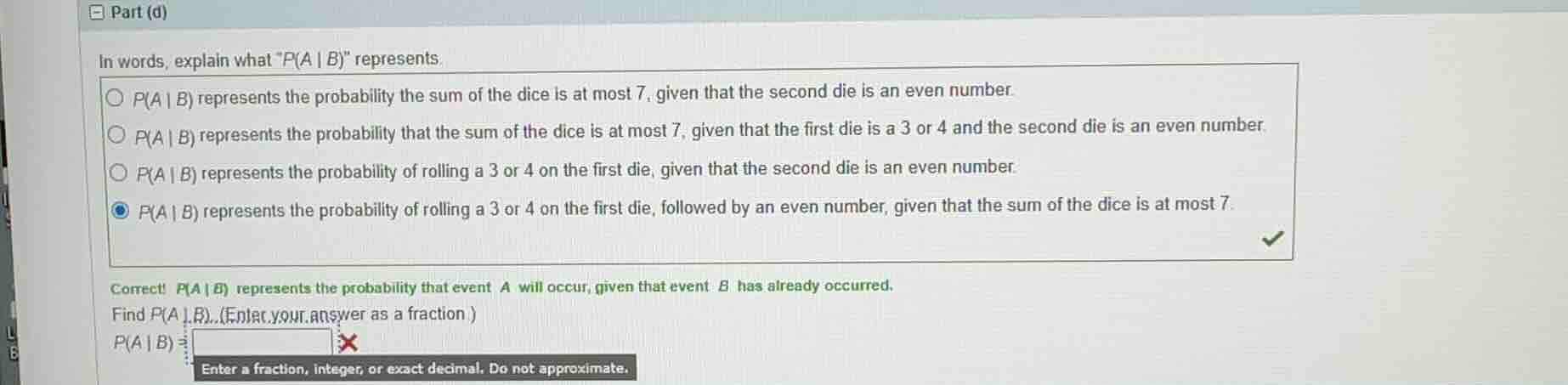
part (d)
in words, explain what ( p(a mid b) ) represents.
- ( p(a mid b) ) represents the probability the sum of the dice is at most 7, given that the second die is an even number.
- ( p(a mid b) ) represents the probability that the sum of the dice is at most 7, given that the first die is a 3 or 4 and the second die is an even number.
- ( p(a mid b) ) represents the probability of rolling a 3 or 4 on the first die, given that the second die is an even number.
- ( p(a mid b) ) represents the probability of rolling a 3 or 4 on the first die, followed by an even number, given that the sum of the dice is at most 7.
correct ( p(a mid b) ) represents the probability that event ( a ) will occur, given that event ( b ) has already occurred.
find ( p(a mid b) ). (enter your answer as a fraction )
( p(a mid b) = ) enter a fraction, integer, or exact decimal. do not approximate.
Step1: Define Events
Let \( A \) be the event of rolling a 3 or 4 on the first die followed by an even number on the second die. Let \( B \) be the event that the sum of the dice is at most 7. We need to find \( P(A|B)=\frac{n(A\cap B)}{n(B)} \), where \( n(A\cap B) \) is the number of outcomes in both \( A \) and \( B \), and \( n(B) \) is the number of outcomes in \( B \).
Step2: Find \( n(B) \) (Sum ≤ 7)
When rolling two dice, the total outcomes are \( 6\times6 = 36 \). The pairs \((x,y)\) where \( x + y\leq7 \):
- \( x = 1 \): \( y = 1,2,3,4,5,6 \) (6 outcomes)
- \( x = 2 \): \( y = 1,2,3,4,5 \) (5 outcomes)
- \( x = 3 \): \( y = 1,2,3,4 \) (4 outcomes)
- \( x = 4 \): \( y = 1,2,3 \) (3 outcomes)
- \( x = 5 \): \( y = 1,2 \) (2 outcomes)
- \( x = 6 \): \( y = 1 \) (1 outcome)
Summing these: \( 6 + 5 + 4 + 3 + 2 + 1=\frac{6\times(6 + 1)}{2}=21 \). So \( n(B)=21 \).
Step3: Find \( n(A\cap B) \) (A ∩ B: first die 3/4, second even, sum ≤7)
- For \( x = 3 \) (first die), second die even (\( y = 2,4,6 \)): check \( 3 + y\leq7 \). \( y = 2,4 \) (since \( 3+6 = 9>7 \)) → 2 outcomes: (3,2), (3,4)
- For \( x = 4 \) (first die), second die even (\( y = 2,4,6 \)): check \( 4 + y\leq7 \). \( y = 2,3 \)? No, \( y \) even: \( y = 2 \) (since \( 4 + 4 = 8>7 \), \( 4+2 = 6\leq7 \)) → 1 outcome: (4,2)
Wait, correction: For \( x = 3 \), even \( y \): \( y = 2,4,6 \). \( 3 + 2 = 5\leq7 \), \( 3 + 4 = 7\leq7 \), \( 3 + 6 = 9>7 \). So \( y = 2,4 \) (2 outcomes). For \( x = 4 \), even \( y \): \( y = 2,4,6 \). \( 4 + 2 = 6\leq7 \), \( 4 + 4 = 8>7 \), \( 4 + 6 = 10>7 \). So \( y = 2 \) (1 outcome). Wait, also \( x = 3 \), \( y = 6 \) is invalid, \( x = 4 \), \( y = 4,6 \) invalid. Wait, another way: \( A \) is (3 or 4 first, even second). So:
- (3,2), (3,4), (3,6) → but (3,6): sum 9 >7, so exclude.
- (4,2), (4,4), (4,6) → (4,4): sum 8 >7, (4,6): sum 10 >7, so only (4,2)
Wait, no: \( A \cap B \) is (first 3/4, second even, sum ≤7). So:
First die 3:
- Second die even (2,4,6). Sum with 3: 3+2=5, 3+4=7, 3+6=9. So valid: (3,2), (3,4) (2 outcomes)
First die 4:
- Second die even (2,4,6). Sum with 4: 4+2=6, 4+4=8, 4+6=10. So valid: (4,2) (1 outcome)
Total \( n(A\cap B)=2 + 1=3 \)? Wait, no, wait (3,6) sum is 9>7, so not in B. (4,4) sum 8>7, (4,6) sum 10>7. So yes, 2 + 1 = 3? Wait, no, wait first die 3: y=2 (sum 5), y=4 (sum 7), y=6 (sum 9). So two valid. First die 4: y=2 (sum 6), y=4 (sum 8), y=6 (sum 10). So one valid. So total 3. Wait, but let's list all B outcomes:
B outcomes (x,y) with x+y ≤7:
(1,1),(1,2),(1,3),(1,4),(1,5),(1,6),
(2,1),(2,2),(2,3),(2,4),(2,5),
(3,1),(3,2),(3,3),(3,4),
(4,1),(4,2),(4,3),
(5,1),(5,2),
(6,1)
Now, A is (x=3 or 4, y even). So in B, find (x=3 or 4, y even):
From B's list:
x=3, y even: (3,2), (3,4) (y=2,4 are even, y=6 not in B)
x=4, y even: (4,2) (y=2 is even, y=4,6 not in B)
So total \( n(A\cap B)=2 + 1=3 \)? Wait, (3,2), (3,4), (4,2) → 3 outcomes.
Wait, but let's check again. B has 21 outcomes (as calculated before: 6+5+4+3+2+1=21). Now, A ∩ B:
x=3, y even, x+y ≤7:
y=2: 3+2=5 ≤7 → yes
y=4: 3+4=7 ≤7 → yes
y=6: 3+6=9 >7 → no
So 2 outcomes.
x=4, y even, x+y ≤7:
y=2: 4+2=6 ≤7 → yes
y=4: 4+4=8 >7 → no
y=6: 4+6=10 >7 → no
So 1 outcome.
Total \( n(A\cap B)=2 + 1=3 \).
Wait, but wait, (4,3) is in B, but y is odd. So no. So yes, 3 outcomes.
Wait, but maybe I made a mistake. Let's list all A ∩ B:
(3,2), (3,4), (4,2). That's 3.
Now, \( n(B)=21 \) (as calculated: 6+5+4+3+2+1=21). Wait, no: 1:6, 2:5, 3:4, 4:3, 5:2, 6:1. Sum: 6+5=11, +4=15, +3=18, +2=20, +1=21. Correct.
So \( P(A|B)=\frac{n(A\cap B)}{n(B)}=\frac{3}{2…

Snap & solve any problem in the app
Get step-by-step solutions on Sovi AI
Photo-based solutions with guided steps
Explore more problems and detailed explanations
\(\frac{1}{7}\)