QUESTION IMAGE
Question
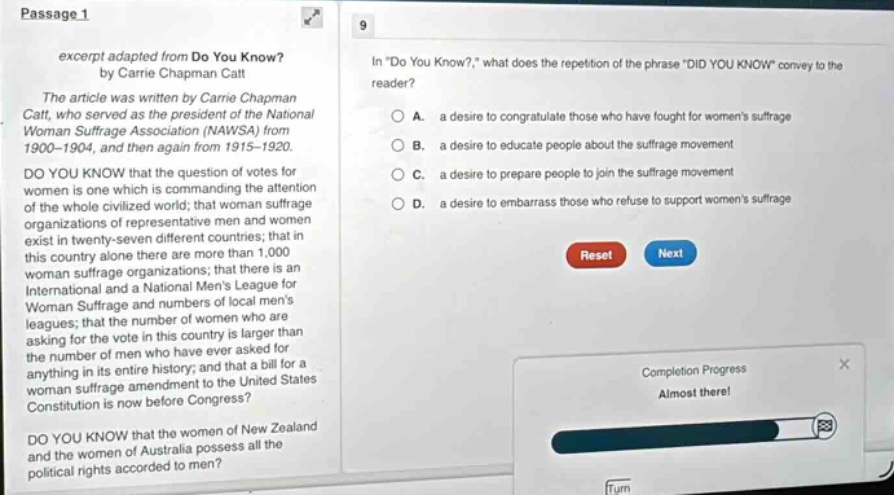
passage 1
excerpt adapted from do you know?
by carrie chapman catt
the article was written by carrie chapman
catt, who served as the president of the national
woman suffrage association (nawsa) from
1900–1904, and then again from 1915–1920.
do you know that the question of votes for
women is one which is commanding the attention
of the whole civilized world; that woman suffrage
organizations of representative men and women
exist in twenty - seven different countries; that in
this country alone there are more than 1,000
woman suffrage organizations; that there is an
international and a national men’s league for
woman suffrage and numbers of local men’s
leagues; that the number of women who are
asking for the vote in this country is larger than
the number of men who have ever asked for
anything in its entire history; and that a bill for a
woman suffrage amendment to the united states
constitution is now before congress?
do you know that the women of new zealand
and the women of australia possess all the
political rights accorded to men?
9
in “do you know?”, what does the repetition of the phrase “did you know” convey to the
reader?
a. a desire to congratulate those who have fought for women’s suffrage
b. a desire to educate people about the suffrage movement
c. a desire to prepare people to join the suffrage movement
d. a desire to embarrass those who refuse to support women’s suffrage
reset next
completion progress
almost there!
(73
fium
The phrase "DID YOU KNOW" is used to present facts about the women's suffrage movement, like the number of organizations, countries with suffrage, and women's rights in other nations. This is to inform (educate) readers about the movement, not congratulate, prepare to join, or embarrass. Option A is incorrect as there's no congratulation. Option C is wrong as it's not about preparing to join. Option D is incorrect as there's no embarrassment intended. So the correct answer is B.

Snap & solve any problem in the app
Get step-by-step solutions on Sovi AI
Photo-based solutions with guided steps
Explore more problems and detailed explanations
B. a desire to educate people about the suffrage movement