QUESTION IMAGE
Question
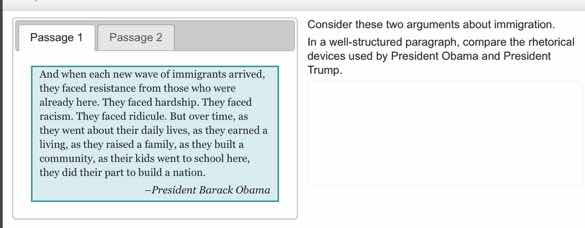
passage 1 passage 2 and when each new wave of immigrants arrived, they faced resistance from those who were already here. they faced hardship. they faced racism. they faced ridicule. but over time, as they went about their daily lives, as they earned a living, as they raised a family, as they built a community, as their kids went to school here, they did their part to build a nation. —president barack obama consider these two arguments about immigration. in a well - structured paragraph, compare the rhetorical devices used by president obama and president trump.
To answer this, we analyze the rhetorical devices in both passages (though only Obama's is fully given here, we can infer a comparison approach).
Step 1: Identify Rhetorical Devices in Obama's Passage
- Anaphora: Repetition of "they faced" (hardship, ridicule, racism) and "as they" (earned a living, raised a family, built a community, kids went to school, did their part) creates rhythm, emphasizes immigrants' struggles and contributions.
- Pathos: Evokes empathy by describing immigrants' hardships (resistance, ridicule, racism) and their positive contributions (earned a living, raised family, built community, built a nation).
Step 2: Anticipate Trump's Rhetorical Devices (Common in Immigration Discourse)
- Ethos/Logos: May appeal to authority (e.g., legal frameworks) or use logical arguments about immigration's impact on jobs, security.
- Diction: Might use more divisive language (e.g., "illegal aliens") to frame immigration as a threat, contrasting with Obama's inclusive "they" (humanizing immigrants).
- Repetition/Parallelism: Could use repetition for emphasis, but with a different tone (e.g., focusing on "law and order" or economic concerns).
Step 3: Structure the Comparison Paragraph
Start with a topic sentence (e.g., "President Obama and President Trump employ distinct rhetorical devices to frame immigration, reflecting contrasting perspectives on immigrants’ roles and the nature of immigration policy."). Then, analyze Obama’s devices (anaphora, pathos, inclusive language) and Trump’s likely devices (ethos/logos, divisive diction, different thematic repetition), explaining how each device shapes the message (e.g., Obama humanizes immigrants as contributors; Trump may frame them as a threat or policy issue). Conclude by noting how rhetoric reflects their broader immigration stances.
For example:
"President Obama and President Trump employ contrasting rhetorical devices to frame immigration, revealing divergent views on immigrants’ place in the nation. Obama uses anaphora (repeating “they faced” and “as they”) to emphasize immigrants’ struggles (resistance, ridicule, racism) and their positive contributions (earning a living, raising families, building a community), evoking pathos to humanize immigrants as integral to nation - building. His inclusive language (“they did their part to build a nation”) fosters empathy and a sense of shared heritage. In contrast, Trump likely uses divisive diction (e.g., “illegal aliens”) to frame immigration as a threat, appealing to ethos (legal authority) or logos (arguments about economic/security impacts) to justify restrictive policies. While Obama’s rhetoric unites by highlighting shared history, Trump’s rhetoric often divides by emphasizing perceived risks, demonstrating how rhetorical choices shape public perception of immigration."
(Note: Since Trump’s passage isn’t provided, this is an informed analysis based on common rhetorical patterns in their immigration discourse. If Trump’s actual text were given, we’d analyze his specific devices directly.)
If we assume the task is to write the comparison paragraph (as the question says "In a well - structured paragraph, compare the rhetorical devices..."), here is the final paragraph:
President Obama and President Trump utilize distinct rhetorical devices to present their views on immigration, which reflects their differing perspectives on immigrants and immigration policy. In his passage, Obama employs anaphora through the repeated phrases “they faced” and “as they”, which serves to e…

Snap & solve any problem in the app
Get step-by-step solutions on Sovi AI
Photo-based solutions with guided steps
Explore more problems and detailed explanations
To answer this, we analyze the rhetorical devices in both passages (though only Obama's is fully given here, we can infer a comparison approach).
Step 1: Identify Rhetorical Devices in Obama's Passage
- Anaphora: Repetition of "they faced" (hardship, ridicule, racism) and "as they" (earned a living, raised a family, built a community, kids went to school, did their part) creates rhythm, emphasizes immigrants' struggles and contributions.
- Pathos: Evokes empathy by describing immigrants' hardships (resistance, ridicule, racism) and their positive contributions (earned a living, raised family, built community, built a nation).
Step 2: Anticipate Trump's Rhetorical Devices (Common in Immigration Discourse)
- Ethos/Logos: May appeal to authority (e.g., legal frameworks) or use logical arguments about immigration's impact on jobs, security.
- Diction: Might use more divisive language (e.g., "illegal aliens") to frame immigration as a threat, contrasting with Obama's inclusive "they" (humanizing immigrants).
- Repetition/Parallelism: Could use repetition for emphasis, but with a different tone (e.g., focusing on "law and order" or economic concerns).
Step 3: Structure the Comparison Paragraph
Start with a topic sentence (e.g., "President Obama and President Trump employ distinct rhetorical devices to frame immigration, reflecting contrasting perspectives on immigrants’ roles and the nature of immigration policy."). Then, analyze Obama’s devices (anaphora, pathos, inclusive language) and Trump’s likely devices (ethos/logos, divisive diction, different thematic repetition), explaining how each device shapes the message (e.g., Obama humanizes immigrants as contributors; Trump may frame them as a threat or policy issue). Conclude by noting how rhetoric reflects their broader immigration stances.
For example:
"President Obama and President Trump employ contrasting rhetorical devices to frame immigration, revealing divergent views on immigrants’ place in the nation. Obama uses anaphora (repeating “they faced” and “as they”) to emphasize immigrants’ struggles (resistance, ridicule, racism) and their positive contributions (earning a living, raising families, building a community), evoking pathos to humanize immigrants as integral to nation - building. His inclusive language (“they did their part to build a nation”) fosters empathy and a sense of shared heritage. In contrast, Trump likely uses divisive diction (e.g., “illegal aliens”) to frame immigration as a threat, appealing to ethos (legal authority) or logos (arguments about economic/security impacts) to justify restrictive policies. While Obama’s rhetoric unites by highlighting shared history, Trump’s rhetoric often divides by emphasizing perceived risks, demonstrating how rhetorical choices shape public perception of immigration."
(Note: Since Trump’s passage isn’t provided, this is an informed analysis based on common rhetorical patterns in their immigration discourse. If Trump’s actual text were given, we’d analyze his specific devices directly.)
If we assume the task is to write the comparison paragraph (as the question says "In a well - structured paragraph, compare the rhetorical devices..."), here is the final paragraph:
President Obama and President Trump utilize distinct rhetorical devices to present their views on immigration, which reflects their differing perspectives on immigrants and immigration policy. In his passage, Obama employs anaphora through the repeated phrases “they faced” and “as they”, which serves to emphasize both the hardships immigrants endured (such as resistance, ridicule, and racism) and their positive contributions to the nation (earning a living, raising families, building communities, and helping to build the nation). This anaphora, combined with pathos, evokes empathy from the audience by highlighting the human side of immigration—portraying immigrants as hard - working, family - oriented individuals who are integral to the country’s development. His use of inclusive language, referring to immigrants as “they” and emphasizing their role in nation - building, creates a sense of unity and shared heritage. In contrast, Trump, in his discussions on immigration, often uses divisive diction (e.g., “illegal aliens”) to frame immigration as a threat to law and order or economic stability. He may also appeal to ethos by referencing legal frameworks or logos by presenting arguments about immigration’s impact on jobs and national security. While Obama’s rhetoric seeks to unify by emphasizing the shared history of immigration and immigrants’ contributions, Trump’s rhetoric tends to divide by focusing on perceived risks, showing how rhetorical choices shape public understanding of immigration.