QUESTION IMAGE
Question
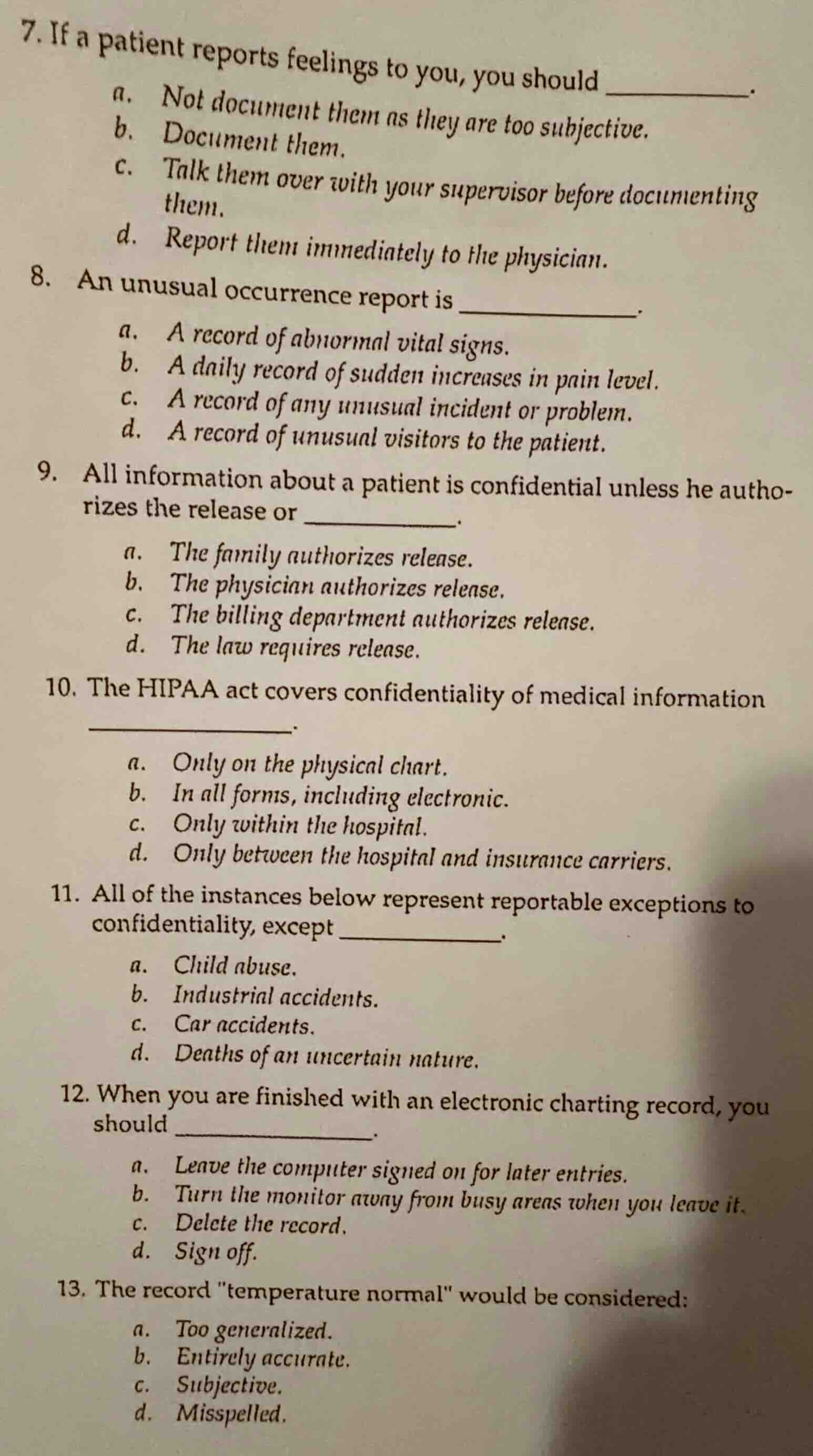
- if a patient reports feelings to you, you should ______.
a. not document them as they are too subjective.
b. document them.
c. talk them over with your supervisor before documenting them.
d. report them immediately to the physician.
- an unusual occurrence report is ______.
a. a record of abnormal vital signs.
b. a daily record of sudden increases in pain level.
c. a record of any unusual incident or problem.
d. a record of unusual visitors to the patient.
- all information about a patient is confidential unless he authorizes the release or ______.
a. the family authorizes release.
b. the physician authorizes release.
c. the billing department authorizes release.
d. the law requires release.
- the hipaa act covers confidentiality of medical information ______.
a. only on the physical chart.
b. in all forms, including electronic.
c. only within the hospital.
d. only between the hospital and insurance carriers.
- all of the instances below represent reportable exceptions to confidentiality, except ______.
a. child abuse.
b. industrial accidents.
c. car accidents.
d. deaths of an uncertain nature.
- when you are finished with an electronic charting record, you should ______.
a. leave the computer signed on for later entries.
b. turn the monitor away from busy areas when you leave it.
c. delete the record.
d. sign off.
- the record \temperature normal\ would be considered:
a. too generalized.
b. entirely accurate.
c. subjective.
d. misspelled.
Question 7
In healthcare documentation, patient feelings (subjective data) are important to document as they provide context about the patient's experience. Option a is wrong as subjective data is documented. Option c is unnecessary; feelings can be documented without supervisor discussion first. Option d is incorrect as reporting to a physician isn't needed for just reporting feelings—documentation is the first step. So option b is correct.
An unusual occurrence report (also called an incident report) is for recording any unusual incident or problem in a healthcare setting. Option a is about vital signs (part of regular charting), option b is daily pain (regular assessment), option d is about visitors (not an "occurrence" in the incident - report sense). So option c matches the definition.
Patient confidentiality is protected unless the patient authorizes release or the law requires it (e.g., court orders, mandatory reporting situations). Family or physician authorization isn't a standard exception unless the law or patient allows. The billing department has no authority to override confidentiality. So option d is correct.

Snap & solve any problem in the app
Get step-by-step solutions on Sovi AI
Photo-based solutions with guided steps
Explore more problems and detailed explanations
b. Document them.