QUESTION IMAGE
Question
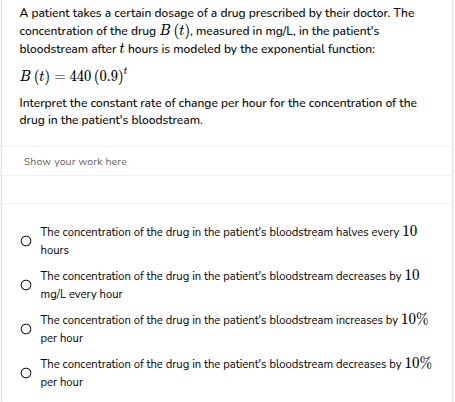
a patient takes a certain dosage of a drug prescribed by their doctor. the concentration of the drug ( b(t) ), measured in mg/l, in the patients bloodstream after ( t ) hours is modeled by the exponential function: ( b(t) = 440(0.9)^t ) interpret the constant rate of change per hour for the concentration of the drug in the patients bloodstream. show your work here (\bigcirc) the concentration of the drug in the patients bloodstream halves every 10 hours (\bigcirc) the concentration of the drug in the patients bloodstream decreases by 10 mg/l every hour (\bigcirc) the concentration of the drug in the patients bloodstream increases by 10% per hour (\bigcirc) the concentration of the drug in the patients bloodstream decreases by 10% per hour
Step1: Recall exponential decay formula
The general form of an exponential function is \( B(t)=a(b)^t \), where \( a \) is the initial amount, and \( b \) is the base that determines the rate of change. If \( 0 < b < 1 \), it represents exponential decay, and the rate of decay can be found by \( 1 - b \) (expressed as a percentage).
Step2: Analyze the given function \( B(t) = 440(0.9)^t \)
Here, the base \( b = 0.9 \). Since \( 0.9 < 1 \), this is an exponential decay function. To find the rate of change per hour, we calculate \( 1 - 0.9 = 0.1 \), which is \( 10\% \) when expressed as a percentage. This means the concentration of the drug in the patient's bloodstream is decreasing by \( 10\% \) per hour.
Let's analyze the other options:
- Option 1: To check if it halves every 10 hours, we would set \( 440(0.9)^{10}\approx440\times0.3487\approx153.43 \), and \( \frac{440}{2} = 220 \). Since \( 153.43
eq220 \), it does not halve every 10 hours.
- Option 2: The function is exponential, not linear, so it does not decrease by a constant amount (10 mg/L) every hour. For example, at \( t = 1 \), \( B(1)=440\times0.9 = 396 \), the change from \( t = 0 \) (where \( B(0)=440 \)) is \( 440 - 396 = 44 \) mg/L, not 10 mg/L. At \( t = 2 \), \( B(2)=440\times(0.9)^2 = 440\times0.81 = 356.4 \), the change from \( t = 1 \) is \( 396 - 356.4 = 39.6 \) mg/L, which is not 10 mg/L.
- Option 3: Since the base is less than 1, it's decay, not increase, so this option is incorrect.

Snap & solve any problem in the app
Get step-by-step solutions on Sovi AI
Photo-based solutions with guided steps
Explore more problems and detailed explanations
D. The concentration of the drug in the patient's bloodstream decreases by 10% per hour