QUESTION IMAGE
Question
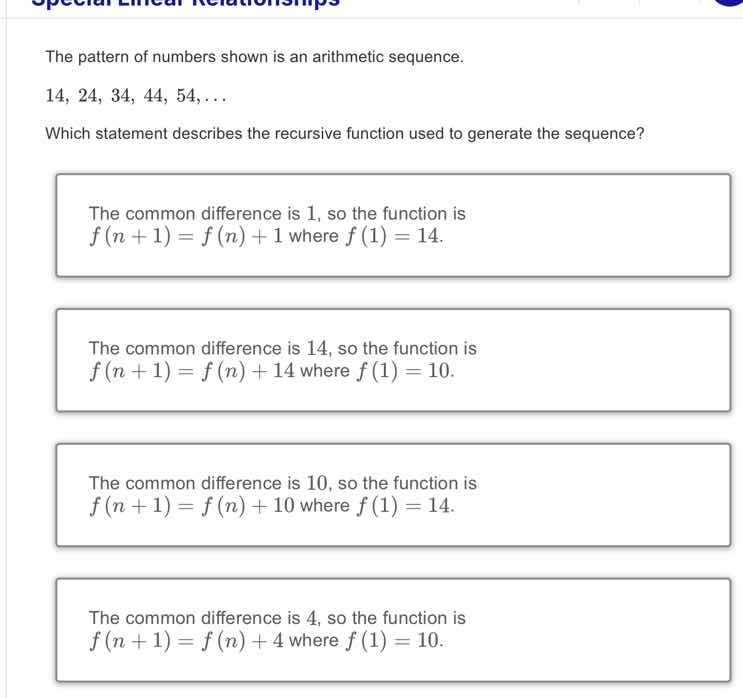
the pattern of numbers shown is an arithmetic sequence.
14, 24, 34, 44, 54, …
which statement describes the recursive function used to generate the sequence?
the common difference is 1, so the function is
$f(n + 1) = f(n) + 1$ where $f(1) = 14$.
the common difference is 14, so the function is
$f(n + 1) = f(n) + 14$ where $f(1) = 10$.
the common difference is 10, so the function is
$f(n + 1) = f(n) + 10$ where $f(1) = 14$.
the common difference is 4, so the function is
$f(n + 1) = f(n) + 4$ where $f(1) = 10$.
Step1: Find common difference
To find the common difference \( d \) in an arithmetic sequence, we subtract consecutive terms. For the sequence \( 14, 24, 34, 44, 54, \dots \), take \( 24 - 14 = 10 \), \( 34 - 24 = 10 \), etc. So the common difference \( d = 10 \).
Step2: Identify recursive function
The first term \( f(1) = 14 \). In a recursive arithmetic sequence, the formula is \( f(n + 1)=f(n)+d \). Substituting \( d = 10 \) and \( f(1)=14 \), we get \( f(n + 1)=f(n)+10 \) with \( f(1)=14 \).

Snap & solve any problem in the app
Get step-by-step solutions on Sovi AI
Photo-based solutions with guided steps
Explore more problems and detailed explanations
The common difference is 10, so the function is \( f(n + 1)=f(n)+10 \) where \( f(1)=14 \).