QUESTION IMAGE
Question
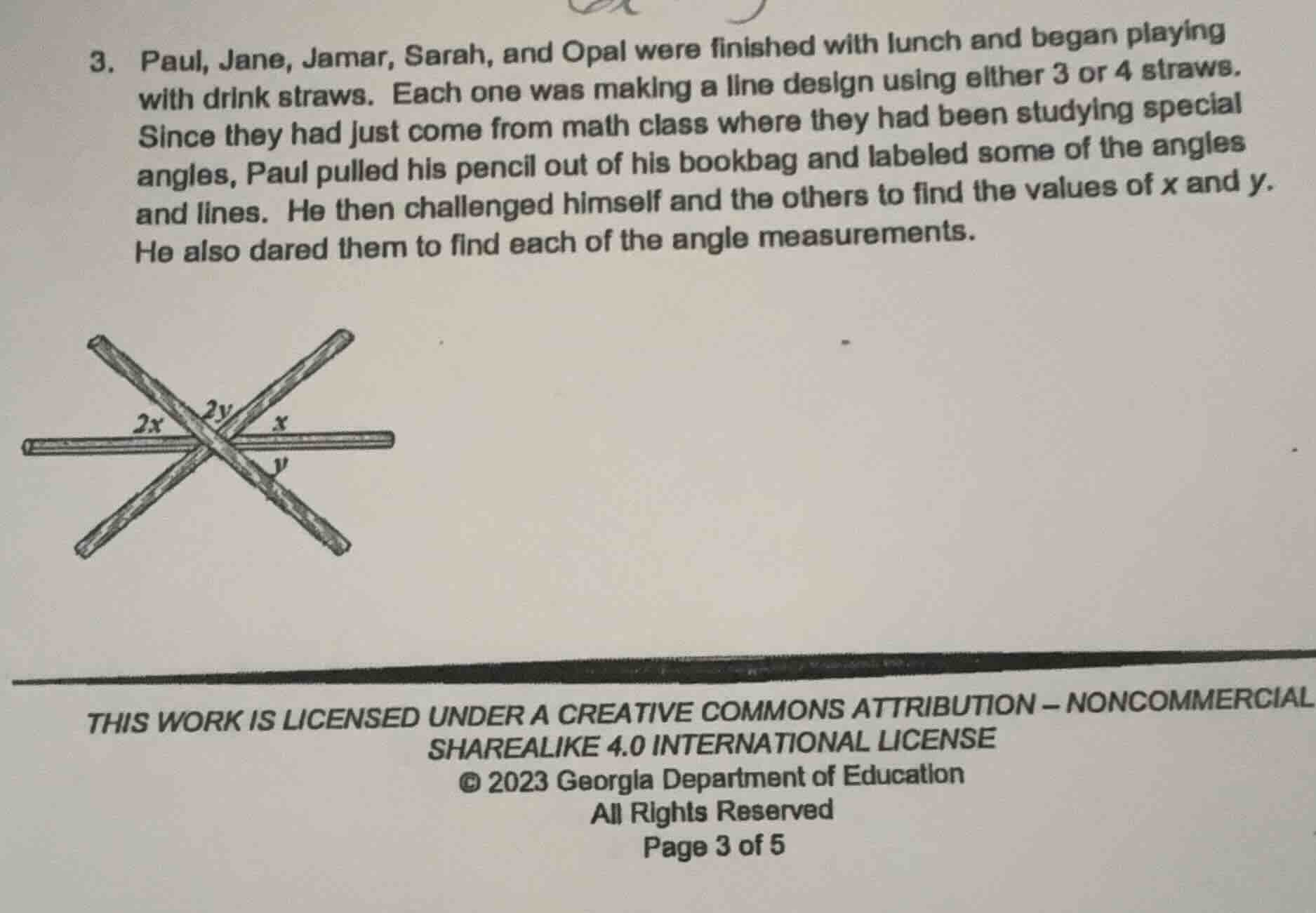
- paul, jane, jamar, sarah, and opal were finished with lunch and began playing with drink straws. each one was making a line design using either 3 or 4 straws. since they had just come from math class where they had been studying special angles, paul pulled his pencil out of his bookbag and labeled some of the angles and lines. he then challenged himself and the others to find the values of x and y. he also dared them to find each of the angle measurements.
Step1: Identify linear pair and vertical angles
From the diagram, \(2x\), \(2y\), and \(x\) are on a straight line (linear pair), so \(2x + 2y+x=180^\circ\) (sum of angles on a straight line is \(180^\circ\)). Also, vertical angles: \(2x\) and \(x + y\) (wait, actually, looking at the angles, \(2x\) and \(x\) with \(2y\) and \(y\) – maybe better to see that \(2x\) and \(x\) are adjacent to \(2y\) and \(y\). Wait, actually, the angles \(2x\), \(2y\), and \(x\) form a linear pair? Wait, no, three angles? Wait, maybe two lines intersecting, so vertical angles. Wait, the horizontal line and the two slanted lines. Let's re-express:
Looking at the angles around the intersection: the angle \(2x\), \(2y\), \(x\), and \(y\) – actually, the straight line (horizontal) has angles \(2x\), \(2y\), and \(x\)? No, maybe two angles: \(2x + x=180^\circ\)? Wait, no, the diagram has \(2x\), \(2y\), \(x\), and \(y\) around the intersection. Wait, actually, the sum of angles on a straight line is \(180^\circ\), so \(2x + 2y + x=180^\circ\)? No, maybe \(2x + x=180^\circ - 2y\)? Wait, no, let's use vertical angles. The angle \(2x\) and the angle opposite to it (which is \(x + y\))? Wait, no, the angle \(2y\) and \(y\) are adjacent? Wait, maybe the correct approach is:
From the diagram, the angles \(2x\), \(2y\), \(x\), and \(y\) – the sum of angles around a point is \(360^\circ\), but we have two straight lines, so linear pairs. Let's take the horizontal line: the angles on it are \(2x\), \(2y\), and \(x\)? No, that can't be. Wait, maybe the horizontal line has angles \(2x\) and \(x\) with the slanted line, and the other slanted line has \(2y\) and \(y\). Wait, actually, the angle \(2x\) and \(x\) are supplementary to the angle \(2y + y\)? No, let's use the fact that \(2x\) and \(x\) are adjacent to \(2y\) and \(y\) such that \(2x + 2y + x + y=180^\circ\times2 = 360^\circ\)? No, that's the sum around a point. Wait, no, two intersecting lines form vertical angles. Wait, maybe the correct equations are:
- \(2x + x=180^\circ - 2y\) (no, that's not right). Wait, let's look at the angles: \(2x\) and \(x\) are on a straight line with \(2y\)? Wait, maybe the angle \(2x\) and \(x\) are supplementary to \(2y + y\). Wait, no, let's use the fact that \(2x = x + y\) (vertical angles)? Wait, no, \(2y = y + x\)? Wait, that would be if the lines are such that \(2x = x + y\) (so \(x = y\)) and \(2y = y + x\) (same). Then, the sum of angles on a straight line: \(2x + 2y + x=180^\circ\)? No, if \(x = y\), then \(2x + 2x + x=180^\circ\) → \(5x=180^\circ\) → \(x = 36^\circ\), \(y = 36^\circ\). But that seems off. Wait, maybe the correct equations are:
From the diagram, the angle \(2x\) and \(x\) are adjacent to \(2y\) and \(y\) such that \(2x + 2y = 180^\circ\) (linear pair) and \(x + y = 180^\circ - 2x\)? No, this is confusing. Wait, let's start over.
The key is that \(2x\) and \(x\) are on a straight line with \(2y\) and \(y\)? Wait, no, the horizontal line has angles \(2x\), \(2y\), and \(x\) – no, three angles on a straight line would sum to \(180^\circ\), so \(2x + 2y + x = 180^\circ\) → \(3x + 2y = 180^\circ\). Also, the vertical angles: \(2x = x + y\) (because the angle opposite to \(2x\) is \(x + y\))? Wait, if \(2x = x + y\), then \(x = y\). Substitute into \(3x + 2y = 180^\circ\): \(3x + 2x = 180^\circ\) → \(5x = 180^\circ\) → \(x = 36^\circ\), so \(y = 36^\circ\). Then, \(2x = 72^\circ\), \(2y = 72^\circ\), \(x = 36^\circ\), \(y = 36^\circ\). Let's check: \(2x + 2y + x = 72 + 72 + 36 = 180\), which works. Also, vertical angles: \(2x = 72\) and \(x + y = 36…

Snap & solve any problem in the app
Get step-by-step solutions on Sovi AI
Photo-based solutions with guided steps
Explore more problems and detailed explanations
\(x = 36^\circ\), \(y = 36^\circ\); angle measurements: \(2x = 72^\circ\), \(2y = 72^\circ\), \(x = 36^\circ\), \(y = 36^\circ\)