QUESTION IMAGE
Question
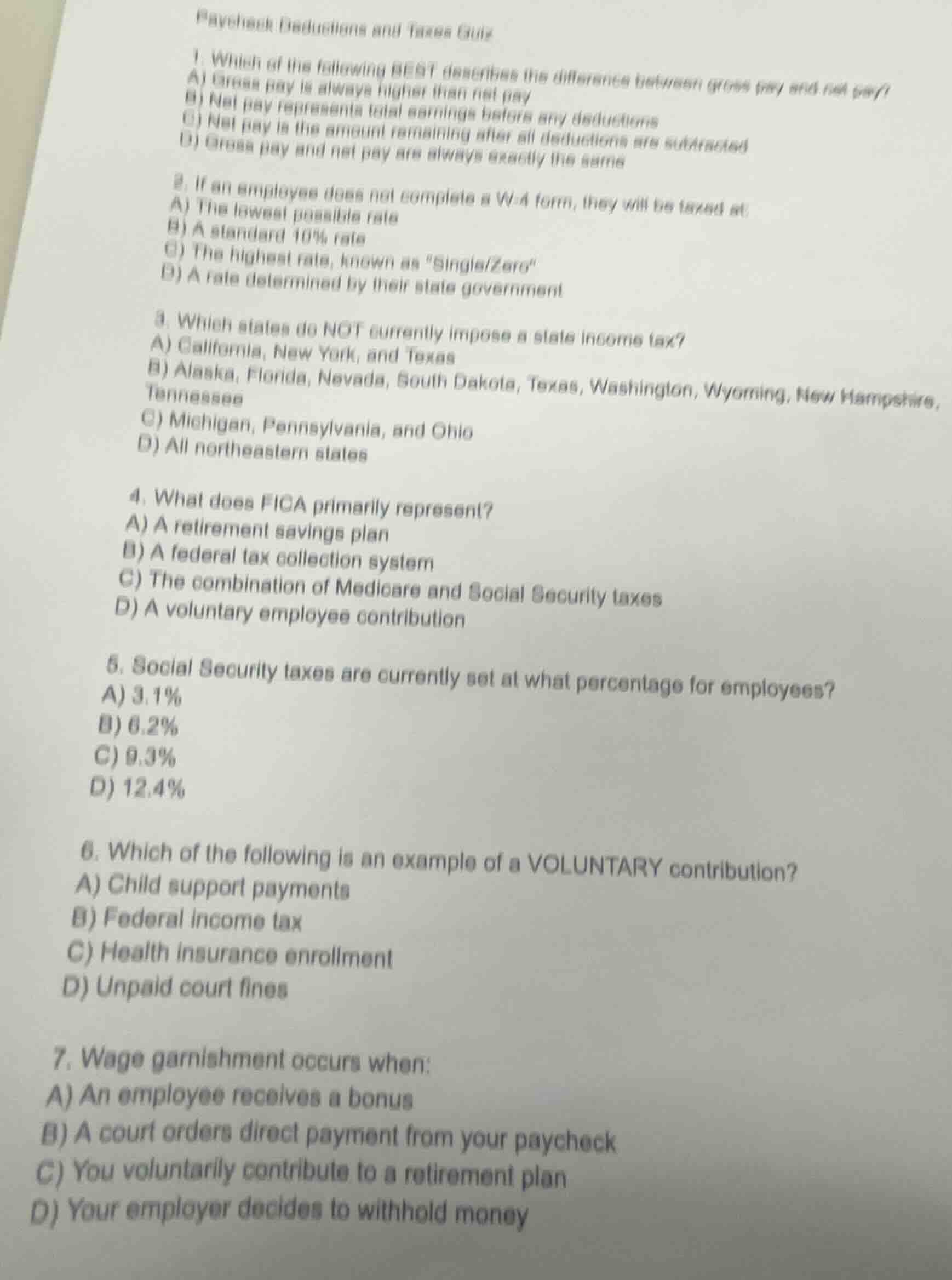
paycheck deductions and taxes quiz
- which of the following best describes the difference between gross pay and net pay?
a) gross pay is always higher than net pay
b) net pay represents total earnings before any deductions
c) net pay is the amount remaining after all deductions are subtracted
d) gross pay and net pay are always exactly the same
- if an employee does not complete a w-4 form, they will be taxed at:
a) the lowest possible rate
b) a standard 10% rate
c) the highest rate, known as \single/zero\
d) a rate determined by their state government
- which states do not currently impose a state income tax?
a) california, new york, and texas
b) alaska, florida, nevada, south dakota, texas, washington, wyoming, new hampshire, tennessee
c) michigan, pennsylvania, and ohio
d) all northeastern states
- what does fica primarily represent?
a) a retirement savings plan
b) a federal tax collection system
c) the combination of medicare and social security taxes
d) a voluntary employee contribution
- social security taxes are currently set at what percentage for employees?
a) 3.1%
b) 6.2%
c) 9.3%
d) 12.4%
- which of the following is an example of a voluntary contribution?
a) child support payments
b) federal income tax
c) health insurance enrollment
d) unpaid court fines
- wage garnishment occurs when:
a) an employee receives a bonus
b) a court orders direct payment from your paycheck
c) you voluntarily contribute to a retirement plan
d) your employer decides to withhold money
- Gross pay is total earnings before deductions; net pay is what's left after all deductions, so option C is correct.
- Employees who don't submit a W-4 are taxed at the highest default "Single/Zero" rate.
- The listed states in option B have no state income tax (some have limited taxes on interest/dividends but no broad income tax).
- FICA combines Social Security and Medicare taxes.
- The employee portion of Social Security tax is 6.2% (the total 12.4% is split between employee and employer).
- Health insurance enrollment is a voluntary deduction; others are mandatory.
- Wage garnishment is court-ordered direct paycheck deduction for debts.

Snap & solve any problem in the app
Get step-by-step solutions on Sovi AI
Photo-based solutions with guided steps
Explore more problems and detailed explanations
- C) Net pay is the amount remaining after all deductions are subtracted
- C) The highest rate, known as "Single/Zero"
- B) Alaska, Florida, Nevada, South Dakota, Texas, Washington, Wyoming, New Hampshire, Tennessee
- C) The combination of Medicare and Social Security taxes
- B) 6.2%
- C) Health insurance enrollment
- B) A court orders direct payment from your paycheck