QUESTION IMAGE
Question
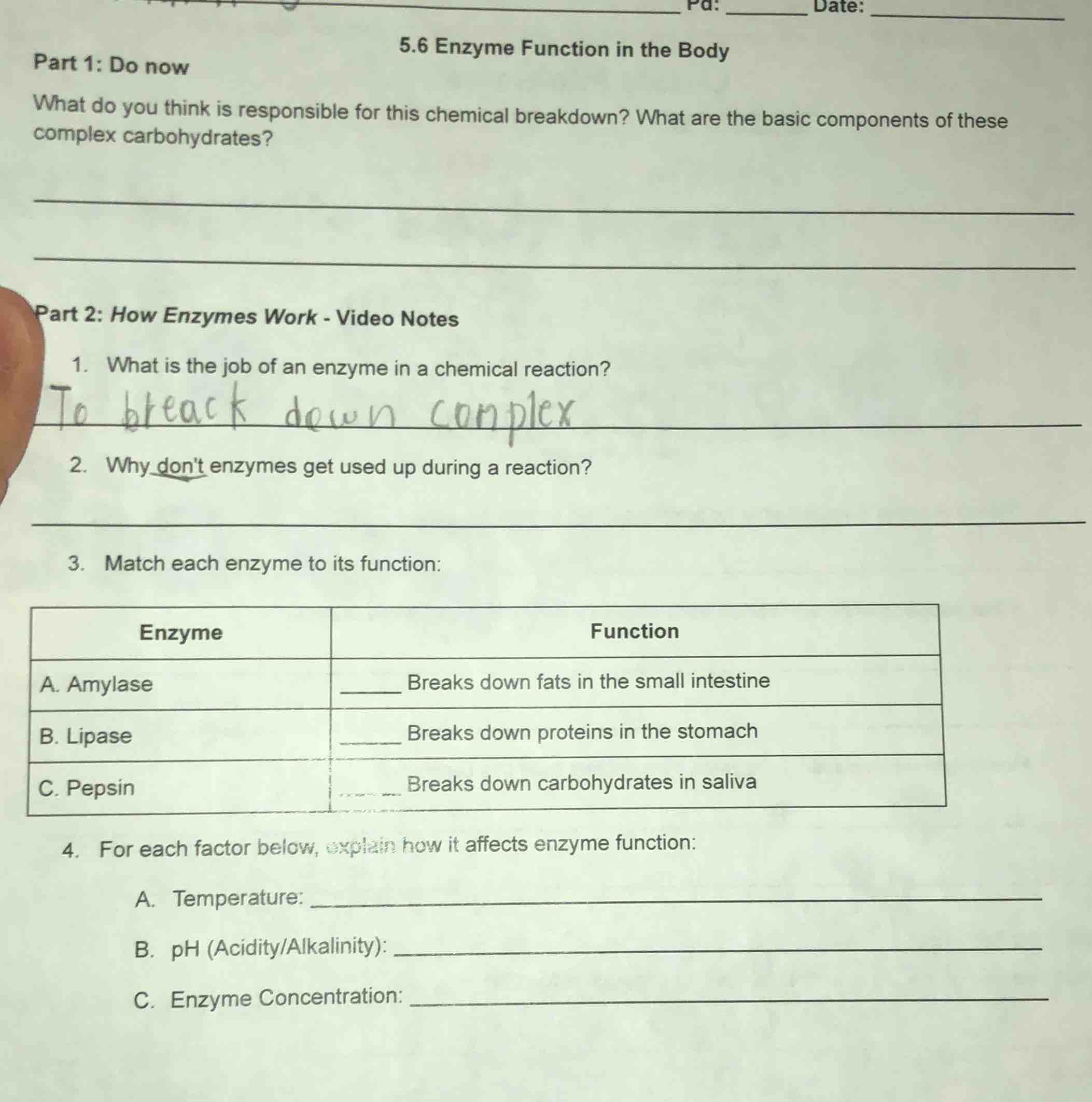
pd: ____ date: __5.6 enzyme function in the bodypart 1: do nowwhat do you think is responsible for this chemical breakdown? what are the basic components of these complex carbohydrates?part 2: how enzymes work - video notes1. what is the job of an enzyme in a chemical reaction?to break down complex2. why dont enzymes get used up during a reaction?3. match each enzyme to its function:| enzyme | function || ---- | ---- || a. amylase | __ breaks down fats in the small intestine || b. lipase | __ breaks down proteins in the stomach || c. pepsin | __ breaks down carbohydrates in saliva |4. for each factor below, explain how it affects enzyme function:a. temperature: ___________b. ph (acidity/alkalinity): ___________c. enzyme concentration: _____________
Part 1:
Enzymes (like amylase) drive complex carbohydrate breakdown; complex carbs are made of monosaccharides (e.g., glucose).
Part 2:
- Enzymes lower reaction activation energy to speed up reactions (the partial answer is incomplete; this is the full job).
- Enzymes are catalysts that remain chemically unchanged, so they are reused.
- Match each enzyme to its known biological function: amylase acts on carbohydrates in saliva, lipase breaks down fats in the small intestine, pepsin breaks down stomach proteins.
- A. Temperature: Enzymes have an optimal temperature; too low slows activity, too high denatures them, stopping function.
B. pH: Each enzyme has an optimal pH; deviations denature the enzyme, reducing or stopping function.
C. Enzyme Concentration: Higher concentration speeds reaction rate (until substrate is limited), as more active sites are available.

Snap & solve any problem in the app
Get step-by-step solutions on Sovi AI
Photo-based solutions with guided steps
Explore more problems and detailed explanations
Part 1:
Enzymes (specifically carbohydrate-digesting enzymes like amylase) are responsible for the chemical breakdown of complex carbohydrates. The basic components of complex carbohydrates are monosaccharides (simple sugars such as glucose).
Part 2:
- To lower the activation energy of the reaction, speeding it up (without being consumed).
- Enzymes are biological catalysts; they are not chemically altered during the reaction, so they can be reused.
3.
| Enzyme | Function |
|---|---|
| B. Lipase | Breaks down fats in the small intestine |
| C. Pepsin | Breaks down proteins in the stomach |
4.
A. Temperature: Low temp slows enzyme activity; optimal temp maximizes it; high temp denatures enzymes, stopping function.
B. pH (Acidity/Alkalinity): Enzymes have an optimal pH; moving outside this range denatures enzymes, reducing their function.
C. Enzyme Concentration: Higher enzyme concentration increases reaction rate (until substrate runs out), as more active sites are available for substrates.