QUESTION IMAGE
Question
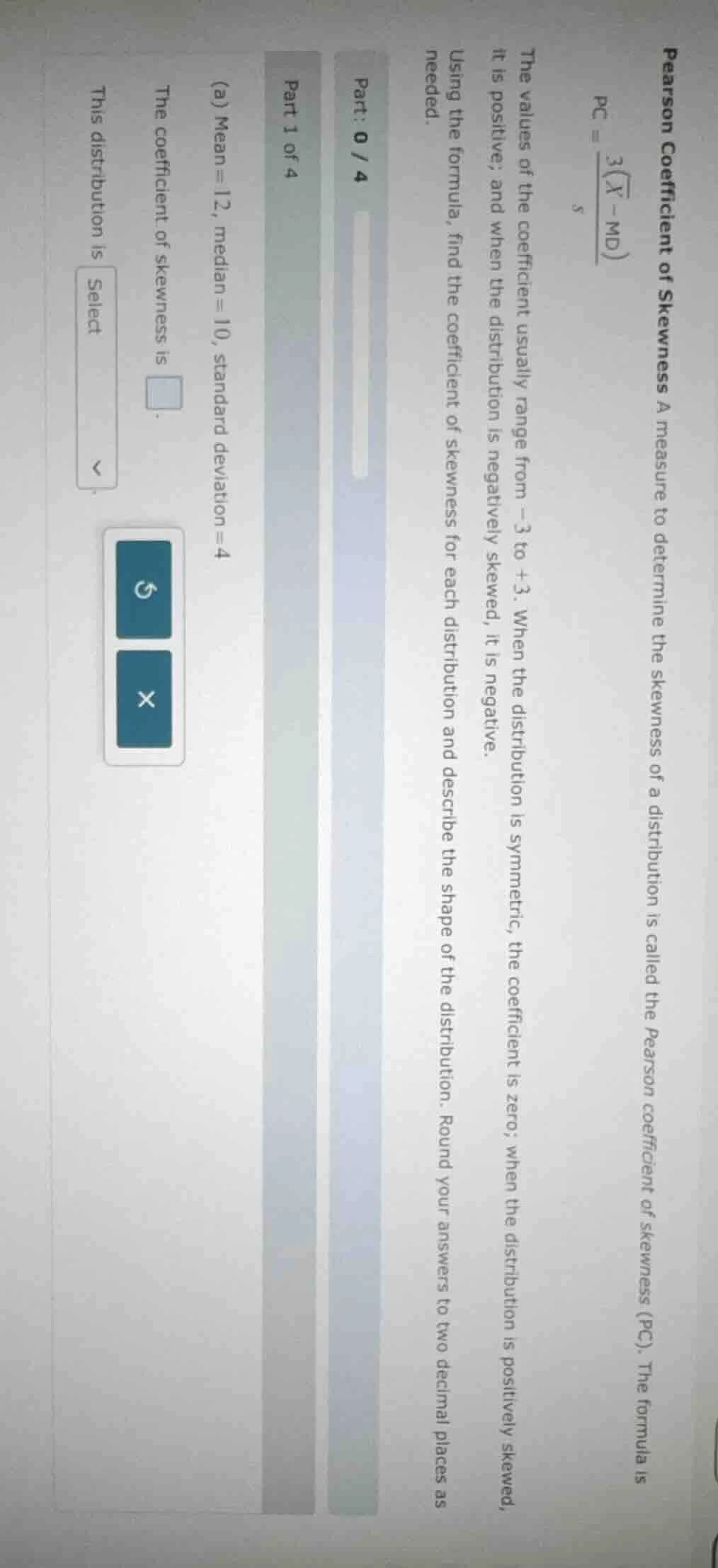
pearson coefficient of skewness a measure to determine the skewness of a distribution is called the pearson coefficient of skewness (pc). the formula is \\( pc = \frac{3(\bar{x} - md)}{s} \\) the values of the coefficient usually range from \\( -3 \\) to \\( +3 \\). when the distribution is symmetric, the coefficient is zero; when the distribution is positively skewed, it is positive; and when the distribution is negatively skewed, it is negative. using the formula, find the coefficient of skewness for each distribution and describe the shape of the distribution. round your answers to two decimal places as needed. part: 0 / 4 part 1 of 4 (a) mean = 12, median = 10, standard deviation = 4 the coefficient of skewness is \\( \square \\). this distribution is \\( \text{select} \\).
Step1: Identify given values
$\bar{X}=12$, $\text{MD}=10$, $s=4$
Step2: Substitute into skewness formula
$\text{PC} = \frac{3(\bar{X}-\text{MD})}{s} = \frac{3(12-10)}{4}$
Step3: Calculate numerator first
$3(12-10)=3\times2=6$
Step4: Compute final coefficient
$\text{PC} = \frac{6}{4}=1.50$
Step5: Classify distribution shape
Positive PC means positively skewed.

Snap & solve any problem in the app
Get step-by-step solutions on Sovi AI
Photo-based solutions with guided steps
Explore more problems and detailed explanations
The coefficient of skewness is 1.50.
This distribution is positively skewed.