QUESTION IMAGE
Question
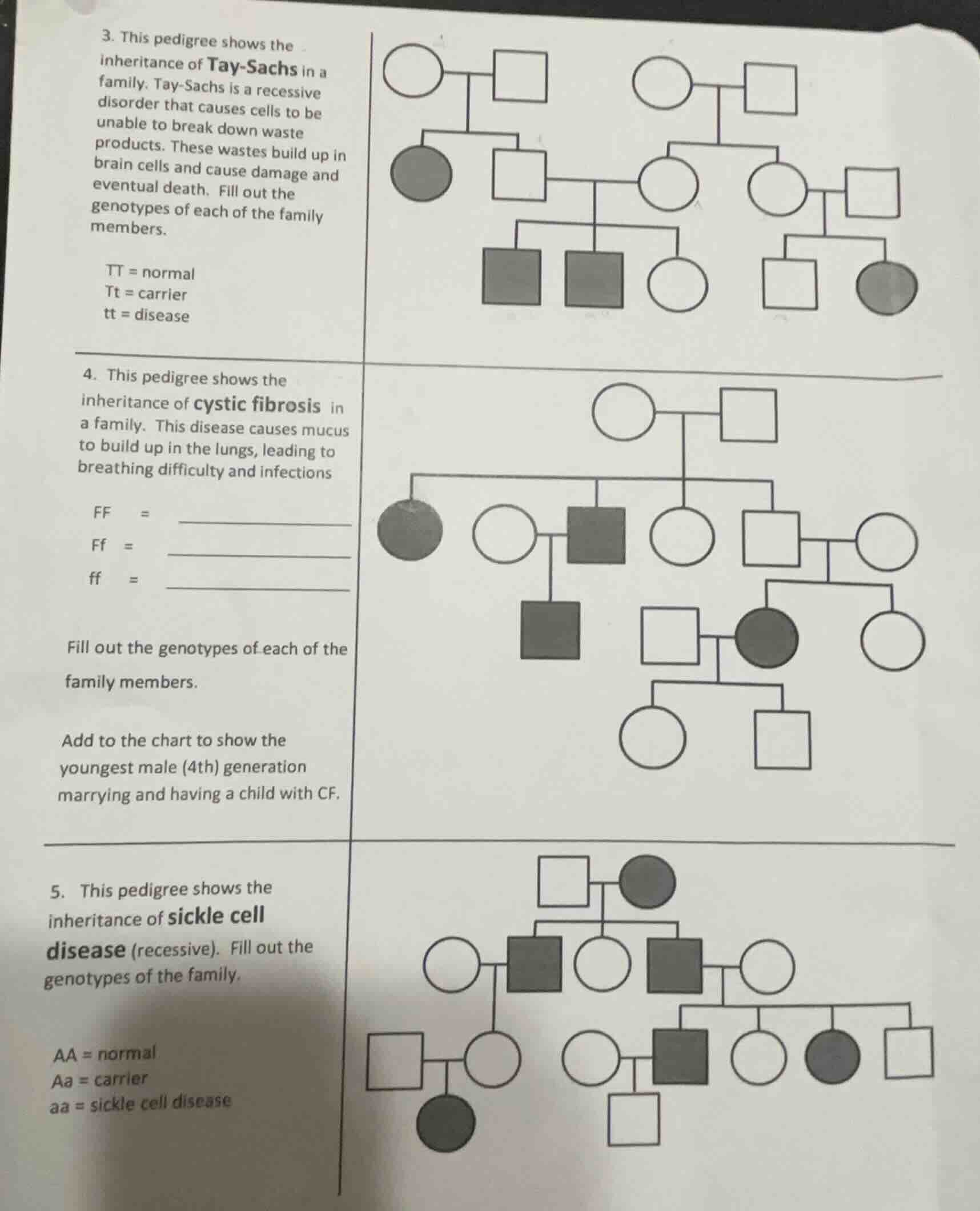
- this pedigree shows the inheritance of tay - sachs in a family. tay - sachs is a recessive disorder that causes cells to be unable to break down waste products. these wastes build up in brain cells and cause damage and eventual death. fill out the genotypes of each of the family members.
tt = normal
tt = carrier
tt = disease
- this pedigree shows the inheritance of cystic fibrosis in a family. this disease causes mucus to build up in the lungs, leading to breathing difficulty and infections
ff =
ff =
ff =
fill out the genotypes of each of the family members.
add to the chart to show the youngest male (4th) generation marrying and having a child with cf.
- this pedigree shows the inheritance of sickle cell disease (recessive). fill out the genotypes of the family.
aa = normal
aa = carrier
aa = sickle cell disease
Response
Question 4 (Cystic Fibrosis Pedigree)
Step 1: Define Genotypes
Cystic fibrosis is a recessive disorder. So:
- \( FF \): Normal (homozygous dominant, no disease alleles)
- \( Ff \): Carrier (heterozygous, has one disease allele but does not show symptoms)
- \( ff \): Disease (homozygous recessive, has two disease alleles and shows symptoms)
Step 2: Analyze Pedigree (General Approach for Filling Genotypes)
- Affected Individuals (Filled Symbols): Must be \( ff \) (since recessive, need two recessive alleles).
- Parents of Affected Individuals: If a child is \( ff \), both parents must contribute an \( f \) allele. So parents of an affected child are either \( Ff \) (carrier) or \( ff \) (affected). But if parents are not affected, they must be \( Ff \) (because they don't show the disease, so can't be \( ff \), but they passed on an \( f \) to the affected child).
- Unaffected Individuals with Affected Relatives: If an individual is unaffected but has an affected sibling/child, they may be \( Ff \) (carrier) or \( FF \) (normal). But if their parents are carriers (\( Ff \)), they could be \( FF \) (25% chance), \( Ff \) (50% chance), or \( ff \) (25% chance, but \( ff \) would be affected).
Step 3: Example Genotype Filling (Using the Pedigree Structure)
- First Generation (Top): The couple (circle and square) have an affected daughter (filled circle). So the parents must be \( Ff \) (since they are unaffected but have an affected child).
- Second Generation: The affected male (filled square) is \( ff \). His parents (from first generation) are \( Ff \) and \( Ff \) (as above). His siblings: the unaffected circles and squares could be \( FF \) or \( Ff \), but since their parents are \( Ff \), they have a chance to be carriers.
- Third Generation: The affected male (filled square) has a mother who is \( Ff \) (from second generation, unaffected) and father who is \( ff \) (affected). So the mother (unaffected) must be \( Ff \) (to pass \( f \) to the \( ff \) child). The affected female (filled circle) in the third generation: her parents are both \( Ff \) (since they are unaffected but have an affected child).
- Fourth Generation: The youngest male (unaffected square) in the 4th generation: if he marries and has a child with CF (\( ff \)), his wife must be at least a carrier (\( Ff \)) or affected (\( ff \)). If he is a carrier (\( Ff \)) and marries a carrier (\( Ff \)), there is a 25% chance of an \( ff \) child. If he is \( FF \), he can't have an \( ff \) child (since he can only pass \( F \)). So to have a child with CF, he must be \( Ff \) (carrier) and his spouse must be \( Ff \) or \( ff \).
Question 3 (Tay - Sachs Pedigree)
Step 1: Recall Tay - Sachs is Recessive
- \( TT \): Normal
- \( Tt \): Carrier
- \( tt \): Disease (affected)
Step 2: Analyze Pedigree
- Affected Individuals (Filled Symbols): \( tt \)
- Parents of Affected Individuals: If a child is \( tt \), parents must be \( Tt \) (if parents are unaffected) or \( tt \) (if affected). For example, the first affected female (filled circle) has parents who are \( Tt \) (unaffected, since they are open symbols).
- Siblings of Affected Individuals: The unaffected brother of the first affected female: since parents are \( Tt \) and \( Tt \), he could be \( TT \) or \( Tt \) (25% \( TT \), 50% \( Tt \), 25% \( tt \); but \( tt \) would be affected, so he is \( TT \) or \( Tt \)).
- Subsequent Generations: The two affected males in the third generation: their parents are \( Tt \) (father, f…

Snap & solve any problem in the app
Get step-by-step solutions on Sovi AI
Photo-based solutions with guided steps
Explore more problems and detailed explanations
(Question 4 Genotype Definitions)
\( FF \): Normal; \( Ff \): Carrier; \( ff \): Disease