QUESTION IMAGE
Question
pedigrees:
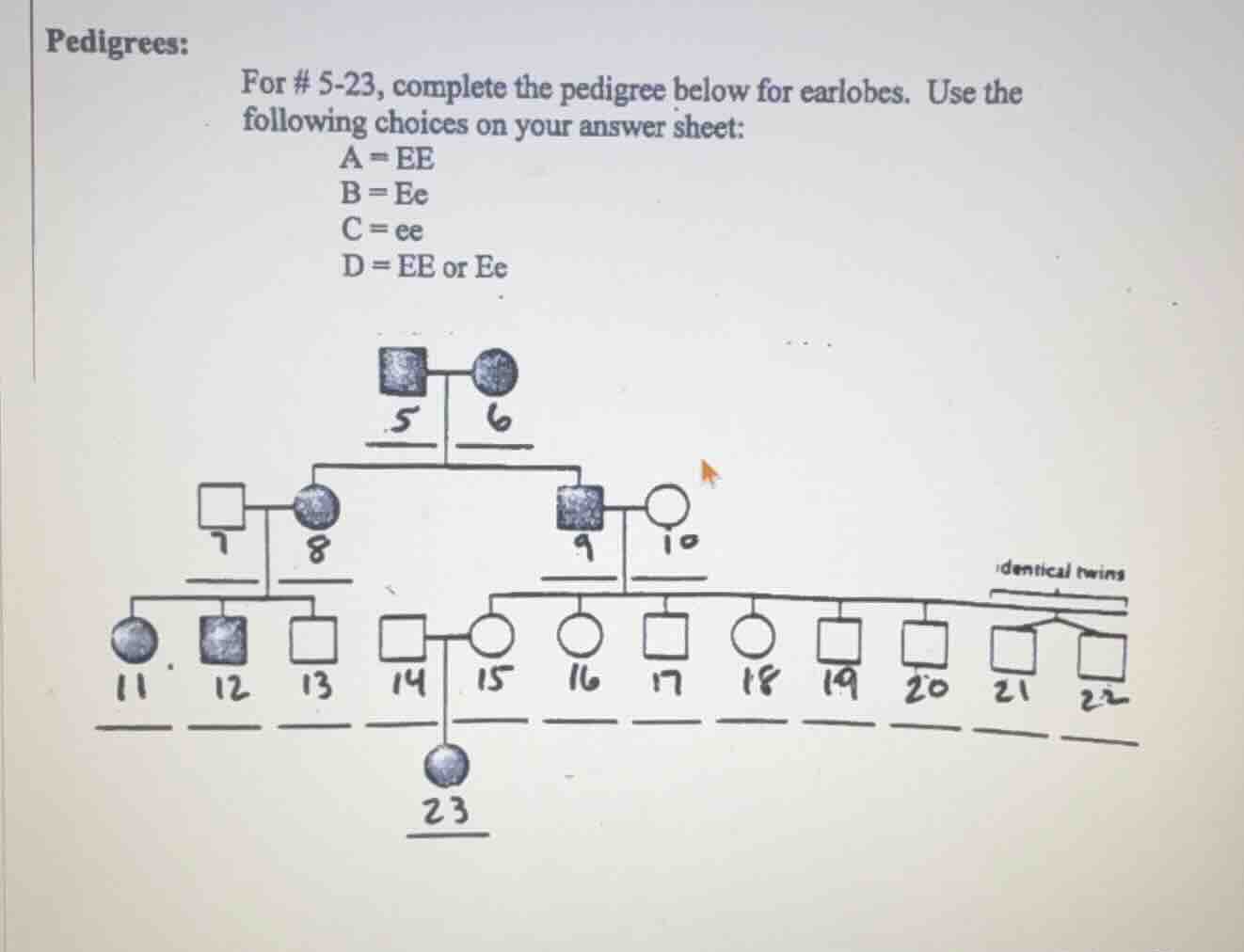
for # 5-23, complete the pedigree below for earlobes. use the
following choices on your answer sheet:
a = ee
b = ee
c = ee
d = ee or ee
Step1: Identify trait inheritance pattern
Shaded individuals have attached earlobes (recessive trait, genotype $ee$; unshaded have free earlobes, dominant trait, $EE$ or $Ee$).
Step2: Analyze Individual 5
Shaded (attached earlobes) → genotype $ee$
Expression: $5 = C$
Step3: Analyze Individual 6
Shaded (attached earlobes) → genotype $ee$
Expression: $6 = C$
Step4: Analyze Individual 8
Child of 5 ($ee$) and 6 ($ee$), shaded → genotype $ee$
Expression: $8 = C$
Step5: Analyze Individual 7
Unshaded (free earlobes); has a shaded child (12, $ee$), so must pass $e$ → genotype $Ee$
Expression: $7 = B$
Step6: Analyze Individual 11
Shaded (attached earlobes) → genotype $ee$
Expression: $11 = C$
Step7: Analyze Individual 12
Shaded (attached earlobes) → genotype $ee$
Expression: $12 = C$
Step8: Analyze Individual 13
Unshaded (free earlobes); parents 7 ($Ee$) and 8 ($ee$) → inherits $E$ from 7, $e$ from 8 → genotype $Ee$
Expression: $13 = B$
Step9: Analyze Individual 9
Shaded (attached earlobes) → genotype $ee$
Expression: $9 = C$
Step10: Analyze Individual 10
Unshaded (free earlobes); all children with 9 ($ee$) are unshaded, so must pass $E$ → genotype $EE$
Expression: $10 = A$
Step11: Analyze Individuals 16-22
Children of 9 ($ee$) and 10 ($EE$) → inherit $E$ from 10, $e$ from 9 → genotype $Ee$; 21/22 (identical twins) share same genotype
Expression: $16=B, 17=B, 18=B, 19=B, 20=B, 21=B, 22=B$
Step12: Analyze Individual 14
Unshaded (free earlobes); has a shaded child (23, $ee$), so must pass $e$ → genotype $Ee$
Expression: $14 = B$
Step13: Analyze Individual 15
Unshaded (free earlobes); has a shaded child (23, $ee$), so must pass $e$ → genotype $Ee$
Expression: $15 = B$
Step14: Analyze Individual 23
Shaded (attached earlobes) → genotype $ee$
Expression: $23 = C$

Snap & solve any problem in the app
Get step-by-step solutions on Sovi AI
Photo-based solutions with guided steps
Explore more problems and detailed explanations
$5 = C$, $6 = C$, $7 = B$, $8 = C$, $9 = C$, $10 = A$, $11 = C$, $12 = C$, $13 = B$, $14 = B$, $15 = B$, $16 = B$, $17 = B$, $18 = B$, $19 = B$, $20 = B$, $21 = B$, $22 = B$, $23 = C$