QUESTION IMAGE
Question
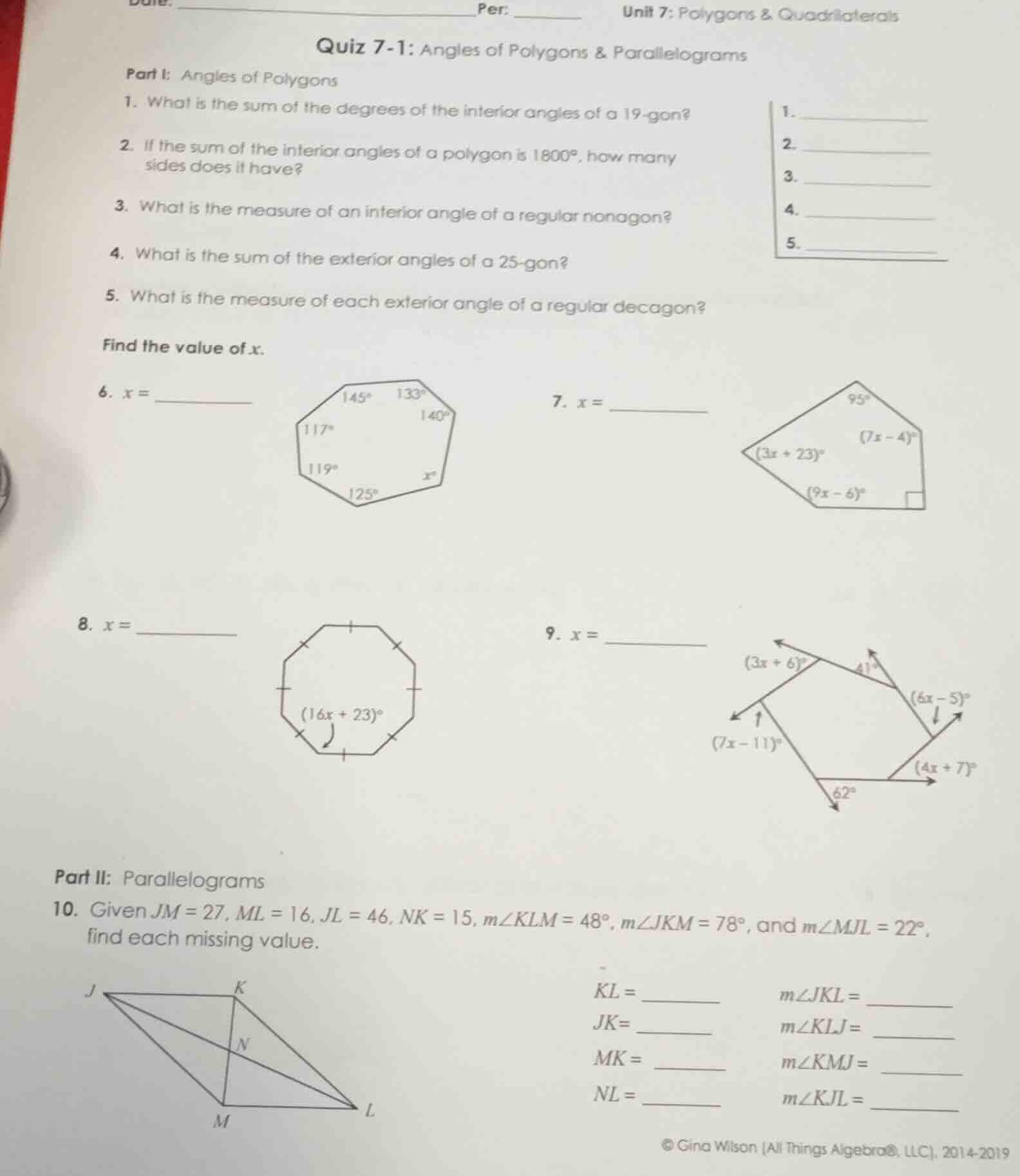
per:unit 7: polygons & quadrilateralsquiz 7-1: angles of polygons & parallelogramspart i: angles of polygons1. what is the sum of the degrees of the interior angles of a 19-gon?2. if the sum of the interior angles of a polygon is $1800^{\circ}$, how many sides does it have?3. what is the measure of an interior angle of a regular nonagon?4. what is the sum of the exterior angles of a 25-gon?5. what is the measure of each exterior angle of a regular decagon?find the value of $x$.6. $x =$7. $x =$8. $x =$9. $x =$part ii: parallelograms10. given $jm = 27$, $ml = 16$, $jl = 46$, $nk = 15$, $m\angle klm = 48^{\circ}$, $m\angle jkm = 78^{\circ}$, and $m\angle mjl = 22^{\circ}$, find each missing value.$kl =$$jk =$$mk =$$nl =$$m\angle jkl =$$m\angle klj =$$m\angle kmj =$$m\angle kjl =$© gina wilson (all things algebra®, llc), 2014-2019
Step1: Sum interior angles of n-gon
Use formula: $(n-2)\times180^\circ$
For 19-gon: $(19-2)\times180^\circ = 17\times180^\circ = 3060^\circ$
Step2: Solve for n given sum
Set $(n-2)\times180^\circ=1800^\circ$
$n-2=\frac{1800^\circ}{180^\circ}=10$
$n=10+2=12$
Step3: Regular nonagon interior angle
Nonagon: $n=9$, sum = $(9-2)\times180^\circ=1260^\circ$
Each angle: $\frac{1260^\circ}{9}=140^\circ$
Step4: Sum exterior angles of any polygon
Sum of exterior angles of any polygon is $360^\circ$
Step5: Regular decagon exterior angle
Decagon: $n=10$
Each angle: $\frac{360^\circ}{10}=36^\circ$
Step6: Find x in 7-gon
Sum of interior angles: $(7-2)\times180^\circ=900^\circ$
Sum of given angles: $117+119+125+145+133+140=779^\circ$
$x=900-779=121$
Step7: Find x in 5-gon
Sum of interior angles: $(5-2)\times180^\circ=540^\circ$
Right angle = $90^\circ$, so:
$(3x+23)+(9x-6)+90+(7x-4)+90=540$
Combine terms: $19x+193=540$
$19x=540-193=347$
$x=\frac{347}{19}=18.26$ (rounded to 2 decimals)
Step8: Find x in regular octagon
Regular octagon interior angle: $\frac{(8-2)\times180^\circ}{8}=135^\circ$
Set $16x+23=135$
$16x=135-23=112$
$x=\frac{112}{16}=7$
Step9: Sum exterior angles to find x
Sum of exterior angles = $360^\circ$:
$(3x+6)+(6x-5)+(4x+7)+62+(7x-11)+41=360$
Combine terms: $20x+100=360$
$20x=360-100=260$
$x=\frac{260}{20}=13$
Step10: Use parallelogram properties
- $KL=JM=27$ (opposite sides congruent)
- $JK=ML=16$ (opposite sides congruent)
- $MK=2\times NK=2\times15=30$ (diagonals bisect each other)
- $NL=\frac{JL}{2}=\frac{46}{2}=23$ (diagonals bisect each other)
- $m\angle JKL=180^\circ-m\angle KLM=180^\circ-48^\circ=132^\circ$ (consecutive angles supplementary)
- $m\angle KLJ=m\angle MJL=22^\circ$ (alternate interior angles)
- $m\angle KMJ=m\angle JKM=78^\circ$ (alternate interior angles)
- $m\angle KJL=180^\circ-m\angle MJL-m\angle JML$; $m\angle JML=m\angle JKL=132^\circ$, so $m\angle KJL=180-22-132=26^\circ$ (or use triangle sum)

Snap & solve any problem in the app
Get step-by-step solutions on Sovi AI
Photo-based solutions with guided steps
Explore more problems and detailed explanations
- $3060^\circ$
- $12$
- $140^\circ$
- $360^\circ$
- $36^\circ$
- $121$
- $18.26$
- $7$
- $13$
10.
$KL=27$, $m\angle JKL=132^\circ$
$JK=16$, $m\angle KLJ=22^\circ$
$MK=30$, $m\angle KMJ=78^\circ$
$NL=23$, $m\angle KJL=26^\circ$