QUESTION IMAGE
Question
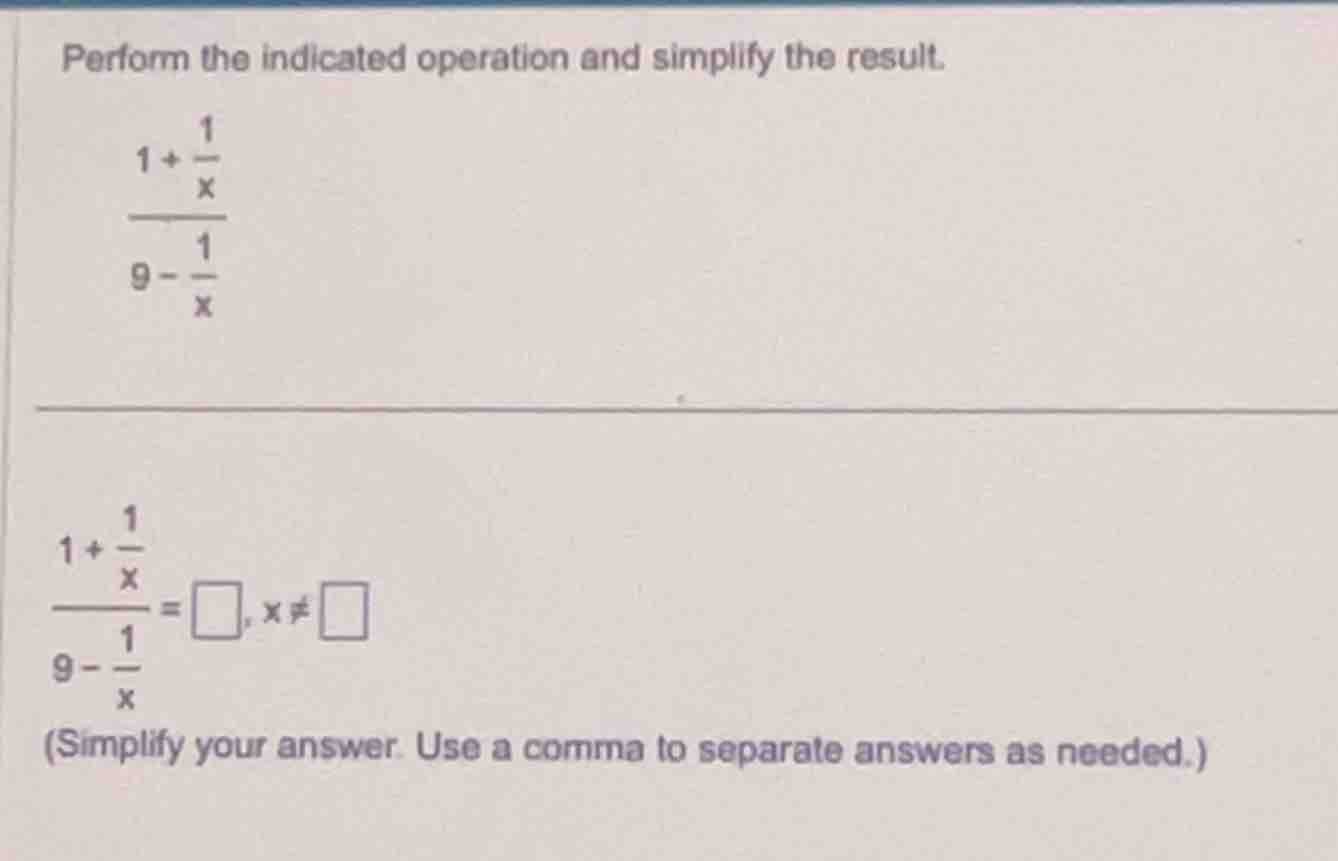
perform the indicated operation and simplify the result.
\\(\dfrac{1 + \dfrac{1}{x}}{9 - \dfrac{1}{x}}\\)
\\(\dfrac{1 + \dfrac{1}{x}}{9 - \dfrac{1}{x}} = \square, x \
eq \square\\)
(simplify your answer. use a comma to separate answers as needed.)
Step1: Simplify numerator and denominator
First, simplify the numerator \(1 + \frac{1}{x}\) and the denominator \(9 - \frac{1}{x}\) separately. For the numerator, find a common denominator: \(1+\frac{1}{x}=\frac{x}{x}+\frac{1}{x}=\frac{x + 1}{x}\). For the denominator, \(9-\frac{1}{x}=\frac{9x}{x}-\frac{1}{x}=\frac{9x - 1}{x}\).
Step2: Divide the two fractions
Now we have a complex fraction \(\frac{\frac{x + 1}{x}}{\frac{9x - 1}{x}}\). Dividing by a fraction is the same as multiplying by its reciprocal, so this becomes \(\frac{x + 1}{x}\times\frac{x}{9x - 1}\).
Step3: Cancel out common factors
The \(x\) in the numerator and denominator cancels out, leaving us with \(\frac{x + 1}{9x - 1}\). We also need to note the restrictions on \(x\). The original expression has \(\frac{1}{x}\), so \(x
eq0\), and also the denominator of the simplified fraction \(9x - 1
eq0\), but from the original denominator \(9-\frac{1}{x}\), when \(x = 0\) it's undefined, and also when we simplified the denominator to \(\frac{9x - 1}{x}\), \(x
eq0\) and from the original numerator \(1+\frac{1}{x}\), \(x
eq0\). But also, when we look at the original complex fraction, the denominators in the numerator and denominator of the complex fraction: \(x
eq0\) (because of \(\frac{1}{x}\) in both numerator and denominator of the complex fraction) and also, when we have the denominator of the complex fraction \(9-\frac{1}{x}\), if \(x = \frac{1}{9}\), then \(9-\frac{1}{x}=9 - 9=0\), but wait, no, let's re - check. Wait, in the original expression, the numerator of the complex fraction is \(1+\frac{1}{x}\), denominator is \(9-\frac{1}{x}\). So \(x
eq0\) (because of \(\frac{1}{x}\)) and also \(9-\frac{1}{x}
eq0\Rightarrow\frac{1}{x}
eq9\Rightarrow x
eq\frac{1}{9}\), and \(1+\frac{1}{x}
eq0\Rightarrow\frac{1}{x}
eq - 1\Rightarrow x
eq - 1\). But when we simplified, we saw that the \(x\) cancels, but the original restrictions: \(x
eq0\) (because \(\frac{1}{x}\) is in the original numerator and denominator), and also, from the denominator of the complex fraction \(9-\frac{1}{x}\), \(x
eq\frac{1}{9}\), and from the numerator \(1+\frac{1}{x}\), \(x
eq - 1\). But wait, in our simplification, when we did \(\frac{\frac{x + 1}{x}}{\frac{9x - 1}{x}}\), the \(x\) cancels, but we still have the restrictions from the original expression. However, the problem asks for \(x
eq\) what? Let's see, the original expression has \(\frac{1}{x}\), so \(x
eq0\), and also, when we look at the denominator of the complex fraction \(9-\frac{1}{x}\), if \(x = 0\), it's undefined, and also, when we have the simplified expression, but the key restriction from the original expression's denominators (the \(\frac{1}{x}\) terms) is \(x
eq0\), and also, when we consider the denominator of the complex fraction \(9-\frac{1}{x}\), if \(x=\frac{1}{9}\), then \(9 - \frac{1}{x}=0\), but wait, no, let's re - evaluate. Wait, the original expression is \(\frac{1+\frac{1}{x}}{9-\frac{1}{x}}\). So the denominators within the numerator and denominator of the complex fraction are \(x\) (from \(\frac{1}{x}\)), so \(x
eq0\). Also, the denominator of the complex fraction \(9-\frac{1}{x}
eq0\Rightarrow\frac{1}{x}
eq9\Rightarrow x
eq\frac{1}{9}\), and the numerator of the complex fraction \(1+\frac{1}{x}
eq0\Rightarrow\frac{1}{x}
eq - 1\Rightarrow x
eq - 1\). But when we simplified, we got \(\frac{x + 1}{9x - 1}\), and the restrictions from the original expression: \(x
eq0\) (because of \(\frac{1}{x}\) in the original numerator and denominator), and also, from the denominator of the complex fract…

Snap & solve any problem in the app
Get step-by-step solutions on Sovi AI
Photo-based solutions with guided steps
Explore more problems and detailed explanations
\(\frac{x + 1}{9x - 1},0\)