QUESTION IMAGE
Question
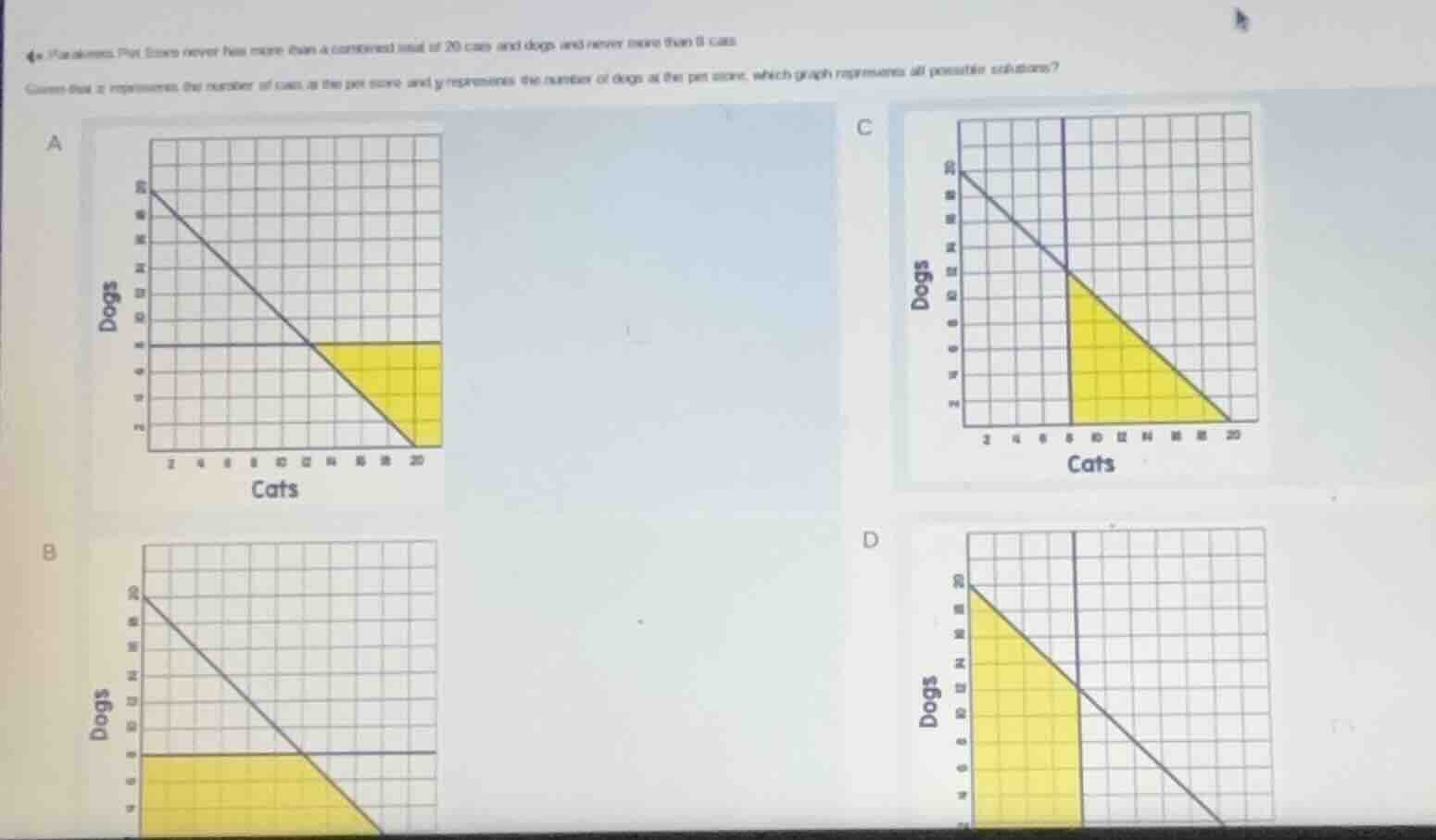
- a pet store never has more than a combined total of 20 cats and dogs, and never more than 8 cats. given that ( x ) represents the number of cats at the pet store and ( y ) represents the number of dogs at the pet store, which graph represents all possible solutions?
options: a, b, c, d (with corresponding graphs)
Step1: Analyze the constraints
Let \( x \) be the number of cats and \( y \) be the number of dogs. The first constraint is \( x + y \leq 20 \) (combined total of cats and dogs is at most 20), which can be rewritten as \( y \leq -x + 20 \). The second constraint is \( x \leq 8 \) (never more than 8 cats), and also \( x \geq 0 \), \( y \geq 0 \) (since the number of animals can't be negative).
Step2: Analyze each graph
- For the constraint \( x \leq 8 \), the region should be to the left of the vertical line \( x = 8 \).
- For the constraint \( y \leq -x + 20 \), the region should be below the line \( y=-x + 20 \).
- Also, \( x\geq0 \) and \( y\geq0 \), so we are in the first quadrant.
Now, let's check each option:
- Option A: The vertical line does not seem to represent \( x = 8 \), and the shaded region does not match the constraints.
- Option B: The vertical line and the shaded region do not align with \( x\leq8 \) and \( y\leq -x + 20 \).
- Option C: The vertical line is \( x = 8 \) (since it's at \( x = 8 \) on the x - axis), the line \( y=-x + 20 \) (when \( x = 0 \), \( y = 20 \); when \( y = 0 \), \( x = 20 \)) is present, and the shaded region is to the left of \( x = 8 \), below \( y=-x + 20 \), and in the first quadrant. This matches our constraints.
- Option D: The shaded region is to the left of \( x = 8 \) but above \( y=-x + 20 \) in some parts, which does not satisfy \( y\leq -x + 20 \).

Snap & solve any problem in the app
Get step-by-step solutions on Sovi AI
Photo-based solutions with guided steps
Explore more problems and detailed explanations
C