QUESTION IMAGE
Question
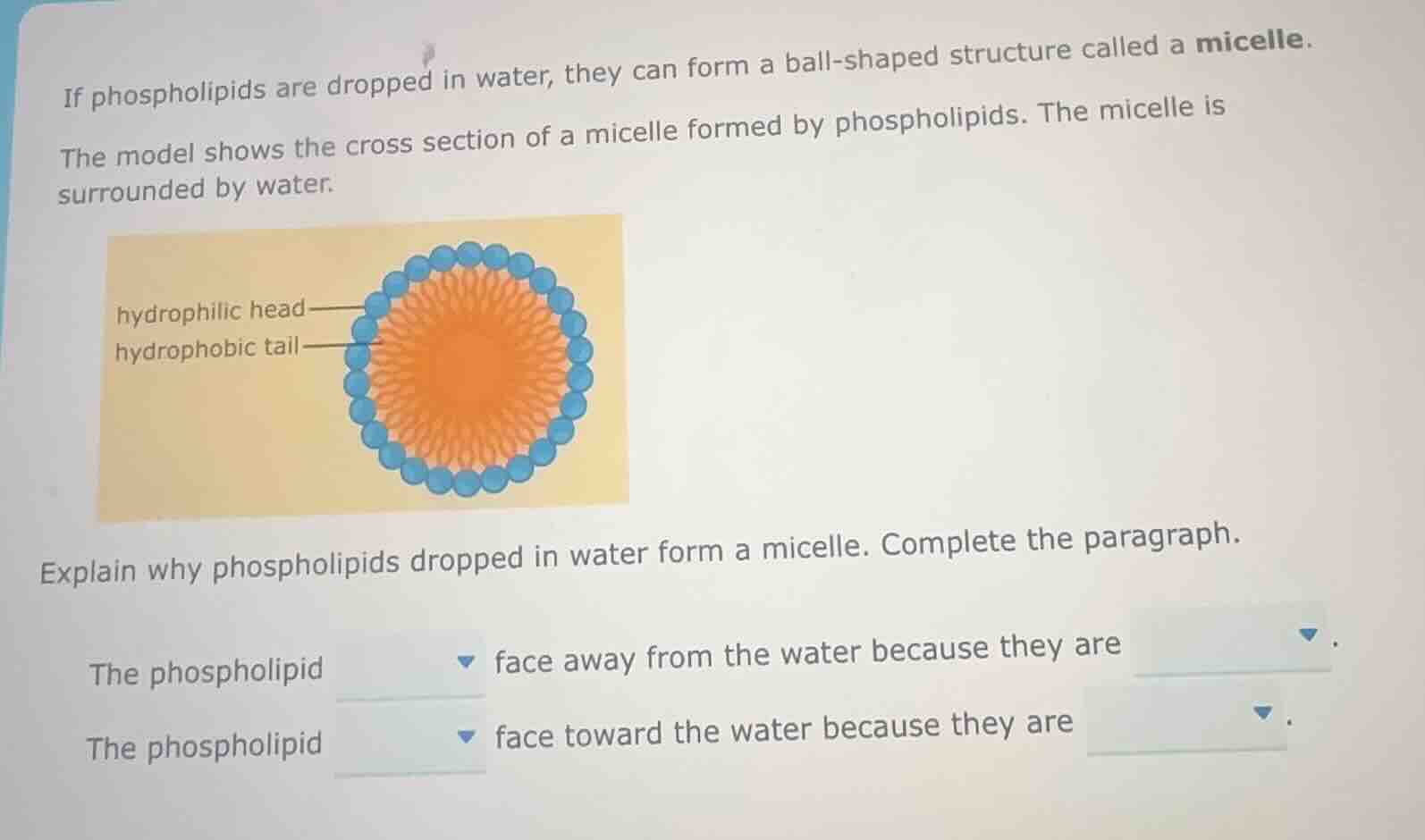
if phospholipids are dropped in water, they can form a ball - shaped structure called a micelle. the model shows the cross section of a micelle formed by phospholipids. the micelle is surrounded by water. image of micelle with labels hydrophilic head and hydrophobic tail explain why phospholipids dropped in water form a micelle. complete the paragraph. the phospholipid dropdown face away from the water because they are dropdown. the phospholipid dropdown face toward the water because they are dropdown.
Phospholipids have a hydrophilic (water - attracting) head and a hydrophobic (water - repelling) tail. In water, the hydrophobic tails will avoid water, so they face inward (away from water), and the hydrophilic heads, which are attracted to water, face outward (toward water) to interact with the surrounding water. This arrangement allows the phospholipids to form a micelle structure. So for the first blank, the part of the phospholipid that faces away from water is the "hydrophobic tails" because they are "hydrophobic" (water - hating/repelling). For the second blank, the part that faces toward water is the "hydrophilic heads" because they are "hydrophilic" (water - loving/attracting).

Snap & solve any problem in the app
Get step-by-step solutions on Sovi AI
Photo-based solutions with guided steps
Explore more problems and detailed explanations
The phospholipid \(\boldsymbol{\text{hydrophobic tails}}\) face away from the water because they are \(\boldsymbol{\text{hydrophobic}}\).
The phospholipid \(\boldsymbol{\text{hydrophilic heads}}\) face toward the water because they are \(\boldsymbol{\text{hydrophilic}}\).