QUESTION IMAGE
Question
photosynthesis
guided reading comprehension
(1) all cells need cell energy to undergo cell activities and survive.
the ultimate source of energy for all living things comes from the sun.
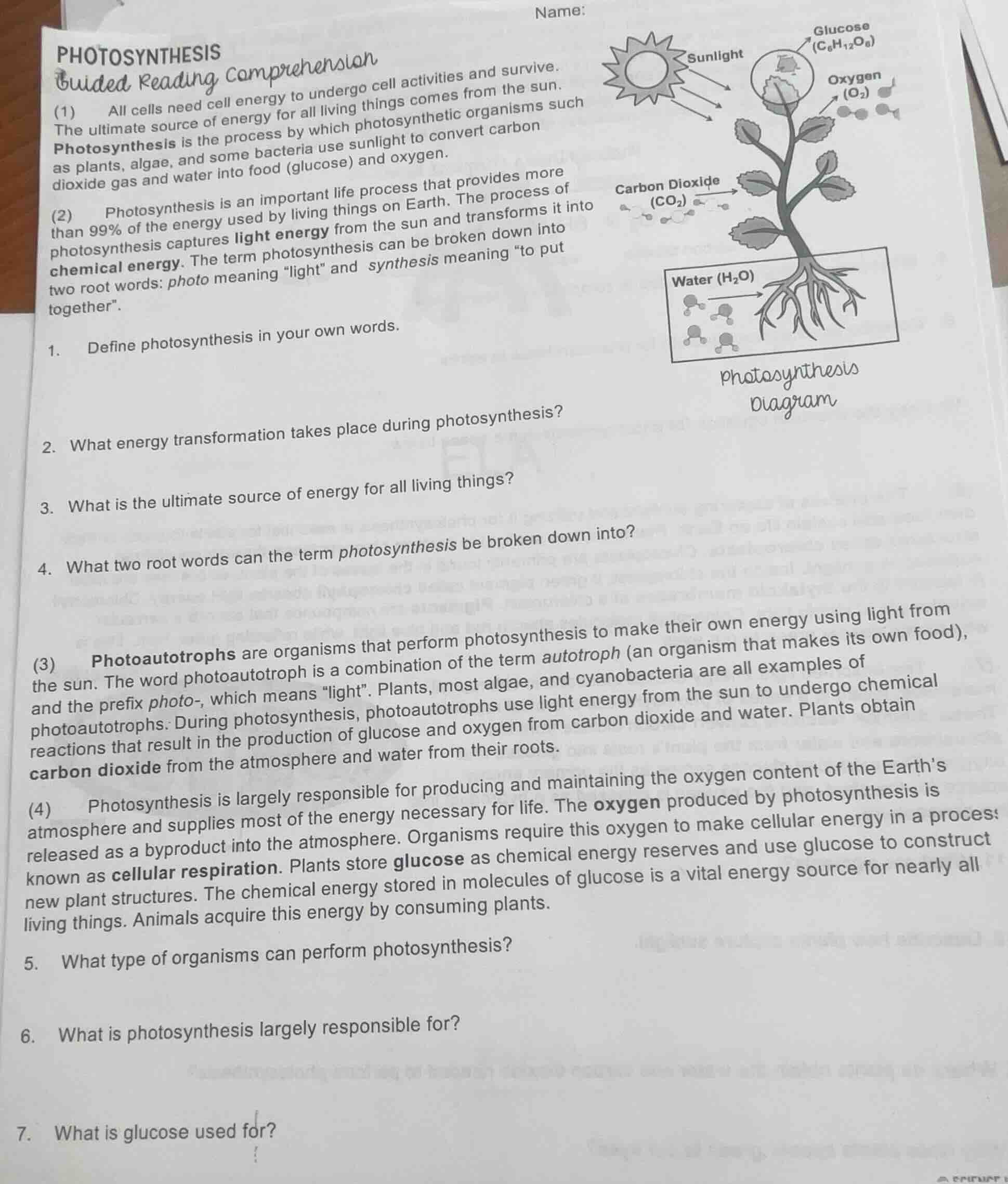
photosynthesis is the process by which photosynthetic organisms such
as plants, algae, and some bacteria use sunlight to convert carbon
dioxide gas and water into food (glucose) and oxygen.
(2) photosynthesis is an important life process that provides more
than 99% of the energy used by living things on earth. the process of
photosynthesis captures light energy from the sun and transforms it into
chemical energy. the term photosynthesis can be broken down into
two root words: photo meaning \light\ and synthesis meaning \to put
together\.
- define photosynthesis in your own words.
- what energy transformation takes place during photosynthesis?
- what is the ultimate source of energy for all living things?
- what two root words can the term photosynthesis be broken down into?
(3) photoautotrophs are organisms that perform photosynthesis to make their own energy using light from
the sun. the word photoautotroph is a combination of the term autotroph (an organism that makes its own food),
and the prefix photo-, which means \light\. plants, most algae, and cyanobacteria are all examples of
photoautotrophs: during photosynthesis, photoautotrophs use light energy from the sun to undergo chemical
reactions that result in the production of glucose and oxygen from carbon dioxide and water. plants obtain
carbon dioxide from the atmosphere and water from their roots.
(4) photosynthesis is largely responsible for producing and maintaining the oxygen content of the earths
atmosphere and supplies most of the energy necessary for life. the oxygen produced by photosynthesis is
released as a byproduct into the atmosphere. organisms require this oxygen to make cellular energy in a process
known as cellular respiration. plants store glucose as chemical energy reserves and use glucose to construct
new plant structures. the chemical energy stored in molecules of glucose is a vital energy source for nearly all
living things. animals acquire this energy by consuming plants.
- what type of organisms can perform photosynthesis?
- what is photosynthesis largely responsible for?
- what is glucose used for?
- Paraphrased from the text's definition of photosynthesis, focusing on the core inputs, organisms, and outputs.
- Directly stated in section (2) of the text.
- Explicitly noted in section (1) as the ultimate energy source.
- Identified in section (2) as the root words for "photosynthesis".
- Listed in section (3) as organisms that perform photosynthesis.
- Stated in section (4) as key roles of photosynthesis.
- Summarized from section (4)'s description of glucose uses.

Snap & solve any problem in the app
Get step-by-step solutions on Sovi AI
Photo-based solutions with guided steps
Explore more problems and detailed explanations
- Photosynthesis is the process where photosynthetic organisms like plants, algae, and some bacteria use sunlight to turn carbon dioxide and water into glucose (food) and oxygen.
- Light energy from the sun is transformed into chemical energy.
- The sun is the ultimate source of energy for all living things.
- The term can be broken down into "photo" (meaning light) and "synthesis" (meaning to put together).
- Photoautotrophs, including plants, most algae, and cyanobacteria, can perform photosynthesis.
- Photosynthesis is largely responsible for producing and maintaining the oxygen content of Earth's atmosphere, and supplying most of the energy needed for life.
- Glucose is used as stored chemical energy, to build new plant structures, and as a vital energy source for nearly all living things (animals acquire it by eating plants).