QUESTION IMAGE
Question
the pleasure of writing
by a. a. milne (excerpt)
the pleasure of writing is one of the essays in the book not that it
matters, it was written in the early 1900s by british author a. a. milne, who
best known for his winnie-the-pooh stories.
sometimes when the printer is waiting for an article which really should
e been sent to him the day before, i sit at my desk and wonder if there
ny possible subject in the whole world upon which i can possibly find
thing to say. on one such occasion i left it to fate, which decided, by
ns of a dictionary opened at random, that i should deliver myself of a
thoughts about goldfish. (you will find this article later on in the book.)
to-day i do not need to bother about a subject. to-day i am without a
nothing less has happened than that i have a new nib¹ in my pen.
the ordinary way, when shakespeare writes a tragedy, or mr. blank
you one of his charming little essays, a certain amount of thought
on before pen is put to paper. one cannot write \scene i. an open
thunder and lightning. enter three witches,\ or \as i look up from
ndow, the nodding daffodils beckon to me to take the morning,\ one
give of ones best in this way on the spur of the moment. at least,
cannot. but when i have a new nib in my pen, then i can go straight
y breakfast to the blotting-paper, and a new sheet of foolscap fills
agically with a stream of blue-black words. when poets and idiots
e pleasure of writing, they mean the pleasure of giving a piece of
ds to the public; with an old nib a tedious business. they do not
s i do) the pleasure of the artist in seeing beautifully shaped \ks\
ous \ss\ grow beneath his steel. anybody else writing this article
nder \will my readers like it?\ i only tell myself \how the
ors² will love it!\
haps they will not love it. maybe i am a little above their heads. i
select the correct answer.
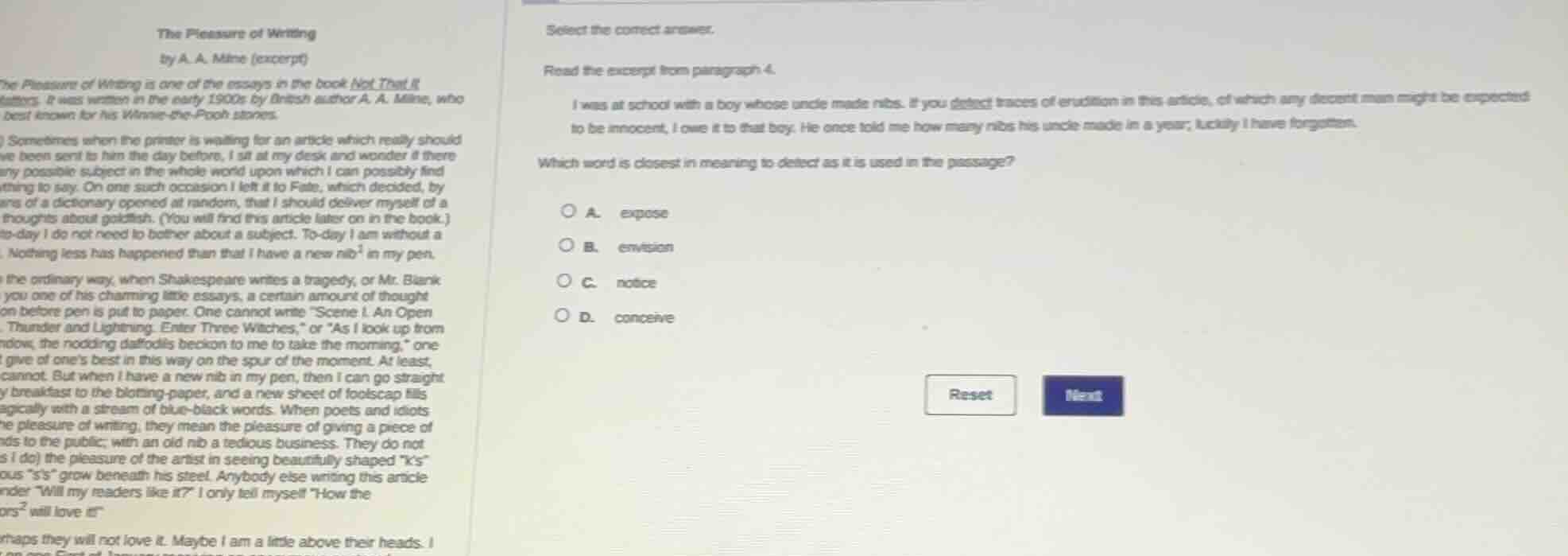
read the excerpt from paragraph 4.
i was at school with a boy whose uncle made nibs. if you detect traces of erudition in this article, of which any decent man might be expected
to be innocent, i owe it to that boy. he once told me how many nibs his uncle made in a year; luckily i have forgotten.
which word is closest in meaning to detect as it is used in the passage?
a. expose
b. envision
c. notice
d. conceive
In the passage, "detect traces of erudition" means to pick out or become aware of small signs of learnedness. "Notice" means to become aware of something, which matches this context. "Expose" means to reveal something hidden, "envision" means to imagine, and "conceive" means to form an idea, none of which fit the meaning here.

Snap & solve any problem in the app
Get step-by-step solutions on Sovi AI
Photo-based solutions with guided steps
Explore more problems and detailed explanations
C. notice