QUESTION IMAGE
Question
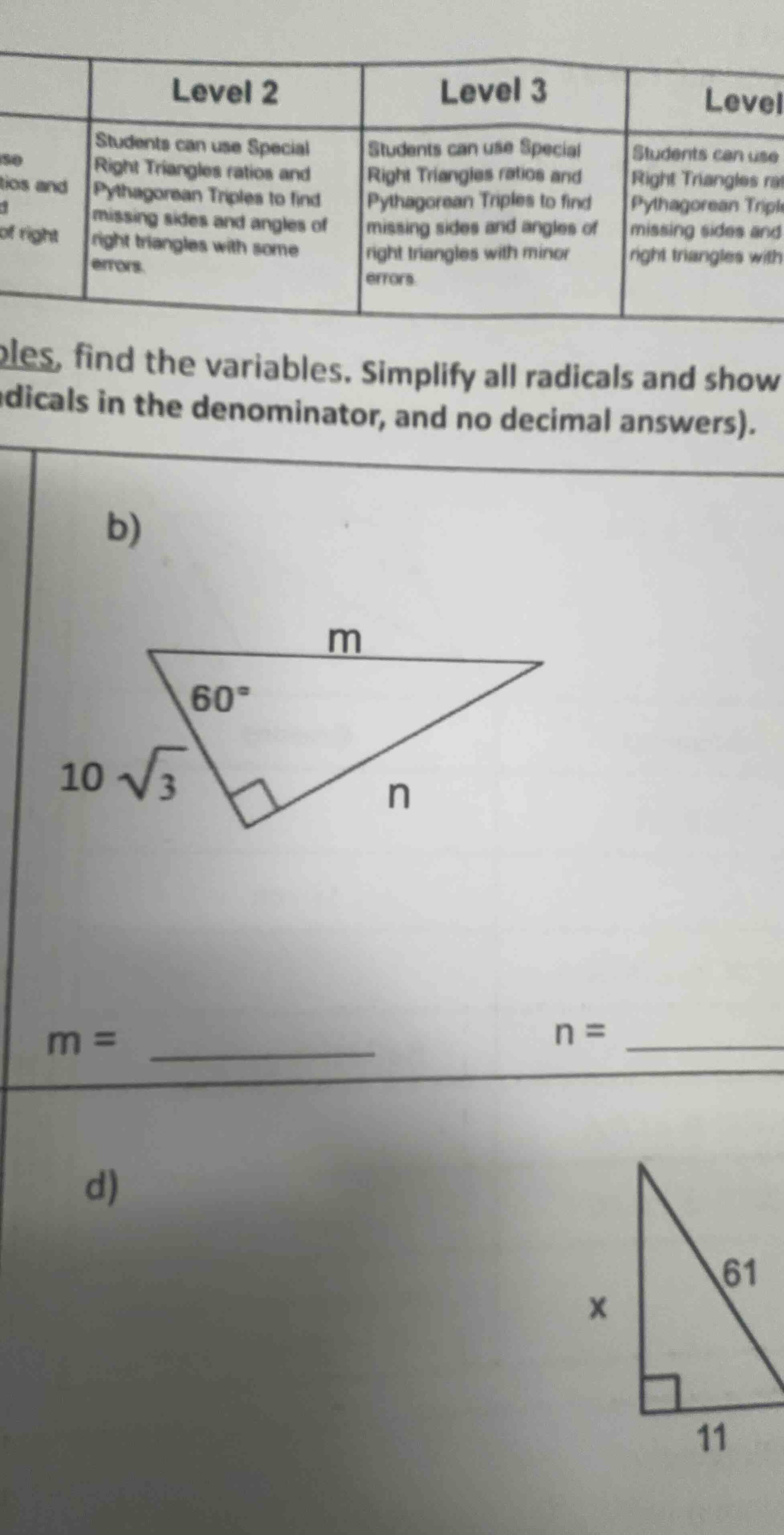
ples, find the variables. simplify all radicals and show dicals in the denominator, and no decimal answers).
b)
right triangle with one angle 60°, one leg 10√3, other leg n, hypotenuse m
m =
n =
d)
right triangle with hypotenuse 61, one leg 11, other leg x
Part (b)
Step1: Identify the triangle type
This is a 30-60-90 right triangle. In a 30-60-90 triangle, the sides are in the ratio \(1 : \sqrt{3} : 2\), where the side opposite \(30^\circ\) is the shortest (let's call it \(n\)), the side opposite \(60^\circ\) is \(n\sqrt{3}\), and the hypotenuse is \(2n\). Here, the side adjacent to \(60^\circ\) (wait, no: the side with length \(10\sqrt{3}\) is opposite the \(60^\circ\) angle? Wait, no, the right angle is between the sides \(10\sqrt{3}\) and \(n\), and the angle of \(60^\circ\) is between \(10\sqrt{3}\) and \(m\) (the hypotenuse). Wait, let's correct: in a right triangle, the angles are \(90^\circ\), \(60^\circ\), so the third angle is \(30^\circ\). So the side opposite \(30^\circ\) is \(n\), the side opposite \(60^\circ\) is \(10\sqrt{3}\), and the hypotenuse is \(m\).
In a 30-60-90 triangle, the side opposite \(60^\circ\) is \(n\sqrt{3}\) (wait, no: let's define: let the side opposite \(30^\circ\) be \(x\), then side opposite \(60^\circ\) is \(x\sqrt{3}\), hypotenuse is \(2x\). So here, the side opposite \(60^\circ\) is \(10\sqrt{3}\), so \(x\sqrt{3}=10\sqrt{3}\), so \(x = 10\). Therefore, the side opposite \(30^\circ\) (which is \(n\)) is \(x = 10\), and the hypotenuse \(m = 2x = 20\). Wait, let's check with trigonometric ratios.
Alternatively, using cosine and sine. For angle \(60^\circ\):
\(\cos(60^\circ)=\frac{\text{adjacent}}{\text{hypotenuse}}=\frac{10\sqrt{3}}{m}\)
We know that \(\cos(60^\circ)=\frac{1}{2}\), so:
\(\frac{1}{2}=\frac{10\sqrt{3}}{m}\)
Solving for \(m\): \(m = 20\sqrt{3}\)? Wait, no, wait I made a mistake. Wait, the side with length \(10\sqrt{3}\): is it adjacent or opposite to \(60^\circ\)?
Wait, the right angle is between \(10\sqrt{3}\) and \(n\), so the angle of \(60^\circ\) is between \(10\sqrt{3}\) and \(m\) (hypotenuse). So the side adjacent to \(60^\circ\) is \(10\sqrt{3}\), the side opposite to \(60^\circ\) is \(n\), and hypotenuse is \(m\).
So \(\sin(60^\circ)=\frac{\text{opposite}}{\text{hypotenuse}}=\frac{n}{m}\)
\(\cos(60^\circ)=\frac{\text{adjacent}}{\text{hypotenuse}}=\frac{10\sqrt{3}}{m}\)
We know \(\cos(60^\circ)=\frac{1}{2}\), so:
\(\frac{1}{2}=\frac{10\sqrt{3}}{m}\)
Wait, that would mean \(m = 20\sqrt{3}\), but that contradicts the 30-60-90 ratio. Wait, maybe I mixed up the angles. Let's find the third angle: \(90^\circ - 60^\circ = 30^\circ\). So the angle opposite \(n\) is \(30^\circ\), the angle opposite \(10\sqrt{3}\) is \(60^\circ\), and the angle opposite \(m\) is \(90^\circ\).
In a 30-60-90 triangle, the sides are in the ratio \(1 : \sqrt{3} : 2\), where the side opposite \(30^\circ\) is the shortest (1 part), side opposite \(60^\circ\) is \(\sqrt{3}\) parts, hypotenuse is 2 parts.
So if the side opposite \(60^\circ\) is \(10\sqrt{3}\) (which is \(\sqrt{3}\) parts), then 1 part is \(10\). Therefore, the side opposite \(30^\circ\) (which is \(n\)) is 1 part = \(10\), and the hypotenuse \(m\) is 2 parts = \(20\). Wait, but then the side opposite \(60^\circ\) would be \(10\sqrt{3}\), which matches. So that's correct.
So:
\(n = 10\) (side opposite \(30^\circ\))
\(m = 20\) (hypotenuse)
Let's verify with Pythagoras: \( (10\sqrt{3})^2 + n^2 = m^2 \)
\( (100 \times 3) + 10^2 = 20^2 \)
\( 300 + 100 = 400 \)
\( 400 = 400 \), which is correct.
Step2: For part (d)
We have a right triangle with hypotenuse \(61\), one leg \(11\), and the other leg \(x\). Using Pythagorean theorem:
\(x^2 + 11^2 = 61^2\)
\(x^2 = 61^2 - 11^2\)
Using difference of squares: \(a^2 - b^2 = (a - b)(a + b)\)
So \(x^2 = (61 - 11)(61 + 11) = (50)(72) = 3600…

Snap & solve any problem in the app
Get step-by-step solutions on Sovi AI
Photo-based solutions with guided steps
Explore more problems and detailed explanations
Part (b)
\(m = \boldsymbol{20}\), \(n = \boldsymbol{10}\)
Part (d)
\(x = \boldsymbol{60}\)