QUESTION IMAGE
Question
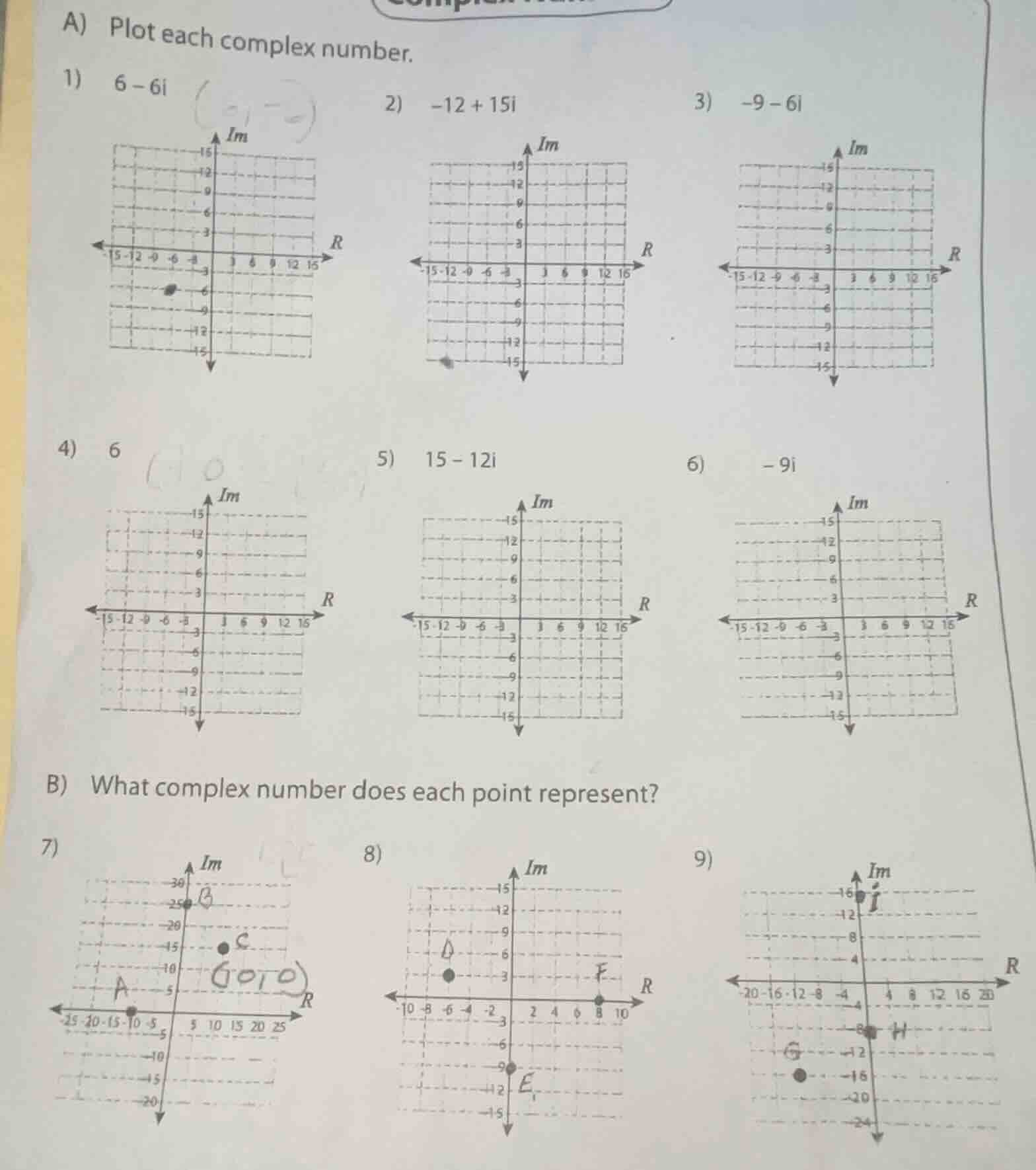
a) plot each complex number.
- 6 - 6i
- -12 + 15i
- -9 - 6i
- 6
- 15 - 12i
- -9i
b) what complex number does each point represent?
7)
8)
9)
Part A: Plotting Complex Numbers
A complex number \( a + bi \) is plotted on the complex plane where the real part (\( a \)) corresponds to the \( x \)-axis (Real, \( R \)) and the imaginary part (\( b \)) corresponds to the \( y \)-axis (Imaginary, \( Im \)).
1. \( 6 - 6i \)
- Real part: \( 6 \) (move 6 units right on \( R \)-axis).
- Imaginary part: \( -6 \) (move 6 units down on \( Im \)-axis).
- Plot the point \( (6, -6) \).
2. \( -12 + 15i \)
- Real part: \( -12 \) (move 12 units left on \( R \)-axis).
- Imaginary part: \( 15 \) (move 15 units up on \( Im \)-axis).
- Plot the point \( (-12, 15) \).
3. \( -9 - 6i \)
- Real part: \( -9 \) (move 9 units left on \( R \)-axis).
- Imaginary part: \( -6 \) (move 6 units down on \( Im \)-axis).
- Plot the point \( (-9, -6) \).
4. \( 6 \) (or \( 6 + 0i \))
- Real part: \( 6 \) (move 6 units right on \( R \)-axis).
- Imaginary part: \( 0 \) (stay on the \( R \)-axis).
- Plot the point \( (6, 0) \).
5. \( 15 - 12i \)
- Real part: \( 15 \) (move 15 units right on \( R \)-axis).
- Imaginary part: \( -12 \) (move 12 units down on \( Im \)-axis).
- Plot the point \( (15, -12) \).
6. \( -9i \) (or \( 0 - 9i \))
- Real part: \( 0 \) (stay on the origin’s \( R \)-axis).
- Imaginary part: \( -9 \) (move 9 units down on \( Im \)-axis).
- Plot the point \( (0, -9) \).
Part B: Identifying Complex Numbers from Points
For a point \( (x, y) \) on the complex plane, the complex number is \( x + yi \) (where \( x \) = real part, \( y \) = imaginary part).
7. Points:
- Point A: \( (-15, 0) \) → \( -15 + 0i = -15 \).
- Point B: \( (0, 25) \) → \( 0 + 25i = 25i \).
- Point C: \( (15, 15) \) → \( 15 + 15i \).
8. Points:
- Point D: \( (-6, 3) \) → \( -6 + 3i \).
- Point E: \( (0, -9) \) → \( 0 - 9i = -9i \).
- Point F: \( (8, 0) \) → \( 8 + 0i = 8 \).
9. Points:
- Point I: \( (0, 16) \) → \( 0 + 16i = 16i \).
- Point H: \( (0, -8) \) → \( 0 - 8i = -8i \).
- Point G: \( (-16, -16) \) → \( -16 - 16i \).
Final Answers (Key Examples):
- A1: Plot \( (6, -6) \) for \( 6 - 6i \).
- B7 (Point A): \( \boldsymbol{-15} \).
- B8 (Point F): \( \boldsymbol{8} \).
- B9 (Point I): \( \boldsymbol{16i} \).
(Note: For plotting, mark the coordinates on the provided grids as described. For part B, use the \( (x, y) \) to \( x + yi \) conversion.)

Snap & solve any problem in the app
Get step-by-step solutions on Sovi AI
Photo-based solutions with guided steps
Explore more problems and detailed explanations
Part A: Plotting Complex Numbers
A complex number \( a + bi \) is plotted on the complex plane where the real part (\( a \)) corresponds to the \( x \)-axis (Real, \( R \)) and the imaginary part (\( b \)) corresponds to the \( y \)-axis (Imaginary, \( Im \)).
1. \( 6 - 6i \)
- Real part: \( 6 \) (move 6 units right on \( R \)-axis).
- Imaginary part: \( -6 \) (move 6 units down on \( Im \)-axis).
- Plot the point \( (6, -6) \).
2. \( -12 + 15i \)
- Real part: \( -12 \) (move 12 units left on \( R \)-axis).
- Imaginary part: \( 15 \) (move 15 units up on \( Im \)-axis).
- Plot the point \( (-12, 15) \).
3. \( -9 - 6i \)
- Real part: \( -9 \) (move 9 units left on \( R \)-axis).
- Imaginary part: \( -6 \) (move 6 units down on \( Im \)-axis).
- Plot the point \( (-9, -6) \).
4. \( 6 \) (or \( 6 + 0i \))
- Real part: \( 6 \) (move 6 units right on \( R \)-axis).
- Imaginary part: \( 0 \) (stay on the \( R \)-axis).
- Plot the point \( (6, 0) \).
5. \( 15 - 12i \)
- Real part: \( 15 \) (move 15 units right on \( R \)-axis).
- Imaginary part: \( -12 \) (move 12 units down on \( Im \)-axis).
- Plot the point \( (15, -12) \).
6. \( -9i \) (or \( 0 - 9i \))
- Real part: \( 0 \) (stay on the origin’s \( R \)-axis).
- Imaginary part: \( -9 \) (move 9 units down on \( Im \)-axis).
- Plot the point \( (0, -9) \).
Part B: Identifying Complex Numbers from Points
For a point \( (x, y) \) on the complex plane, the complex number is \( x + yi \) (where \( x \) = real part, \( y \) = imaginary part).
7. Points:
- Point A: \( (-15, 0) \) → \( -15 + 0i = -15 \).
- Point B: \( (0, 25) \) → \( 0 + 25i = 25i \).
- Point C: \( (15, 15) \) → \( 15 + 15i \).
8. Points:
- Point D: \( (-6, 3) \) → \( -6 + 3i \).
- Point E: \( (0, -9) \) → \( 0 - 9i = -9i \).
- Point F: \( (8, 0) \) → \( 8 + 0i = 8 \).
9. Points:
- Point I: \( (0, 16) \) → \( 0 + 16i = 16i \).
- Point H: \( (0, -8) \) → \( 0 - 8i = -8i \).
- Point G: \( (-16, -16) \) → \( -16 - 16i \).
Final Answers (Key Examples):
- A1: Plot \( (6, -6) \) for \( 6 - 6i \).
- B7 (Point A): \( \boldsymbol{-15} \).
- B8 (Point F): \( \boldsymbol{8} \).
- B9 (Point I): \( \boldsymbol{16i} \).
(Note: For plotting, mark the coordinates on the provided grids as described. For part B, use the \( (x, y) \) to \( x + yi \) conversion.)