QUESTION IMAGE
Question
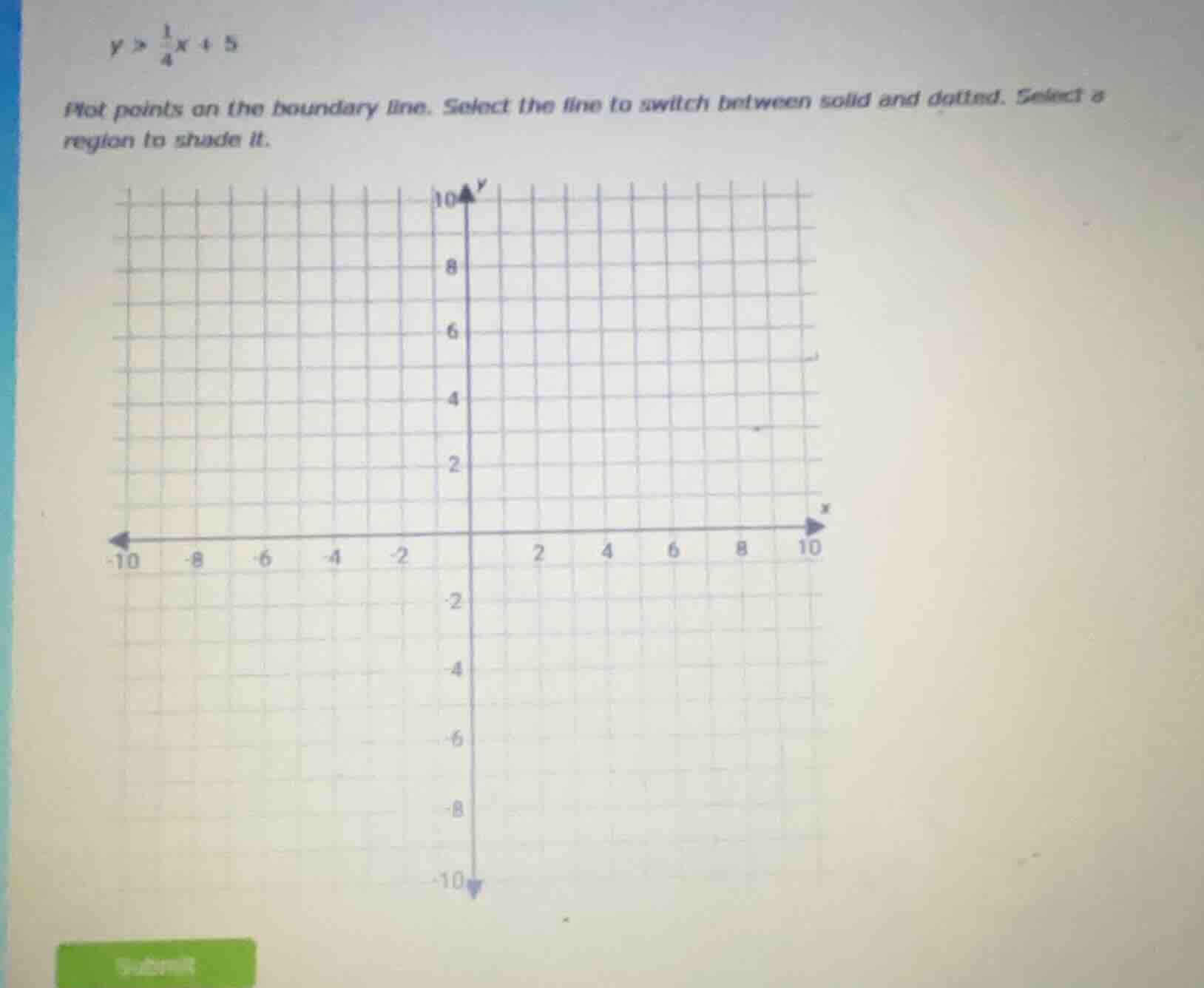
$y > \frac{1}{4}x + 5$
plot points on the boundary line. select the line to switch between solid and dotted. select a region to shade it.
Step1: Identify the boundary line equation
The inequality is \( y > \frac{1}{4}x + 5 \). The boundary line is \( y=\frac{1}{4}x + 5 \), which is a straight line with slope \( \frac{1}{4} \) and y - intercept 5. Since the inequality is "greater than" (not "greater than or equal to"), the boundary line should be dashed.
Step2: Find two points on the boundary line
- When \( x = 0 \), substitute into \( y=\frac{1}{4}x + 5 \), we get \( y=\frac{1}{4}(0)+5 = 5 \). So the point is \( (0,5) \).
- When \( x = 4 \), substitute into \( y=\frac{1}{4}x + 5 \), we get \( y=\frac{1}{4}(4)+5=1 + 5=6 \). So the point is \( (4,6) \).
Step3: Determine the shading region
To determine which side of the line to shade, we can test a point not on the line. Let's use the origin \( (0,0) \). Substitute \( x = 0 \) and \( y = 0 \) into the inequality \( y>\frac{1}{4}x + 5 \):
\( 0>\frac{1}{4}(0)+5\)
\( 0 > 5 \), which is false. So we shade the region that does not include the origin, i.e., the region above the dashed line \( y=\frac{1}{4}x + 5 \).

Snap & solve any problem in the app
Get step-by-step solutions on Sovi AI
Photo-based solutions with guided steps
Explore more problems and detailed explanations
- Plot the boundary line \( y = \frac{1}{4}x+5 \) as a dashed line (using points like \( (0,5) \) and \( (4,6) \)).
- Shade the region above the dashed line (since the test point \( (0,0) \) does not satisfy the inequality, we shade the opposite side of the origin relative to the line).