QUESTION IMAGE
Question
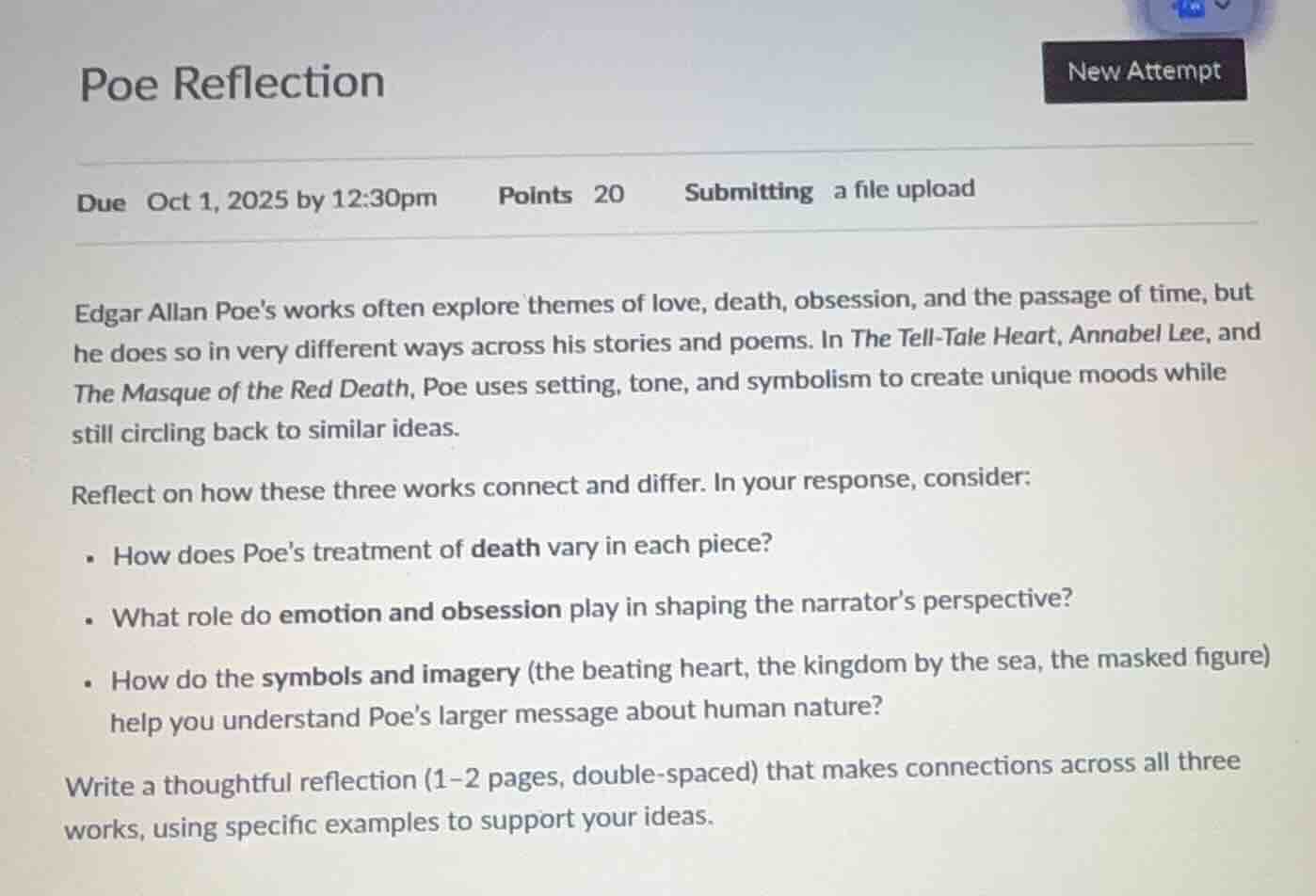
poe reflection
due oct 1, 2025 by 12:30pm points 20 submitting a file upload
edgar allan poe’s works often explore themes of love, death, obsession, and the passage of time, but he does so in very different ways across his stories and poems. in the tell - tale heart, annabel lee, and the masque of the red death, poe uses setting, tone, and symbolism to create unique moods while still circling back to similar ideas.
reflect on how these three works connect and differ. in your response, consider:
- how does poe’s treatment of death vary in each piece?
- what role do emotion and obsession play in shaping the narrator’s perspective?
- how do the symbols and imagery (the beating heart, the kingdom by the sea, the masked figure) help you understand poe’s larger message about human nature?
write a thoughtful reflection (1 - 2 pages, double - spaced) that makes connections across all three works, using specific examples to support your ideas.
- Treatment of Death:
- The Tell-Tale Heart: Death is intimate, violent, and tied to guilt; the narrator murders the old man over his "vulture eye," and death haunts him via the imagined heartbeat, framing death as a weight of moral transgression.
- Annabel Lee: Death is a romantic, cosmic separation; Annabel Lee's death is framed as a theft by jealous angels, and the speaker's love transcends death, casting death as a barrier that cannot break emotional bonds.
- The Masque of the Red Death: Death is an inevitable, equalizing force; the "Red Death" is a plague that invades the prince's sealed fortress, killing all regardless of wealth or status, portraying death as inescapable and democratic.
- Emotion and Obsession:
- The Tell-Tale Heart: Obsession with the old man's eye drives the narrator's violent act; guilt (a twisted emotional aftermath) distorts his perception, making him hallucinate the heartbeat and confess.
- Annabel Lee: Obsessive, eternal love defines the speaker's perspective; he fixates on their childhood bond, refusing to accept her death, and sleeps in her tomb to maintain proximity.
- The Masque of the Red Death: The prince's obsessive denial of death (hiding in his fortress) shapes his arrogant, detached perspective; his obsession with control blinds him to death's inevitability.
- Symbols and Human Nature:
- Beating Heart: Symbolizes the inescapability of guilt and the fragility of human rationality; even the narrator, who tries to frame himself as sane, is undone by his subconscious guilt, revealing that moral transgressions cannot be hidden.
- Kingdom by the Sea: Symbolizes an idealized, innocent space lost to death; it reflects human desire to cling to perfect, unchanging moments, even as mortality disrupts them.
- Masked Figure (Red Death): Symbolizes the universality of death; its invasion of the sealed castle reveals that human attempts to control or avoid death are futile, and that all people are equal in the face of mortality.

Snap & solve any problem in the app
Get step-by-step solutions on Sovi AI
Photo-based solutions with guided steps
Explore more problems and detailed explanations
A reflective analysis connecting and contrasting the three works:
Edgar Allan Poe’s The Tell-Tale Heart, Annabel Lee, and The Masque of the Red Death all grapple with death, emotion, and human vulnerability, but their treatments of these themes reveal distinct facets of human experience.
In The Tell-Tale Heart, death is a personal, guilt-laden act. The narrator’s murder of the old man is driven by an irrational obsession with the man’s "pale blue eye, with a film over it"—a fixation that warps his sense of reason. After the killing, the imagined beating of the old man’s heart haunts him, a physical manifestation of the guilt he cannot suppress. This frames death not as an abstract force, but as a moral weight that exposes the fragility of human sanity; even the narrator’s desperate attempts to prove his unravel as his subconscious guilt breaks through.
In contrast, Annabel Lee casts death as a romantic, cosmic separation. The speaker’s obsession with his childhood love, Annabel Lee, is rooted in a belief that their bond is so pure it incurs the jealousy of "seraphs in heaven," who kill her to end their connection. Unlike the narrator of The Tell-Tale Heart, the speaker’s emotion is not guilt but an unyielding, eternal love. He refuses to accept death as a final end, instead sleeping in Annabel Lee’s tomb to remain close to her. Here, death is a barrier that human love can transcend, reflecting the human desire to cling to intimate connections beyond mortality.
The Masque of the Red Death takes the broadest view of death, framing it as an inevitable, equalizing force. Prince Prospero’s obsession with avoiding the deadly plague leads him to seal himself and his nobles in a lavish fortress, where they indulge in revelry to deny the reality of death outside. The masked figure of the Red Death, however, invades the castle, killing every guest regardless of their wealth or status. This symbolizes that death cannot be outrun or contained by human power, exposing the arrogance of those who believe they can control their fate.
Across all three works, Poe uses symbols to reveal core truths about human nature. The beating heart in The Tell-Tale Heart shows that guilt and moral conscience are inescapable, even for those who claim to be rational. The kingdom by the sea in Annabel Lee represents the human longing for a perfect, unchanging world, a desire that death cruelly disrupts. The masked Red Death figure in The Masque of the Red Death underscores the universal truth that mortality is the great equalizer, and human attempts to avoid it are futile. Together, these works explore the many faces of death—personal, romantic, and universal—and the complex emotions and obsessions that shape how humans confront their own mortality.