QUESTION IMAGE
Question
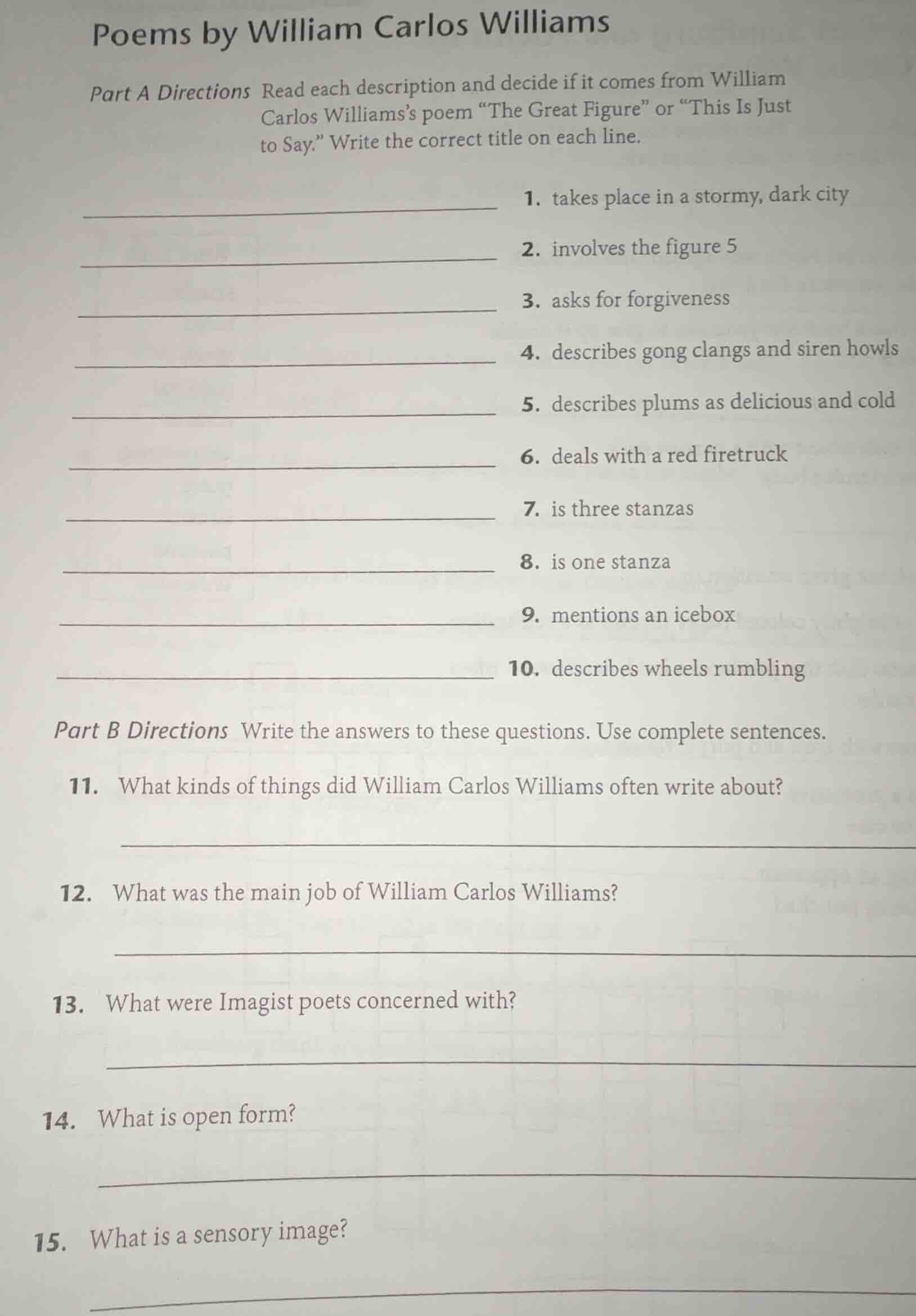
poems by william carlos williams
part a directions read each description and decide if it comes from william
carlos williams’s poem “the great figure” or “this is just
to say.” write the correct title on each line.
______________________________ 1. takes place in a stormy, dark city
______________________________ 2. involves the figure 5
______________________________ 3. asks for forgiveness
______________________________ 4. describes gong clangs and siren howls
______________________________ 5. describes plums as delicious and cold
______________________________ 6. deals with a red firetruck
______________________________ 7. is three stanzas
______________________________ 8. is one stanza
______________________________ 9. mentions an icebox
______________________________ 10. describes wheels rumbling
part b directions write the answers to these questions. use complete sentences.
- what kinds of things did william carlos williams often write about?
_____________________________________________________
- what was the main job of william carlos williams?
_____________________________________________________
- what were imagist poets concerned with?
_____________________________________________________
- what is open form?
_____________________________________________________
- what is a sensory image?
_____________________________________________________
For Part A, descriptions are matched to the two poems based on their core content:
- "The Great Figure" is set in a rainy, dark urban scene.
- The central symbol of "The Great Figure" is the number 5.
- "This Is Just to Say" is an apology poem asking for forgiveness.
- "The Great Figure" includes sounds of emergency vehicles and gongs.
- "This Is Just to Say" focuses on eating cold, delicious plums.
- "The Great Figure" centers on a red firetruck.
- "This Is Just to Say" is structured in three short stanzas.
- "The Great Figure" is a single, continuous stanza.
- "This Is Just to Say" references plums taken from an icebox.
- "The Great Figure" describes the rumble of the firetruck's wheels.
For Part B, answers are based on key facts about William Carlos Williams and poetic terms:
- Williams was known for writing about everyday, mundane, small-scale objects and moments from ordinary life.
- Williams worked primarily as a pediatrician and general physician alongside his writing career.
- Imagist poets focused on clear, precise, concrete sensory details and avoiding overly flowery, abstract language.
- Open form is a poetic style that rejects traditional fixed structures like consistent meter, rhyme schemes, or stanza lengths, instead letting content shape the poem's structure.
- A sensory image is a literary device that uses language to evoke a reader's sense of sight, sound, touch, taste, or smell, creating a vivid, tangible scene or feeling.

Snap & solve any problem in the app
Get step-by-step solutions on Sovi AI
Photo-based solutions with guided steps
Explore more problems and detailed explanations
Part A
- "The Great Figure"
- "The Great Figure"
- "This Is Just to Say"
- "The Great Figure"
- "This Is Just to Say"
- "The Great Figure"
- "This Is Just to Say"
- "The Great Figure"
- "This Is Just to Say"
- "The Great Figure"
Part B
- William Carlos Williams often wrote about ordinary, everyday objects and mundane moments from daily life.
- The main job of William Carlos Williams was a physician (specifically a pediatrician and general practitioner).
- Imagist poets were concerned with creating clear, precise, concrete sensory images and avoiding abstract, overly ornate language.
- Open form is a poetic structure that does not follow traditional fixed rules of meter, rhyme, or stanza length, allowing the poem's content to dictate its shape.
- A sensory image is a literary element that uses descriptive language to appeal to one or more of the reader's five senses (sight, sound, touch, taste, smell) to create a vivid, tangible experience.