QUESTION IMAGE
Question
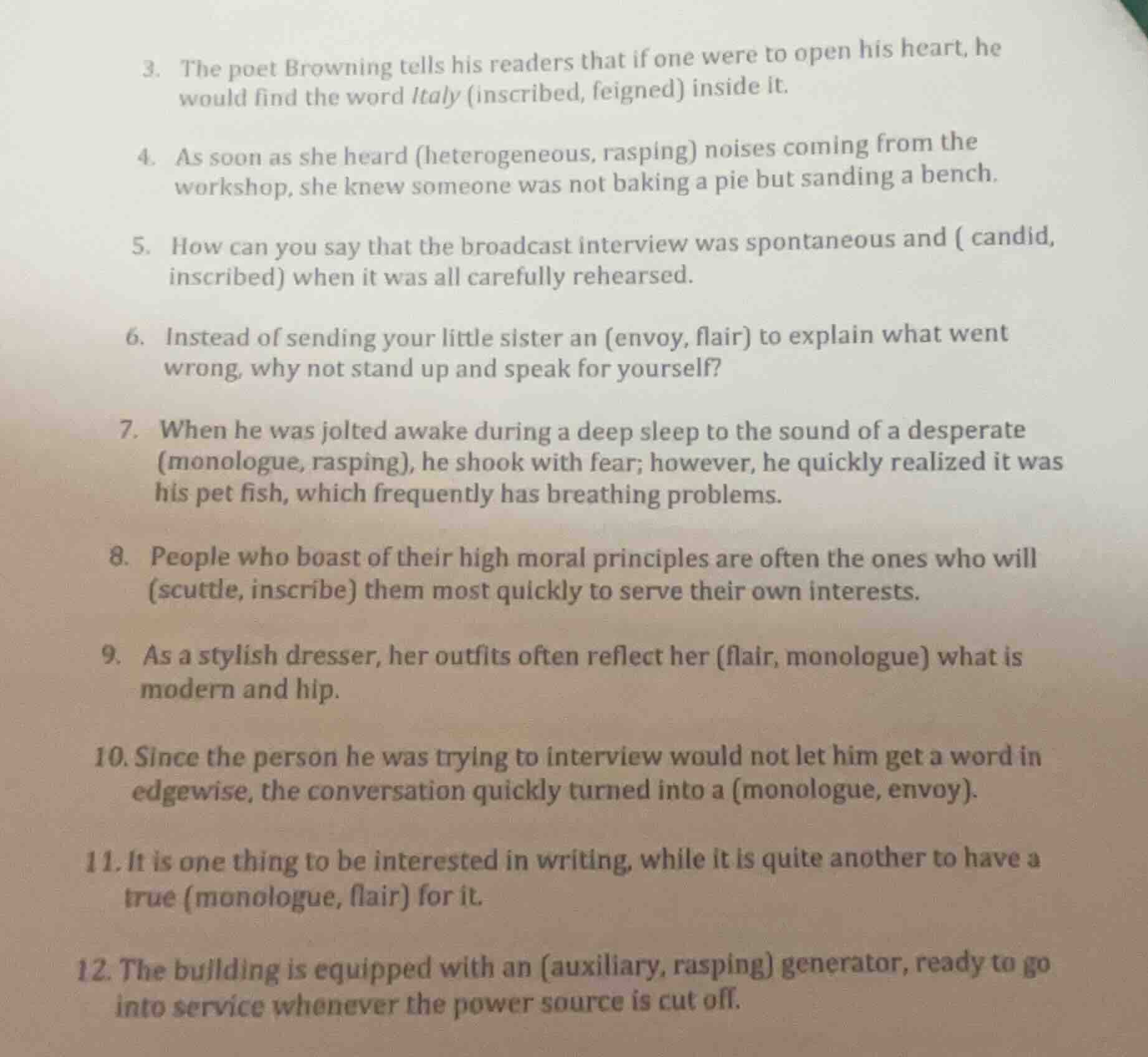
- the poet browning tells his readers that if one were to open his heart, he would find the word italy (inscribed, feigned) inside it.
- as soon as she heard (heterogeneous, rasping) noises coming from the workshop, she knew someone was not baking a pie but sanding a bench.
- how can you say that the broadcast interview was spontaneous and ( candid, inscribed) when it was all carefully rehearsed.
- instead of sending your little sister an (envoy, flair) to explain what went wrong, why not stand up and speak for yourself?
- when he was jolted awake during a deep sleep to the sound of a desperate (monologue, rasping), he shook with fear; however, he quickly realized it was his pet fish, which frequently has breathing problems.
- people who boast of their high moral principles are often the ones who will (scuttle, inscribe) them most quickly to serve their own interests.
- as a stylish dresser, her outfits often reflect her (flair, monologue) what is modern and hip.
- since the person he was trying to interview would not let him get a word in edgewise, the conversation quickly turned into a (monologue, envoy).
- it is one thing to be interested in writing, while it is quite another to have a true (monologue, flair) for it.
- the building is equipped with an (auxiliary, rasping) generator, ready to go into service whenever the power source is cut off.
Question 3
To solve this, we analyze the context. The poet's heart having a word inside implies it's written or engraved. "Inscribed" means written or engraved, while "feigned" means pretended. So "inscribed" fits.
The context is about noises from a workshop with sanding. "Rasping" describes a harsh, scraping sound (like from sanding), while "heterogeneous" means diverse. So "rasping" is correct.
The interview was rehearsed, so it can't be spontaneous and sincere. "Candid" means sincere, "inscribed" is about writing. The contrast shows "candid" is the wrong one, but wait—wait, the question is to choose the right word? Wait, the sentence is "How can you say... spontaneous and (candid, inscribed) when it was rehearsed." So we need the word that's inappropriate. Wait, no—wait, the options are between candid (sincere) and inscribed (written). Since it's rehearsed, it's not candid. Wait, but the question is to pick the right word for the blank? Wait, the sentence structure: "spontaneous and (candid, inscribed)"—so we need a word that goes with spontaneous. But since it's rehearsed, it's not spontaneous or candid. Wait, maybe I misread. Let's re - read: "How can you say that the broadcast interview was spontaneous and (candid, inscribed) when it was all carefully rehearsed." So we need to pick the word that is inappropriate. But the task is to choose the correct word for the blank. Wait, "candid" means sincere, "inscribed" is written. So if it's rehearsed, it's not candid. But the blank is part of "spontaneous and...", so we need to pick the word that is wrong. Wait, no—maybe the question is to choose the word that fits the context (but the context is that it's rehearsed, so the word should be the wrong one). Wait, maybe the question is to choose the word that is incorrect. But the options are candid and inscribed. Since "inscribed" doesn't make sense here (interview can't be inscribed), and "candid" is about sincerity. But since it's rehearsed, it's not candid. So the word that is used incorrectly is "candid", but the blank is to fill with the wrong word? Wait, no—maybe the question is to choose the word that should be there (but it's a trick question). Wait, perhaps I made a mistake. Let's check definitions: "candid" = honest, sincere; "inscribed" = written on. So the interview was rehearsed, so it's not spontaneous or candid. So the word in the blank should be the one that is wrong, so "candid" is the wrong one, but the question is to choose the correct word for the blank. Wait, maybe the question is to choose the word that is appropriate (but in this case, neither is appropriate, but between the two, "candid" is the one that is paired with "spontaneous" (both about sincerity and naturalness), but since it's rehearsed, it's not. But the task is to choose the word for the blank. So the answer is "candid" (but it's the wrong one, but the question is to pick from the two). Wait, maybe the question is to pick the word that is incorrect. But the problem is to choose the right word for the blank. Let's re - express the sentence: "How can you say that the broadcast interview was spontaneous and (candid, inscribed) when it was all carefully rehearsed." So we need to pick the word that is used in the wrong context. So "candid" is the word that is wrongly used here, but the blank is to fill with the word. Wait, maybe the question is to choose the word that is appropriate (but it's not, because it's rehearsed). I think I messed up. Let's start over. The two words: candid (sincere) and inscribed (written). The interview is a verbal thing, so "inscribed" is out of place. So the correct word (the one that is used, but incorrectly) is "candid". So the answer is "candid" (but it's the wrong one, but the question is to choose from the two).

Snap & solve any problem in the app
Get step-by-step solutions on Sovi AI
Photo-based solutions with guided steps
Explore more problems and detailed explanations
inscribed