QUESTION IMAGE
Question
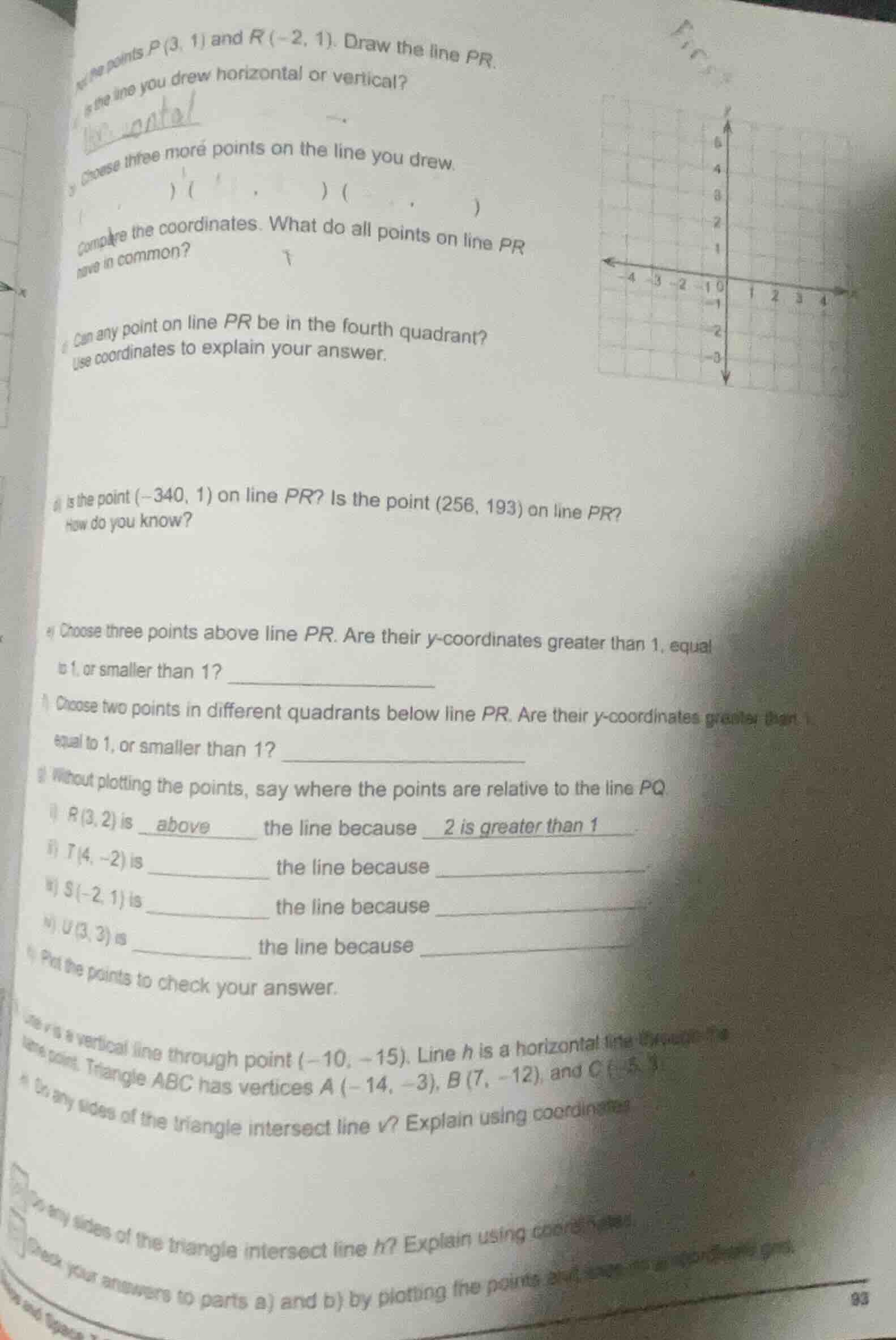
the points p (3, 1) and r (-2, 1). draw the line pr.
is the line you drew horizontal or vertical?
choose three more points on the line you drew.
( , ) ( , ) ( , )
complete the coordinates. what do all points on line pr
have in common?
can any point on line pr be in the fourth quadrant?
use coordinates to explain your answer.
is the point (-340, 1) on line pr? is the point (256, 193) on line pr?
how do you know?
choose three points above line pr. are their y - coordinates greater than 1, equal
to 1, or smaller than 1?
choose two points in different quadrants below line pr. are their y - coordinates greater than 1,
equal to 1, or smaller than 1?
without plotting the points, say where the points are relative to the line pq
r (3, 2) is above the line because 2 is greater than 1.
t (4, -2) is the line because .
s (-2, 1) is the line because .
u (3, 3) is the line because .
plot the points to check your answer.
line v is a vertical line through point (-10, -15). line h is a horizontal line through the
same point. triangle abc has vertices a (-14, -3), b (7, -12), and c (-5, 3).
do any sides of the triangle intersect line v? explain using coordinates.
do any sides of the triangle intersect line h? explain using coordinates.
check your answers to parts a) and b) by plotting the points and the lines on a coordinate grid.
Part 1: Analyzing Line PR (Points \( P(3, 1) \) and \( R(-2, 1) \))
1. Is the line horizontal or vertical?
Step 1: Recall slope formula
The slope \( m \) between two points \( (x_1, y_1) \) and \( (x_2, y_2) \) is \( m = \frac{y_2 - y_1}{x_2 - x_1} \).
Step 2: Calculate slope of PR
For \( P(3, 1) \) and \( R(-2, 1) \), \( y_2 - y_1 = 1 - 1 = 0 \), so \( m = \frac{0}{-2 - 3} = 0 \).
A slope of 0 means the line is horizontal (parallel to the x - axis).
Step 1: Identify the equation of PR
Since it’s a horizontal line with \( y = 1 \) (all points have \( y \) - coordinate 1), any point with \( y = 1 \) lies on PR.
Step 2: Pick x - values and form points
Choose \( x = 0 \), \( x = 1 \), \( x = - 1 \). The points are \( (0, 1) \), \( (1, 1) \), \( (-1, 1) \). (Other valid points: e.g., \( (2, 1) \), \( (-3, 1) \), etc.)
From the line’s equation \( y = 1 \), all points on PR have the same \( y \) - coordinate ( \( y = 1 \) ), while \( x \) - coordinates can be any real number.

Snap & solve any problem in the app
Get step-by-step solutions on Sovi AI
Photo-based solutions with guided steps
Explore more problems and detailed explanations
Horizontal