QUESTION IMAGE
Question
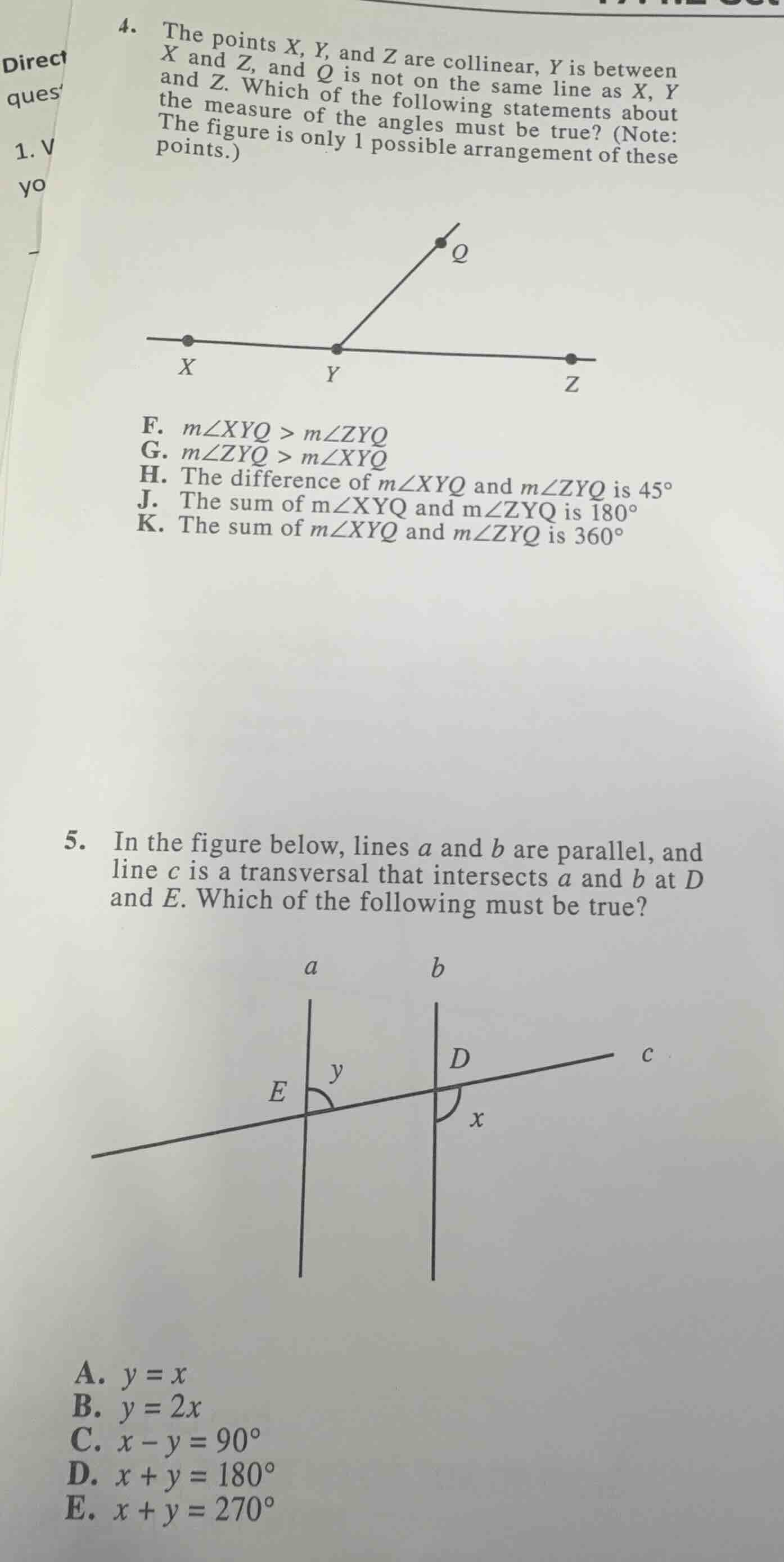
- the points x, y, and z are collinear, y is between x and z, and q is not on the same line as x, y and z. which of the following statements about the measure of the angles must be true? (note: the figure is only 1 possible arrangement of these points.) f. ( mangle xyq > mangle zyq ) g. ( mangle zyq > mangle xyq ) h. the difference of ( mangle xyq ) and ( mangle zyq ) is ( 45^circ ) j. the sum of ( mangle xyq ) and ( mangle zyq ) is ( 180^circ ) k. the sum of ( mangle xyq ) and ( mangle zyq ) is ( 360^circ ) 5. in the figure below, lines ( a ) and ( b ) are parallel, and line ( c ) is a transversal that intersects ( a ) and ( b ) at ( d ) and ( e ). which of the following must be true? a. ( y = x ) b. ( y = 2x ) c. ( x - y = 90^circ ) d. ( x + y = 180^circ ) e. ( x + y = 270^circ )
(Question 4):
Step1: Identify linear pair
Points $X, Y, Z$ are collinear, so $\angle XYZ$ is a straight angle ($180^\circ$). $\angle XYQ$ and $\angle ZYQ$ form a linear pair along this straight line.
Step2: Apply linear pair property
The sum of angles in a linear pair is $180^\circ$. So:
$m\angle XYQ + m\angle ZYQ = 180^\circ$
(Question 5):
Step1: Identify corresponding angles
Lines $a \parallel b$, transversal $c$ creates corresponding angles. The angle supplementary to $x$ corresponds to $y$.
Step2: Apply parallel line angle property
Corresponding angles are equal, so the angle supplementary to $x$ equals $y$. Thus:
$x + y = 180^\circ$

Snap & solve any problem in the app
Get step-by-step solutions on Sovi AI
Photo-based solutions with guided steps
Explore more problems and detailed explanations
Question 4: J. The sum of $m\angle XYQ$ and $m\angle ZYQ$ is $180^\circ$
Question 5: D. $x + y = 180^\circ$