QUESTION IMAGE
Question
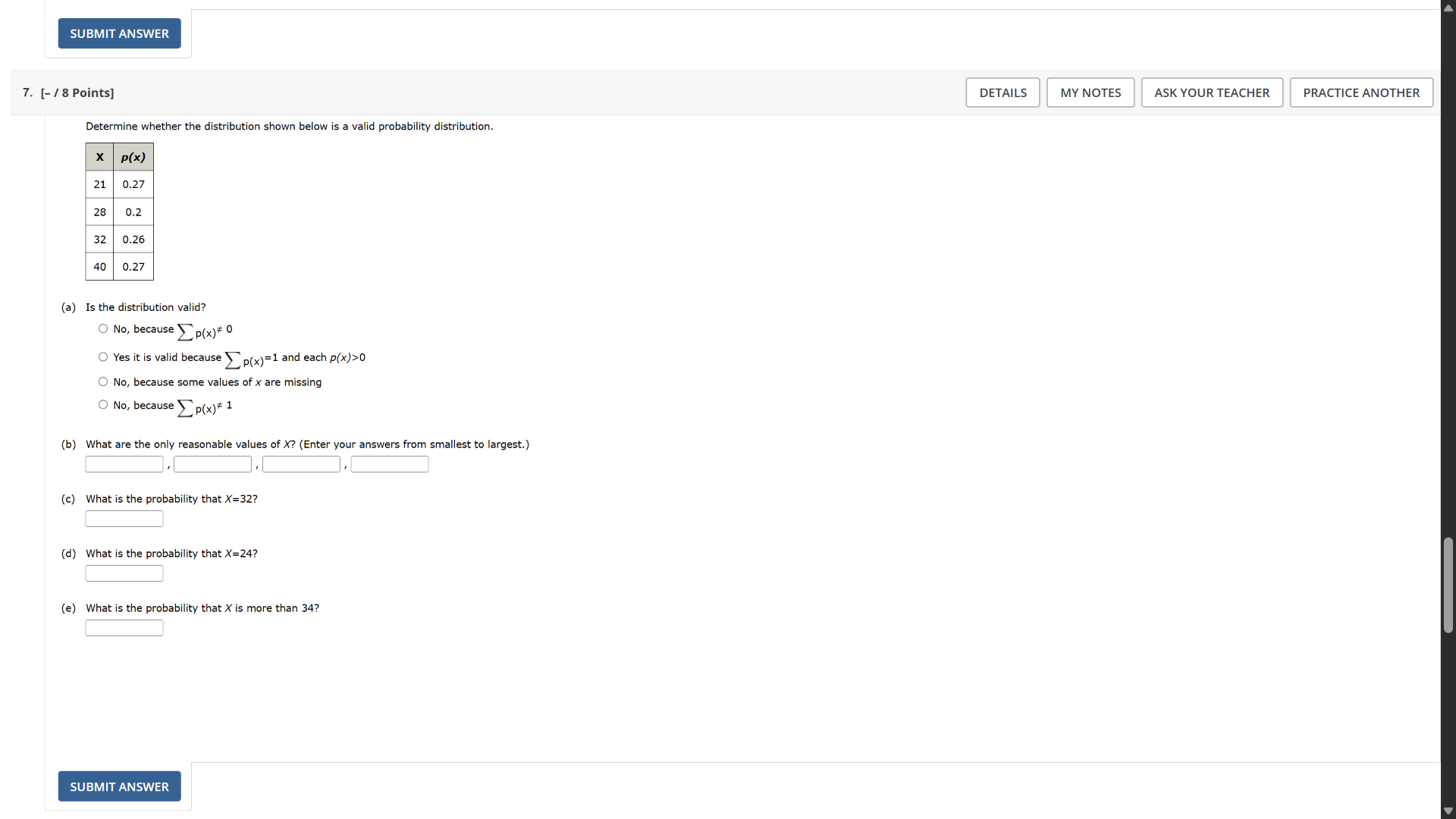
- - / 8 points determine whether the distribution shown below is a valid probability distribution. (a) is the distribution valid? \\(\bigcirc\\) no, because \\(\sum p(x)\
eq 0\\) \\(\bigcirc\\) yes it is valid because \\(\sum p(x)=1\\) and each \\(p(x)>0\\) \\(\bigcirc\\) no, because some values of \\(x\\) are missing \\(\bigcirc\\) no, because \\(\sum p(x)\
eq 1\\) (b) what are the only reasonable values of \\(x\\)? (enter your answers from smallest to largest.) (c) what is the probability that \\(x = 32\\)? (d) what is the probability that \\(x = 24\\)? (e) what is the probability that \\(x\\) is more than 34?
Part (a)
Step1: Recall valid probability distribution conditions
A valid probability distribution requires two conditions: 1) Each \( p(x) > 0 \), and 2) The sum of all \( p(x) \) values is equal to 1.
Step2: Calculate the sum of \( p(x) \)
Sum the given probabilities: \( 0.27 + 0.2 + 0.26 + 0.27 \).
\[
0.27 + 0.2 = 0.47 \\
0.47 + 0.26 = 0.73 \\
0.73 + 0.27 = 1
\]
Also, each \( p(x) \) (0.27, 0.2, 0.26, 0.27) is greater than 0. So the distribution satisfies both conditions.
Step1: Identify reasonable \( x \) values
The reasonable values of \( X \) are the ones listed in the probability distribution table, as these are the values for which we have probabilities defined.
Step2: Order the \( x \) values
The \( x \) values are 21, 28, 32, 40. Ordering them from smallest to largest: 21, 28, 32, 40.
Step1: Find \( p(x) \) for \( x = 32 \)
From the table, when \( x = 32 \), the probability \( p(x) \) is given as 0.26.

Snap & solve any problem in the app
Get step-by-step solutions on Sovi AI
Photo-based solutions with guided steps
Explore more problems and detailed explanations
Yes it is valid because \(\sum p(x)=1\) and each \( p(x)>0\)