QUESTION IMAGE
Question
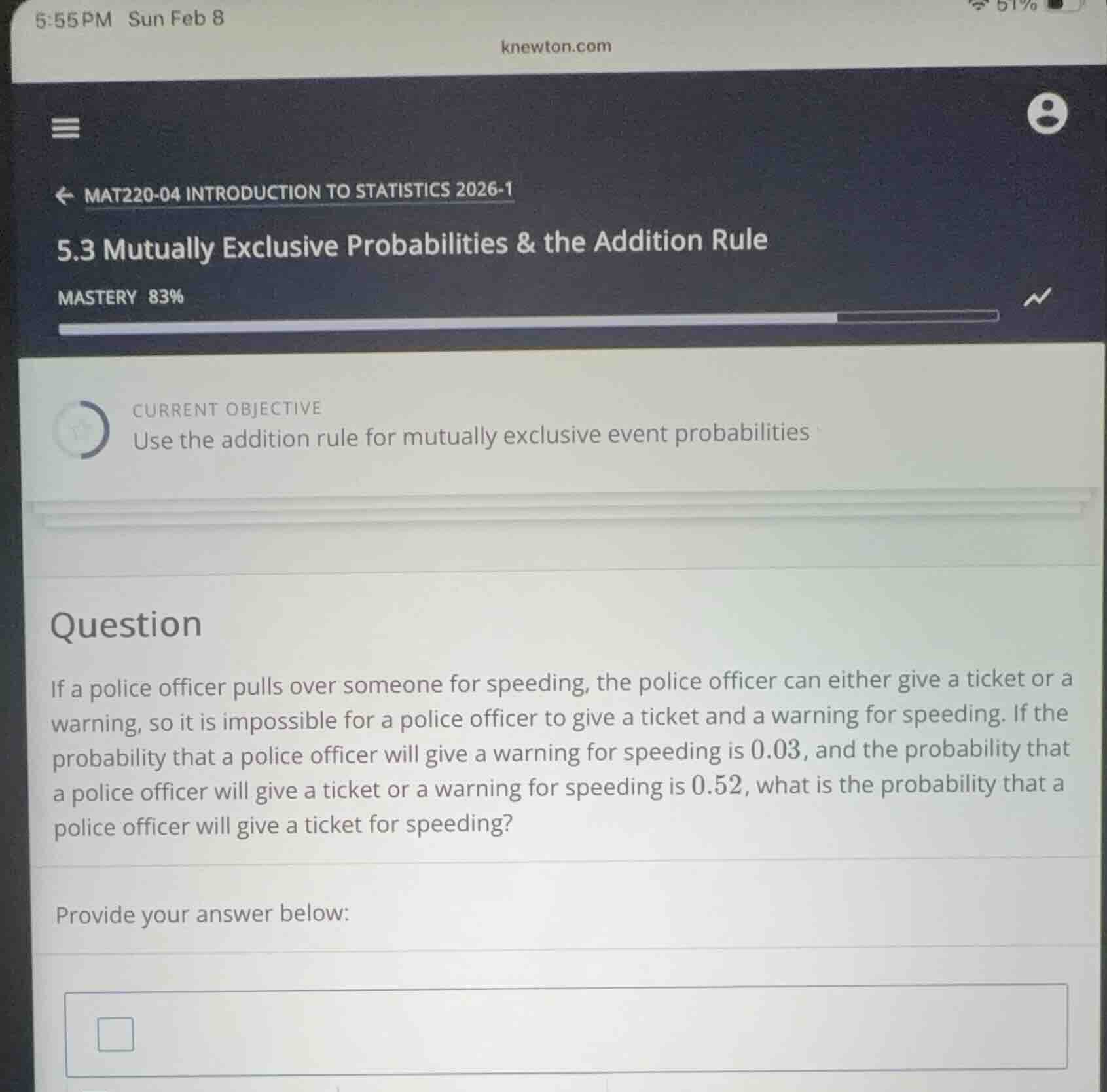
if a police officer pulls over someone for speeding, the police officer can either give a ticket or a warning, so it is impossible for a police officer to give a ticket and a warning for speeding. if the probability that a police officer will give a warning for speeding is 0.03, and the probability that a police officer will give a ticket or a warning for speeding is 0.52, what is the probability that a police officer will give a ticket for speeding? provide your answer below:
Step1: Recall the addition rule for mutually exclusive events
For two mutually exclusive events \( A \) and \( B \), the probability of \( A \) or \( B \) occurring is given by \( P(A \cup B) = P(A) + P(B) \). Let \( A \) be the event of giving a ticket and \( B \) be the event of giving a warning. Since a ticket and a warning cannot happen at the same time, \( A \) and \( B \) are mutually exclusive. We know \( P(B) = 0.03 \) and \( P(A \cup B) = 0.52 \), and we need to find \( P(A) \).
Step2: Rearrange the formula to solve for \( P(A) \)
From \( P(A \cup B) = P(A) + P(B) \), we can rearrange it to \( P(A) = P(A \cup B) - P(B) \).
Step3: Substitute the known values
Substitute \( P(A \cup B) = 0.52 \) and \( P(B) = 0.03 \) into the formula: \( P(A) = 0.52 - 0.03 \).
Step4: Calculate the result
\( 0.52 - 0.03 = 0.49 \).

Snap & solve any problem in the app
Get step-by-step solutions on Sovi AI
Photo-based solutions with guided steps
Explore more problems and detailed explanations
\( 0.49 \)