QUESTION IMAGE
Question
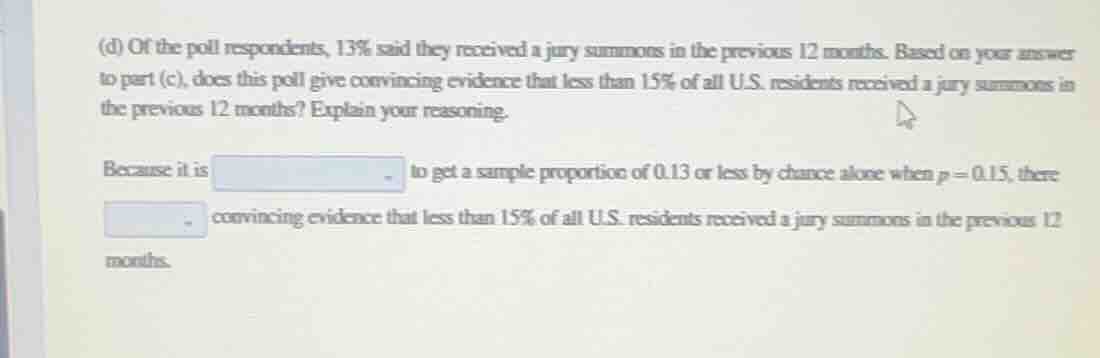
(d) of the poll respondents, 13% said they received a jury summons in the previous 12 months. based on your answer to part (c), does this poll give convincing evidence that less than 15% of all u.s. residents received a jury summons in the previous 12 months? explain your reasoning. because it is to get a sample proportion of 0.13 or less by chance alone when p = 0.15, there convincing evidence that less than 15% of all u.s. residents received a jury summons in the previous 12 months.
To solve this, we need to recall the concept of statistical significance (from Statistics, a subfield of Mathematics). When we test a hypothesis (here, whether the proportion \( p < 0.15 \)), we check how likely the sample result (13% or 0.13) is if the null hypothesis (\( p = 0.15 \)) is true. If this likelihood (the probability of getting the sample proportion or more extreme when \( p = 0.15 \)) is low (usually below a threshold like 0.05), we say it's unlikely to happen by chance, so there is convincing evidence.
Step 1: Interpret the "by chance" probability
In part (c) (not shown, but typically in such problems), we'd calculate the probability of getting a sample proportion of 0.13 or less when \( p = 0.15 \). If this probability is unlikely (e.g., small, like less than 5%), then:
- First blank: "unlikely" (because getting 0.13 or less by chance when \( p = 0.15 \) is not probable).
- Second blank: "is" (because the low probability means the result is not due to chance, so there is convincing evidence).
To determine the blanks, we use statistical hypothesis testing logic. If the sample proportion (0.13) is unlikely to occur by chance when the true proportion \( p = 0.15 \), we conclude there is convincing evidence that \( p < 0.15 \). The first blank describes the chance (unlikely), and the second confirms the evidence exists.

Snap & solve any problem in the app
Get step-by-step solutions on Sovi AI
Photo-based solutions with guided steps
Explore more problems and detailed explanations
Because it is \(\boldsymbol{\text{unlikely}}\) to get a sample proportion of 0.13 or less by chance alone when \( p = 0.15 \), there \(\boldsymbol{\text{is}}\) convincing evidence that less than 15% of all U.S. residents received a jury summons in the previous 12 months.