QUESTION IMAGE
Question
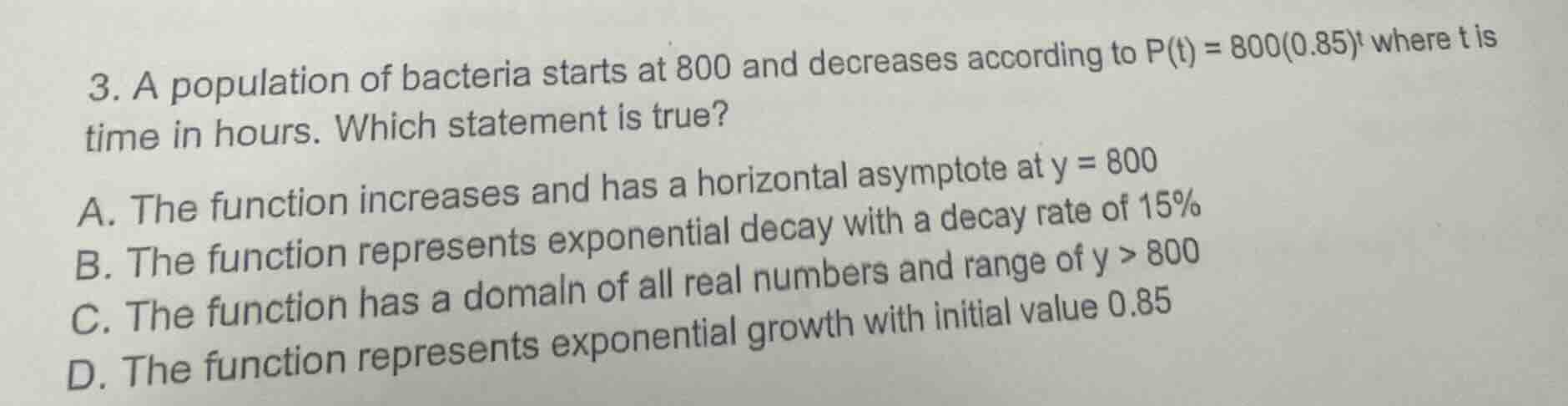
- a population of bacteria starts at 800 and decreases according to $p(t) = 800(0.85)^t$ where t is time in hours. which statement is true?
a. the function increases and has a horizontal asymptote at $y = 800$
b. the function represents exponential decay with a decay rate of 15%
c. the function has a domain of all real numbers and range of $y > 800$
d. the function represents exponential growth with initial value 0.85
Brief Explanations
- Analyze Option A: The function is \( P(t) = 800(0.85)^t \). Since the base \( 0.85<1 \), the function is decreasing, not increasing. Also, the horizontal asymptote for an exponential function \( a(b)^t \) ( \( b<1 \)) is \( y = 0 \), not \( y = 800 \). So A is false.
- Analyze Option B: The general form of exponential decay is \( P(t)=a(1 - r)^t \), where \( a \) is the initial amount and \( r \) is the decay rate. Here, \( a = 800 \) and \( 1 - r=0.85 \), so \( r = 1 - 0.85=0.15 = 15\% \). Since the base \( 0.85<1 \), it is exponential decay with a decay rate of \( 15\% \). This statement is true.
- Analyze Option C: The domain of an exponential function \( P(t)=800(0.85)^t \) is all real numbers (as \( t \) can be any real number). But the range: when \( t
ightarrow+\infty \), \( P(t)
ightarrow0 \), and when \( t = 0 \), \( P(0)=800 \). So the range is \( 0
- Analyze Option D: Since the base \( 0.85<1 \), the function represents exponential decay, not growth. The initial value is \( 800 \) (when \( t = 0 \), \( P(0)=800(0.85)^0 = 800 \)), not \( 0.85 \). So D is false.

Snap & solve any problem in the app
Get step-by-step solutions on Sovi AI
Photo-based solutions with guided steps
Explore more problems and detailed explanations
B. The function represents exponential decay with a decay rate of 15%